


“Guarujá’s Time Has Come”: APS President Highlights Benefits of Fixed Link Project at Public Hearing
May, 21, 2025 Posted by Denise VileraWeek 202521
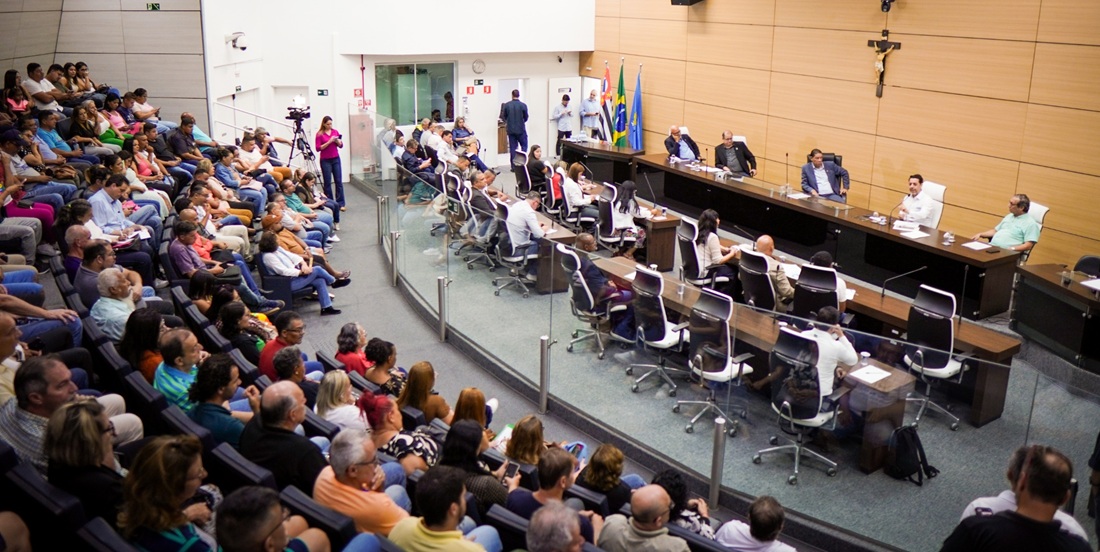
Anderson Pomini, president of the Santos Port Authority (APS), delivered a presentation on the Santos-Guarujá Tunnel during a public hearing organized by the Guarujá City Council in a packed auditorium. The discussion focused on the project’s impact on neighborhoods, local businesses, mobility, and the municipality’s economy.
Pomini answered questions from city councilors, municipal secretaries, and residents, outlining the key points of the largest infrastructure project under Brazil’s new Growth Acceleration Program (PAC). The tunnel will also be Latin America’s first immersed fixed-link crossing.
“During the current administration, APS has held 60 meetings with all public agencies and representatives involved to reach a consensus. Now that the bidding notice has been published, it is essential to maintain dialogue,” said Pomini.
Convened by the Council’s Committee on Relevant Affairs, the hearing brought together shop owners, residents from affected areas, and the general community. “There is still significant concern regarding the proposed route and the potential impacts on traffic, local commerce, and housing,” explained Councilman Edilson Dias, who chairs the committee.
Tunnel Route
“The tunnel route has undergone years of studies and discussions and is now well-defined. While the winning bidder may adjust the tunnel’s entrance and exit points (access ramps), any changes will require approval from the public authorities,” Pomini noted.
Expropriations
“If expropriations are necessary, residents will be compensated at market value per square meter, not the lower tax-assessed value,” he emphasized.
Traffic Impacts
“In addition to easing the ferry traffic, we plan to build a complete logistics hub in Guarujá to organize and manage heavy vehicle movement. This space will house customs services, freight brokers, and provide full support for truck drivers. It will be a kind of ‘one-stop shop’ that improves logistics at the Port and mobility in Guarujá.”
Stilt Houses (Palafitas)
“It’s unacceptable that a port like Santos, which connects Brazil’s wealth to the world, still has families living in stilt houses along its margins. These residents will be relocated to dignified housing. Of course, providing homes is just one part of the solution—it will require coordinated efforts across government,” Pomini said.
Benefits for the City
“Guarujá’s time has come. The high-quality infrastructure that brings wealth to Santos will now reach Guarujá. It’s time for the city to benefit from the Port’s operations in the same proportion. Each new port operation will trigger compensation projects that directly benefit the municipality. The tunnel will boost local commerce, attract investments, and generate opportunities for economic and social development,” he stated.
At the end of the hearing, Pomini praised the City Council’s initiative. “I’m an enthusiast of this project. I’m truly happy to help solve something that’s been discussed for 97 years. We all want the tunnel. But infrastructure development inevitably comes with challenges. That’s why we’re here—to work together on adjustments that minimize disruptions to people’s lives.”
About the Tunnel
With a total length of 1.5 km (870 meters of which will be underwater), the tunnel will be Brazil’s first immersed tunnel and the largest in Latin America. It will feature three lanes in each direction, one of which will be dedicated to a light rail transit (LRT) system, along with separate access for pedestrians and cyclists. The structure will use prefabricated module technology, similar to that used in Europe’s Fehmarnbelt tunnel.
With an estimated investment of BRL 6 billion (approximately USD 1.2 billion), funded equally by the federal government and the state of São Paulo, the auction to select a concessionaire is scheduled for August 1st. According to the Ministry of Ports and Airports, the project is expected to create around 9,000 direct and indirect jobs.
The fixed link will reduce maritime traffic interference in port operations and cut cargo transport time by about 45 minutes, boosting the logistics hub’s competitiveness. It is also expected to reduce emissions by shortening travel distances and decreasing reliance on ferries, which currently transport 21,000 vehicles and 15,000 pedestrians and cyclists daily.
-
Ores
Nov, 01, 2019
0
Vale receives authorization to resume operations at mine in Mariana
-
Shipping
Aug, 01, 2025
0
‘Unexciting’ container market sees liner CFOs adjusting full-year forecasts
-
Ports and Terminals
Apr, 22, 2021
0
Outeiro authorized to operate cargo via transshipment
-
Ports and Terminals
Oct, 13, 2025
0
Suape’s SUA 01 terminal moves toward private sector lease approval