


Immersed Tunnel Auction Between Santos and Guarujá Postponed to September 5
May, 22, 2025 Posted by Denise VileraWeek 202521
The auction for the immersed tunnel between Santos and Guarujá has been postponed to September 5, moving from the original date of August 1. The Ministry of Ports and Airports and the State Government of São Paulo, which jointly launched the project’s concession notice, stated that the decision was made due to “contributions” from companies interested in the project.
According to official statements released last night, these contributions resulted from a recent mission to Europe, during which Brazilian port and waterway projects were presented to investors and major infrastructure firms.
“During the mission, valuable opportunities for improving the concession model, financial structure, and technical assumptions of the bidding notice were identified. These suggestions are now being incorporated to enhance the quality of the bidding process, increase the asset’s attractiveness, and ensure greater legal and operational security for the project,” said the State Government.
The federal note added that the feedback will help “improve the bidding process and increase competition in the auction of Latin America’s first immersed tunnel.” It also recalled that the concessionaire will be responsible for the tunnel’s construction, operation, and maintenance and that the project is expected to generate 9,000 direct and indirect jobs.
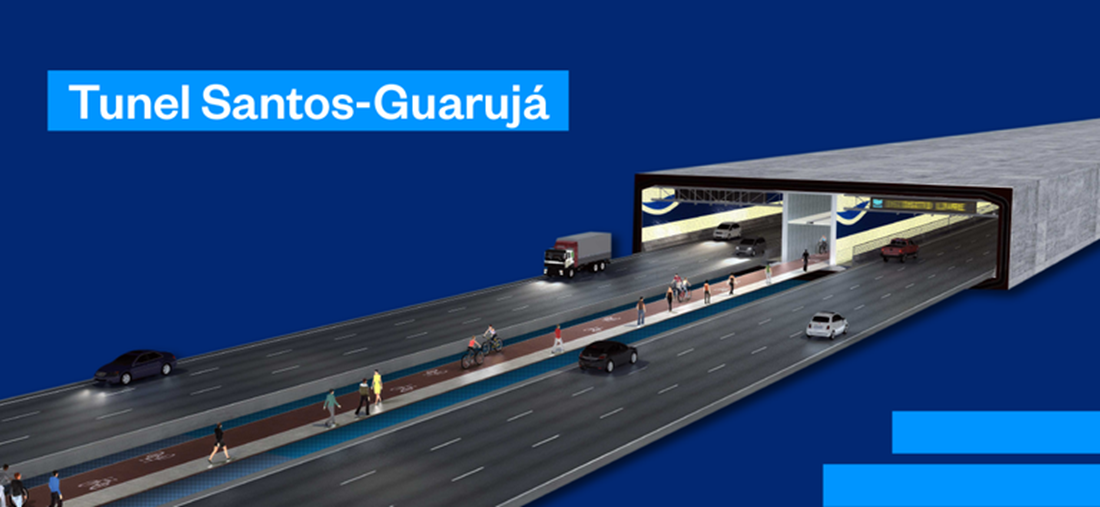
The immersed tunnel is part of Brazil’s new Growth Acceleration Program (PAC) and is considered the largest infrastructure project currently planned by the Federal Government. “With a total length of 1.5 kilometers—870 meters of which will be submerged—the tunnel will include three lanes in each direction, one of them dedicated to a light rail transit (LRT) system, as well as separate access for pedestrians and cyclists,” the ministry noted.
The State Government also emphasized that the project represents a technological leap for Brazilian engineering. It adopts the internationally proven immersed tunnel technique, already successfully used in countries like the Netherlands, Japan, China, and South Korea. The construction model ensures lower urban impact, faster execution, easier maintenance, and better operational efficiency throughout the concession period.
Cost and Funding
The total investment is estimated at R$5.96 billion, of which R$5.13 billion will be jointly funded by the federal and state governments. The winning concessionaire will provide the remainder, which will sign a 30-year contract covering construction, operation, and maintenance. The auction is being led by the São Paulo State Secretariat for Partnerships and Investments, and construction is scheduled to start in early 2026, with completion expected by 2031.
European Mission
From April 21 to 24, Minister Silvio Costa Filho and Governor Tarcísio de Freitas (Republicanos) led a delegation through Portugal, the Netherlands, and Denmark, presenting the project to companies with global expertise in immersed tunnel construction.
The project was showcased in Portugal to Mota-Engil, which partners with Chinese infrastructure giant CCCC (China Communications Construction Company). In the Netherlands, meetings were held with executives from Ballast Nedam and TEC Tunnel, renowned in the immersed tunnel sector. In Denmark, the delegation visited the construction site of the Fehmarnbelt Tunnel, which will connect Denmark’s Lolland Island to Germany’s Fehmarn Island. At 18.1 kilometers, it will be the longest immersed tunnel in the world and serve as a reference for the Brazilian project.
Launch Ceremony Unites Lula and Tarcísio
The public notice for the Santos–Guarujá tunnel auction, known as International Tender 01/2025, was officially launched on February 27 this year. The event brought together President Luiz Inácio Lula da Silva (PT) and Governor Tarcísio de Freitas in Santos, marking a rare moment of political unity to advance major infrastructure projects in Brazil.
The government presented the tender as the culmination of 98 years of plans and proposals for a dry connection between the two cities. The first such proposal dates back to January 1927, when architect Enéas Marini suggested building a tunnel. Various other proposals over the decades, including for bridges and other tunnels, were ultimately shelved.
During the event, both leaders emphasized the importance of collaborative governance. “I want to have a civil relationship with all governors. We weren’t elected to fight but to work together,” said Lula.
Tarcísio echoed the sentiment: “Mr. President, you said, ‘We shouldn’t be politically divided—we should serve the people.’ And that’s what we are doing.”
Broader Impact
Today, over 21,000 vehicles, 7,700 cyclists, and 7,600 pedestrians cross the channel daily using ferries and small boats. With the dry connection, the crossing will take only a few minutes, significantly reducing congestion and improving logistics for the Port of Santos, Latin America’s largest port.
Source: A Tribuna
-
Grains
May, 15, 2025
0
Drop in Iron Ore Exports to China Raises Red Flags for Brazilian Mining Companies
-
Other Cargo
Nov, 08, 2021
0
Brazil’s IRS seizes 800 kg of cocaine at the Port of Paranaguá
-
Shipping
Jun, 07, 2024
0
Russia and China to form Arctic liner
-
Sugar and Ethanol
Feb, 10, 2025
0
Sugar Exports Drop 35% in January, Pressuring International Prices