


Indonesia and EU seal trade pact after nine years, aim to offset Trump tariffs
Sep, 23, 2025 Posted by Lucas LorimerWeek 202540
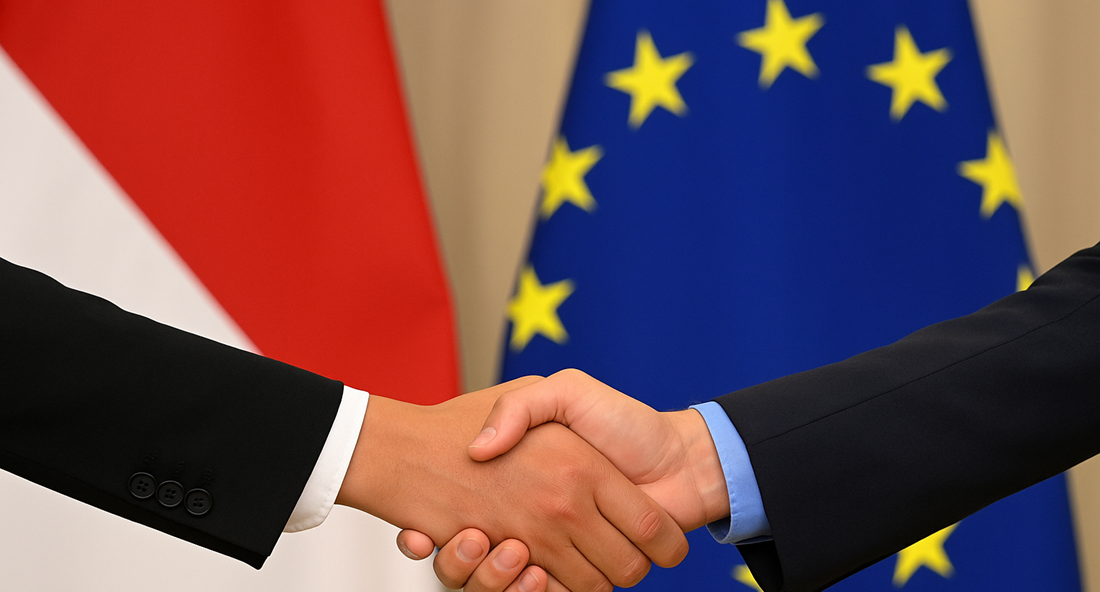
Indonesia and the European Union concluded a free trade agreement on Tuesday, marking the end of nine years of negotiations. The goal of this agreement is to boost exports and investments while mitigating the impact of U.S. President Donald Trump’s tariffs.
Both sides will remove import duties on more than 90% of products, with most of these changes taking effect as soon as the agreement comes into force. The remainder — including Indonesia’s 50% tariff on EU cars — will be phased out over a five-year period.
Indonesia says it expects bilateral trade, valued at US$30.1 billion in goods in 2024, to double within the first five years.
Stimulus for the agreement
Since Trump’s re-election last November, the EU has been pushing to forge new trade alliances, including with the South American Mercosur bloc and Mexico, as well as accelerating negotiations with India.
The EU, comprising 27 countries, hopes these alliances will mitigate the impact of Trump’s tariffs and reduce its dependence on China, particularly for minerals crucial to its green transition.
Indonesia’s exports are also subject to a broad U.S. tariff of 19%.
The EU states that its exporters will be exempt from €600 million (US$707.4 million) in Indonesian taxes and anticipates increased sales of chemicals, machinery, cars, and food products, primarily milk powder and cheese.
Indonesia expects an increase in exports of palm oil, coffee, textiles, and apparel, among other products, and aims for the pact to enter into force on January 1, 2027.
At present, Indonesia — a vast archipelago with more than 284 million people—is on the verge of becoming an upper-middle-income country, and will therefore lose access to preferential rights granted by the EU to developing nations.
In the coming months, the deal will require legal review and be translated into the EU’s official languages. EU governments and the European Parliament will then need to formally consent to the agreement.
Indonesia’s Coordinating Minister for Economic Affairs, Airlangga Hartarto, said he expected closer supply chains.
Indonesia is in talks with EU automakers about partnerships to produce batteries and electric vehicles in the Southeast Asian country, he told reporters.
Access to critical minerals
EU Trade Commissioner Maroš Šefčovič, speaking in Bali, stated that the agreement would enhance European companies’ investment in Indonesia and improve the bloc’s access to critical minerals for its clean-tech and steel industries. Among them are nickel, copper, bauxite, and tin.
Eddy Martono, president of the Indonesian Palm Oil Association, stated that the agreement would eliminate tariffs on the sector’s exports to the EU, a major buyer of the product.
However, non-tariff barriers, including the EU Deforestation Regulation (EUDR), remain an obstacle for the industry, he said in a text message to Reuters.
Indonesia is the world’s largest producer of palm oil, and the EUDR — which the EU is expected to delay by another year — requires producers to prove that shipments did not come from areas deforested after 2020.
“There is still homework to be done, namely the EUDR, which must also be resolved immediately because it will still be implemented this year,” he said, adding that this risks undermining the effectiveness of the trade deal.
-
Economy
Jul, 29, 2024
0
President Milei renews his vow to scrap export taxes as Argentina’s powerful farmers get impatient
-
Economy
Aug, 04, 2022
0
New tax cut on glyphosate and other industrial inputs
-
Economy
Oct, 20, 2021
0
Brazil-US trade reaches record level
-
Shipping
Apr, 18, 2024
0
Hapag-Lloyd announces its Strategy 2030