


KBT intermodal terminal posts record container volumes since launch
Sep, 18, 2025 Posted by Lucas LorimerWeek 202539
On Monday, September 15, the KBT intermodal logistics terminal — a strategic collaboration between Klabin, Brado Logística, and TCP — celebrated its fourth anniversary, marking the occasion with the best productivity figures since its inauguration. In the first half of 2025, 49,646 TEUs were handled, 12% higher than the 44,450 TEUs in the same period of 2024. Exports of paper and pulp also posted strong results, rising from 21,216 TEUs in the first half of last year to 23,978 TEUs this year, an increase of 13%.
“The progressive increases in container handling year after year reinforce not only TCP’s commitment to excellence and continuous improvement at the Ortigueira terminal, but also highlight the strength of the strategic collaboration between Klabin, Brado, and TCP. This operational synergy has been essential to ensuring smooth logistics, modal integration, and consistent gains in productivity and predictability,” said Fabio Henrique Mattos, TCP’s logistics operations manager.
“Klabin’s business model is integrated, flexible, and diversified, which allows the company to continuously expand its activities both internally and externally. The KBT has been essential in this regard, as it has provided fundamental growth in strategic markets over the past four years. Since 2021, the synergy among the three companies has ensured an operation that combines efficiency, sustainability, and record-breaking results year after year. All of this is the result of the hard work of everyone involved in the KBT,” said Roberto Bisogni, Klabin’s Director of Operational Planning and Logistics.
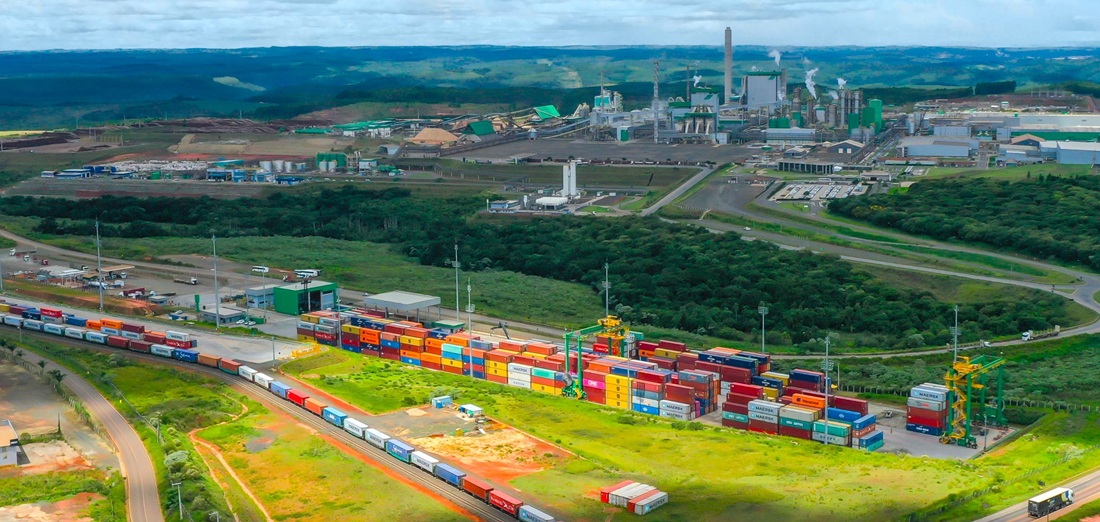
These results reflect the KBT’s innovative logistics model, which connects the TCP-operated container terminal adjacent to Klabin’s Ortigueira Unit — with annual production capacity of 2.5 million tonnes of paper and pulp — to the Paranaguá Container Terminal via the railway operated by Brado Logística. The major differentiator was creating an intermodal corridor that reduced reliance on highways, putting the railway at the center of the operation. In May of this year, a record of 31 train runs was set in a single month (one per day) — each train run represents a composition with a locomotive and loaded wagons leaving Ortigueira bound for the Port of Paranaguá. Currently, Paranaguá Container Terminal is the only port terminal in southern Brazil with a direct connection between the primary zone and a rail line.
Progress can also be measured by the number of train arrivals. According to Brado Logística, 140 trains from the KBT arrived at TCP in the first half of 2024; in 2025, that number rose to 152 in the same period. This growth directly reduced highway traffic: Brado estimates that approximately 12,232 trucks were taken off the road between Ortigueira and Paranaguá in the first half of this year, easing logistics costs and reducing pressure on the state’s road network.
For Giovanni Guidolim, TCP’s commercial, logistics, and customer service manager, the results confirm the initiative’s strategic importance: “As a tailor-made solution for a single client, the KBT has been consolidating year after year as a national benchmark, proving its value with real gains in efficiency and quality. The alignment among Klabin, Brado, and TCP ensures not only sustainable growth but also safer, more reliable, and more predictable operations.”
Sustainability in practice
Prioritizing rail in the intermodal model also delivers significant environmental benefits. From January to July 2025, it is estimated that transporting paper and pulp by rail avoided around 16,000 tonnes of carbon dioxide emissions — equivalent to the annual emissions of 3,400 vehicles. According to Brado Logística’s calculations, it would take 113,800 trees to offset this amount of CO2.
Graciele Santos, Brado Logística’s commercial executive, emphasized that the KBT is an example of how technology and sustainability can go hand in hand. “The concentrated load capacity of a single train minimizes CO2 emissions while also helping to ease road traffic. It’s a clear example of how well-structured initiatives can contribute to tackling climate change,” she said.
Environmental gains also extend to port infrastructure. Cargo arriving in Paranaguá is handled by three electrified rubber-tired gantry cranes (RTGs), which TCP converted two years ago, reducing carbon dioxide emissions by 97% in each unit’s operation.
Managed by TCP, the Ortigueira container terminal currently employs a team of 98 people and reflects both the consolidation and growing complexity of operations. The expectation is that the model will continue boosting KBT’s productivity and the competitiveness of Klabin’s paper and pulp exports in domestic and international markets, through both long-haul and cabotage shipments.
Unprecedented achievement
In August 2025, the Ortigueira container terminal received ISO 9001 certification for the first time, attesting to its adoption of high-quality standards and its commitment to operational efficiency, customer satisfaction, and continuous improvement.
The audit process took place in the first half of August and also evaluated all 33 processes at the Paranaguá Container Terminal, which make up the Integrated Management System (SGI). With this, TCP achieved recertification of ISO 9001 (Quality Management), ISO 14001 (Environmental Management), and ISO 45001 (Occupational Health and Safety Management).
Source: TCP
-
Shipping
Apr, 14, 2026
0
Svitzer appoints new Managing Director for operations in Brazil
-
Ports and Terminals
Jan, 26, 2021
0
Port of Rio de Janeiro activates Cotunduba Canal signaling-buoy transceivers
-
Trade Regulations
Feb, 25, 2026
0
Mercosur–Egypt scraps final trade tariffs
-
Grains
Jul, 26, 2021
0
China’s soybean imports expected to decelerate sharply at the end of 2021