

Maritime sector looks to Brazilian ethanol as an alternative beyond IMO negotiations
Oct, 21, 2025 Posted by Lucas LorimerWeek 202544
A.P. Moller – Maersk and Everllance, global shipping giants, following the recent round of discussions at the International Maritime Organization (IMO) on the future regulatory framework for emissions, have presented a joint statement supporting the global decarbonization plan for the maritime sector. Their joint position underscores the importance of scalable, immediately available low-carbon solutions. Despite the outcome of the Net-Zero Framework (NZF) discussions, Maersk, Everllance, and Brazilian ethanol producers remain focused on tangible solutions for a cleaner future. Present at the event were major ethanol producers and traders in Brazil, including Atvos, Copersucar, FS, Inpasa, and Raízen.
Ethanol: proven, accessible, and ready-to-use solution
The joint position strengthens Brazil’s technical and regulatory standing in the international debate, demonstrating that the energy transition does not depend on a single regulatory framework. In several countries, ethanol is already widely used as an additive or direct fuel in road transport.
In the maritime sector, Brazil’s established and sustainable ethanol production scale is an undeniable competitive advantage. Successful tests using ethanol and an E10 blend in dual-fuel (bunker and methanol) ships have paved the way for new sustainable propulsion alternatives, demonstrating the solution’s readiness.
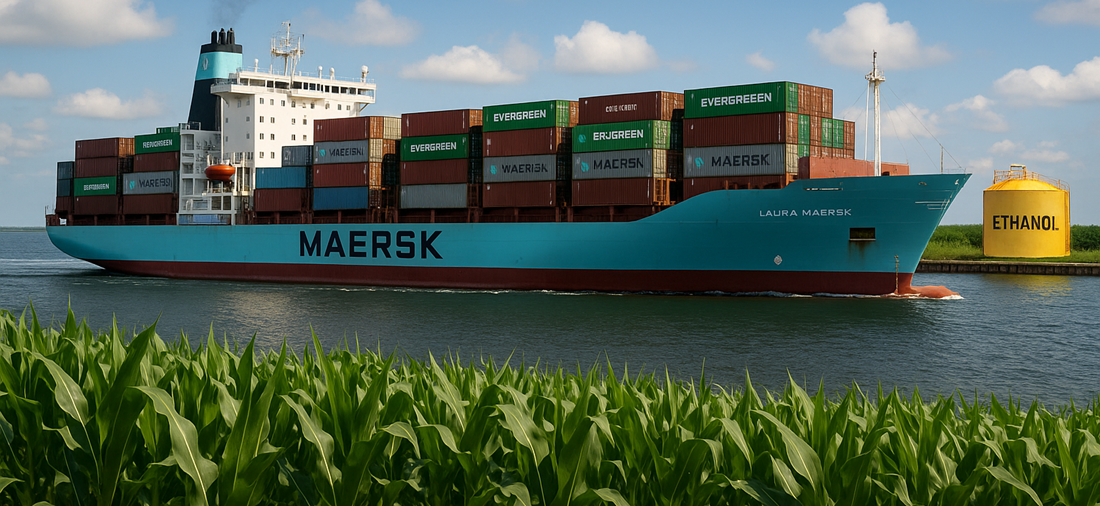
Maersk will continue its pilot test on the vessel Laura Maersk until the end of November. The company is assessing whether there are any differences between standard methanol and E10 in terms of ignition quality—that is, how the fuels burn—along with potential variations in corrosion, lubrication, and, importantly, emissions. The purpose of the blend is to increase supply availability and the fuel pool for dual-fuel vessels.
The Laura Maersk, with a capacity of 2,100 TEUs, serves clients in the Baltic Sea and is the world’s first methanol-powered container ship.
Brazil as a leader in the energy transition
By supporting Maersk’s initiative, ethanol producers and traders reinforce Brazil’s commitment to a cleaner, more competitive energy future based on renewable sources, aligned with environmental goals and global efforts toward carbon neutrality—regardless of the pace of international regulatory developments.
“This is a memorable moment made possible by the sum of many efforts. For maritime transport, the existing ethanol production scale is an advantage and could provide a third fuel option for dual-fuel methanol engines. Collaboration among ethanol producers, users, and regulators will be essential to better understand its role in the future energy landscape of the sector,” said Morten Bo Christiansen, Senior Vice President and Head of Energy Transition at A.P. Moller – Maersk.
“Ethanol, already used on a large scale in other transport sectors, is one of several alternative fuels that deserve deeper technical and regulatory evaluation. Brazil has demonstrated the capacity to produce ethanol sustainably, with growth potential and compliance with the strictest certification standards, which is key to the global decarbonization of the sector,” said Danilo Veras, Vice President of Public and Regulatory Affairs for Latin America at A.P. Moller – Maersk.
Economic and industrial opportunity
Validating ethanol as a maritime fuel represents a major opportunity for Brazil, the world’s largest producer of renewable fuels. In a conservative projection, if just 10% of projected bunker fuel demand in 2030 were replaced by ethanol, the resulting demand would be equivalent to the country’s entire current production — providing a significant boost to the national economy, job creation, and new investments in infrastructure, innovation, and certification. The record 2024/25 harvest reached 34.96 billion liters.
The support of producers highlights the maturity and readiness of Brazil’s domestic supply chain to integrate renewable energy solutions into the international market.
Toward a robust, data-driven global standard
Producers advocate for an urgent need for a solid global fuel standard, based on life-cycle emissions and transparency, to ensure that the energy transition adopts the most efficient and available solutions.
“We fully support the IMO’s future work to analyze ethanol’s compatibility with maritime technologies, competition for feedstocks, life-cycle assessment, and certification processes. Continued collaboration among producers, users, and regulators will be essential to consolidate ethanol’s role in the sector’s energy mix, and we will keep investing and demonstrating its viability, regardless of the regulatory challenges ahead,” concluded the Brazilian ethanol producers.
Image generated by Artificial Intelligence
Source: Maersk
-
Ports and Terminals
Apr, 03, 2025
1
Paulo Nery, Appointed as President of Porto do Recife, Pledges Growth and Innovation
-
Fruits
May, 15, 2026
0
Cepea sees modest grape shipments in Brazil’s first export window
-
Ports and Terminals
Jun, 22, 2021
0
With bidding approved, Porto do Recife to publish notice to begin dredging work
-
Ports and Terminals
May, 19, 2026
0
Port of Rio de Janeiro receives first 366-meter vessel after access channel expansion