


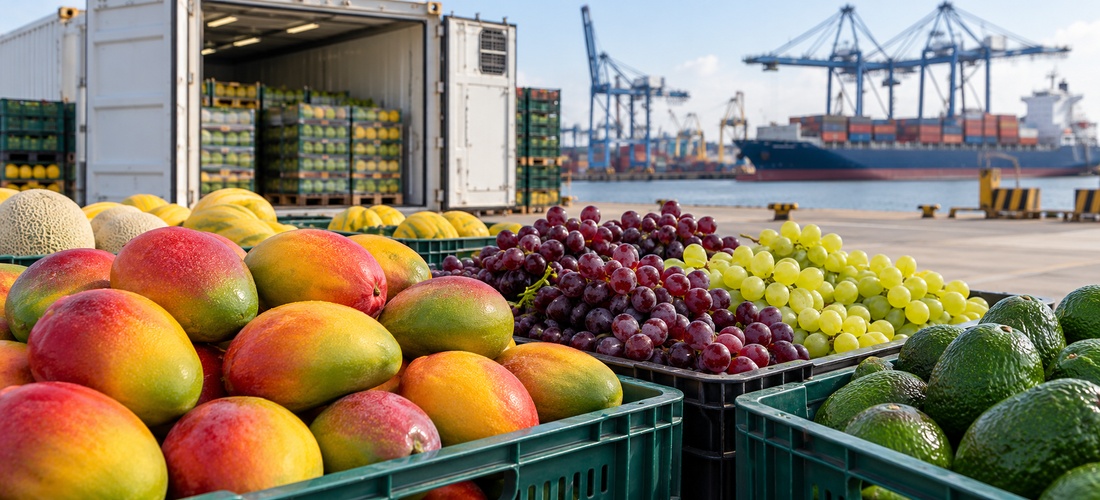
Papayas, Melons and Mangoes Lead Brazil’s Fruit Export Specialization Ranking
Oct, 28, 2026 Posted by Gabriel MalheirosWeek 202644
Papayas, melons and mangoes are Brazil’s most export-specialized fruits among nine products analyzed by the Center for Advanced Studies on Applied Economics (Cepea). The study also shows that Brazilian fruit exports have become more diversified, with seven of the nine fruits gaining ground in international markets between 2016 and 2024.
The ranking, featured in the October edition of Hortifruti Brasil magazine, uses the Revealed Comparative Advantage (RCA) index to measure the relative importance of each Brazilian fruit in global trade. Papayas rank first, followed by melons and mangoes.
In addition to the three leading fruits, lemons and limes, watermelons, grapes and avocados also recorded gains in the index during the period analyzed. Bananas and apples complete the group of nine products, although their production remains more heavily oriented toward the domestic market.
The results indicate that Brazil’s fruit industry is establishing a stronger presence in specific international markets, even though individual fruit categories differ considerably in production volumes, export revenue and shares of global trade.
Ranking Measures Export Specialization, Not Just Shipment Volumes
The RCA index helps explain why the results should not be confused with a conventional export ranking.
Calculated using data from FAOSTAT and Brazil’s Comex Stat database, the index compares the share of a particular fruit in Brazil’s total fruit exports with that product’s share of global fruit trade. The higher the ratio, the greater Brazil’s relative export specialization in that product.
This means that papayas topping the ranking does not necessarily indicate that they generate the most export revenue or account for the largest shipment volumes.
Mangoes illustrate this distinction. Although they rank third in export specialization, they were Brazil’s leading fresh fruit export by revenue in 2024, generating approximately $350 million, according to the analysis published by Hortifruti Brasil.
Cepea itself emphasizes that the RCA index does not directly measure competitiveness or profitability. Understanding a fruit’s position in international markets also requires examining export destinations, competitors, market access, technology, production schedules and logistics.
Avocados Gain Ground in International Markets
Among the fruits that improved their position, avocados stand out as one of the clearest examples of changing export patterns.
Brazilian avocado export revenue rose from $6.8 million in 2016 to $36.2 million in 2024, measured in current dollars. Growth was driven primarily by the Hass variety.
Despite this expansion, Brazil still accounts for a relatively small share of the international avocado market. According to the study, increasing that share will require greater production scale and productivity, as well as the ability to maintain consistent quality and reliable supplies.
Preserving fruit quality during transportation and distribution is also critical. For perishable products, increasing exportable production is not enough if quality and shelf life cannot be maintained until the fruit reaches the buyer.
Logistics Determine the Ability to Capture Market Opportunities
International production schedules are among the central factors highlighted in the analysis.
Periods when major competitors reduce their supplies can create important market opportunities for Brazilian fruit. Taking advantage of these windows, however, requires coordination between production, harvesting, packaging, transportation and delivery to destination markets.
For fresh fruit, this coordination makes logistics an integral part of commercial strategy. Transit times, shipping service availability, post-harvest preservation and transportation costs can determine whether an international sales opportunity results in an actual export shipment.
The study also highlights the need to reduce losses, control costs and diversify export destinations to turn temporary market gains into a more stable international presence.
This helps explain why the size of Brazil’s domestic production alone does not determine the international performance of individual fruit industries. Some products show strong export specialization despite relatively modest production volumes, while other fruits produced on a large scale remain primarily destined for domestic consumption.
Bananas and Apples Remain More Dependent on Brazil’s Domestic Market
Bananas and apples represent the other end of the ranking.
Both fruits are widely produced in Brazil, but their supply chains remain largely focused on domestic consumption. Their lower export specialization reflects this market orientation as well as the difficulties of competing in international markets already served by major established suppliers.
According to Cepea, marketing costs and logistics constraints also weigh on the expansion of exports in these categories.
The contrast reinforces one of the study’s main conclusions: high production volumes do not necessarily translate into a prominent position in international trade.
Seven of Nine Fruits Expand Their International Presence
The improvement in the RCA index for seven of the nine fruits between 2016 and 2024 shows that Brazil’s fruit industry has broadened its presence in international markets.
Papayas, melons and mangoes remain at the top of the ranking, but gains for lemons and limes, watermelons, grapes and particularly avocados point to additional opportunities for export growth.
Maintaining this trajectory will depend less on a single increase in production and more on the industry’s ability to combine consistent supplies, product quality, market access and efficient logistics.
In addition, tools such as Datamar’s DataLiner make it possible to analyze the volumes actually shipped overseas by sea. The table below shows the performance of Brazil’s main fruit exports between January and August 2026:
Top Fruit Exports | Jan-Aug 2026 | TEUs
| wdt_ID | wdt_created_by | wdt_created_at | wdt_last_edited_by | wdt_last_edited_at | DTM HS4 DESCRIPTION | YTD Value | Last Year | %Growth | %MShare |
|---|---|---|---|---|---|---|---|---|---|
| 1 | I_write_a_lot | 28/10/2026 05:04 PM | I_write_a_lot | 28/10/2026 05:04 PM | PINEAPPLES MANGOS AVOCADOS OTHERS | 16.684 | 11.751 | 42.0% | 36.04% |
| 2 | I_write_a_lot | 28/10/2026 05:04 PM | I_write_a_lot | 28/10/2026 05:04 PM | CITRUS FRUIT | 11.632 | 11.600 | 0.3% | 25.13% |
| 3 | I_write_a_lot | 28/10/2026 05:04 PM | I_write_a_lot | 28/10/2026 05:04 PM | MELONS WATERMELONS & PAPAWS | 11.315 | 12.835 | -11.8% | 24.44% |
| 4 | I_write_a_lot | 28/10/2026 05:04 PM | I_write_a_lot | 28/10/2026 05:04 PM | APPLES PEARS & QUINCES | 4.462 | 1.184 | 276.9% | 9.64% |
| 5 | I_write_a_lot | 28/10/2026 05:04 PM | I_write_a_lot | 28/10/2026 05:04 PM | BANANAS | 775 | 1.032 | -25.0% | 1.67% |
| 6 | I_write_a_lot | 28/10/2026 05:04 PM | I_write_a_lot | 28/10/2026 05:04 PM | GRAPES | 718 | 1.152 | -37.7% | 1.55% |
| 7 | I_write_a_lot | 28/10/2026 05:04 PM | I_write_a_lot | 28/10/2026 05:04 PM | FROZEN FRUIT OR NUTS | 634 | 586 | 8.2% | 1.37% |
| 8 | I_write_a_lot | 28/10/2026 05:04 PM | I_write_a_lot | 28/10/2026 05:04 PM | OTHER FRESH FRUIT | 36 | 18 | 100.0% | 0.08% |
| 9 | I_write_a_lot | 28/10/2026 05:04 PM | I_write_a_lot | 28/10/2026 05:04 PM | FRUIT PEEL | 28 | 68 | -58.8% | 0.06% |
| 10 | I_write_a_lot | 28/10/2026 05:04 PM | I_write_a_lot | 28/10/2026 05:04 PM | PRESERVED FRUIT | 13 | 10 | 30.0% | 0.03% |
Source: DataLiner – explore our trade data
In the fresh fruit market, competition does not end at the farm. It continues throughout transportation and is only completed when the product reaches its destination at the right time and in the condition required by the buyer.
Source: HF Brasil
-
Other Cargo
Nov, 26, 2019
0
Machine and equipment sales maintain stability in October
-
Ports and Terminals
Nov, 11, 2021
0
30-ton granite block falls from a container at Porto do Mucuripe, in Fortaleza
-
Grains
Dec, 01, 2022
0
Uncertainties over grain corridor affect Ukraine’s exports in October
-
Oil and Gas
Nov, 22, 2022
0
Brazil-Qatar trade peaks; animal protein stands out