


Poor port access and tight capacity push up Brazil logistics costs
Aug, 12, 2026 Posted by Gabriel MalheirosWeek 202633
Efficient terminals are not enough when roads, railways and waterways fail to expand at the same pace as production.
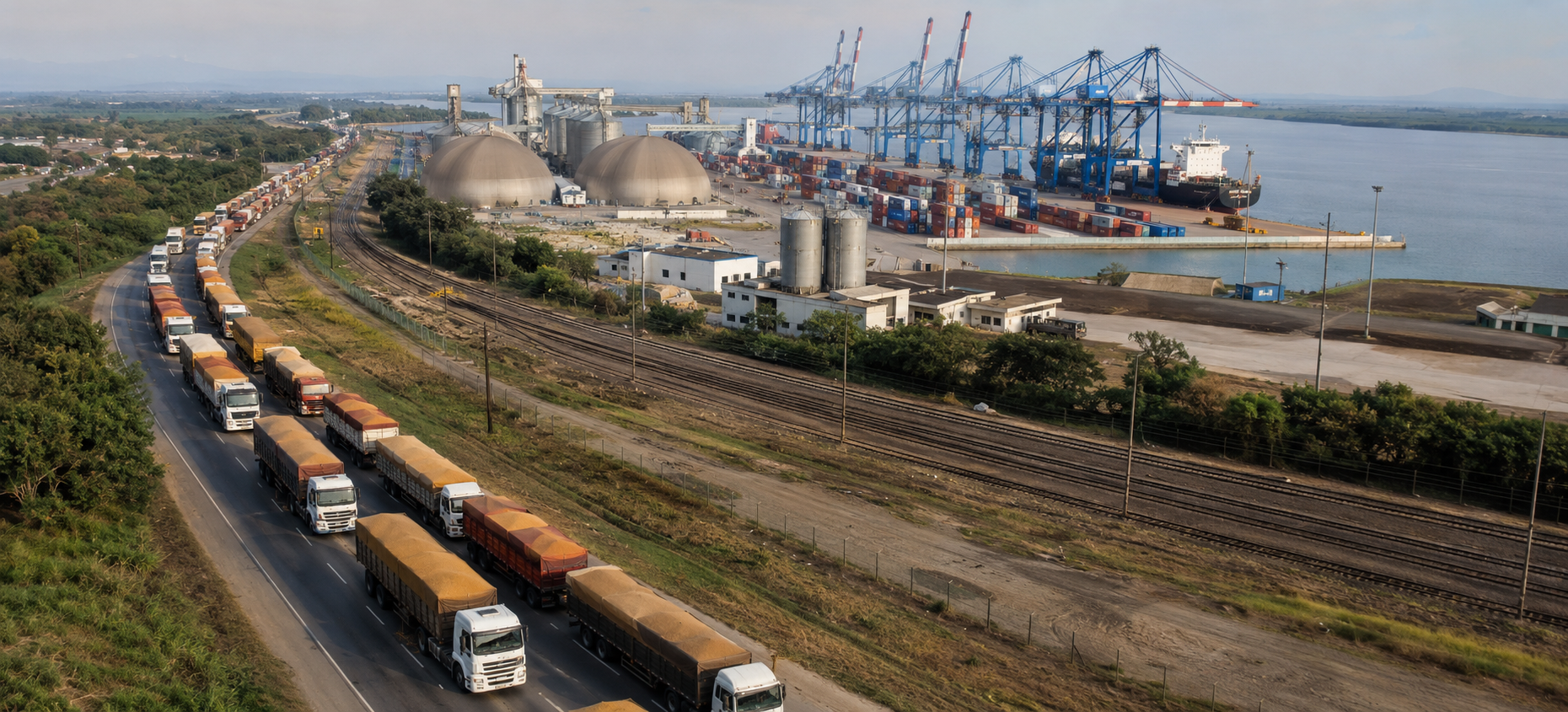
During harvest periods, delays ripple through the supply chain: trucks sit idle, freight costs rise, cargo quality can be put at risk and pressure builds on final prices.
In February, at the peak of Brazil’s soybean harvest, the line of trucks waiting to access the Port of Miritituba, in Pará state, reached 40 kilometers along BR-163, the main route used to move grain from the Center-West to Brazil’s Northern Arc export corridor. Trucking companies and producers reported higher costs and greater uncertainty in meeting port delivery windows.
Queues form when the number of trucks arriving within a short period exceeds the receiving capacity of terminals and control points along the corridor. At harvest peak, cargo flows are concentrated in narrow time windows, and any restriction can trigger a domino effect. Rain and poor road conditions slow traffic, while accidents and inspections further reduce fluidity. At the same time, final access to terminal yards is already operating close to its limit.
Trucks end up parked on shoulders and local roads, creating lines that feed on themselves: the longer unloading takes, the more vehicles build up at the entrance and the heavier congestion becomes around the port area.
The problem can generate costs that go beyond road freight and reach maritime transport, according to Jesualdo Silva, CEO of Brazil’s port terminals association ABTP. The association says demurrage — the fee charged when a vessel or container is held beyond the agreed period — can cost about $40,000 per day, a cost that is ultimately passed on to the cargo.
“Cargo is the one that suffers most. Cargo pays for the trucks, the freight, port operations, dredging — everything. All those costs squeeze margins,” Silva said.
Investment remains too low
For Brazil’s transport confederation CNT, truck queues are not an isolated event but a recurring challenge that requires long-term planning and investment in infrastructure and management.
The group says federal investment has increased over the past two years but remains below the level needed to reverse the deterioration of critical stretches.
CNT president Vander Costa said Brazil has still not managed to effectively integrate its different transport modes. He said sorting yards, cargo scheduling systems and logistics hubs near terminals could help reduce lines and congestion during peak periods.
“The solution depends on effective integration between transport modes. Roads, railways and waterways must work in a complementary way, expanding the country’s ability to move production,” Costa said.
“It is urgent to prepare a plan for waterways, focused on dredging programs and maintenance of navigable routes, as well as new financing and concession mechanisms involving strategic waterways,” he added.
For Ronei Glanzmann, CEO of MoveInfra, Brazil is already paying a high price for its logistics bottlenecks, but delaying strategic projects will cost even more.
“Brazil is a very road-dependent country, but it cannot forget railway works and waterway projects. These are expensive works, especially railways, but they are necessary and, sooner or later, they will have to be done. If it takes 10 years to finish, then it needs to start now,” he said.
Glanzmann said access to the Miritituba terminals illustrates the mismatch between production growth and transport infrastructure.
“Our major wealth is in Brazil’s interior. There is no point thinking only about the port, at the end of the chain, if we do not have the route to get there.”
CNT’s 2025 Road Survey reinforces that diagnosis. Of the 13,900 kilometers assessed in Brazil’s North region, 81.3% were classified as fair, poor or very poor.
According to the confederation, pavement, signage and road geometry conditions directly affect the performance of corridors that connect production areas to Northern Arc ports, pushing up costs and increasing accident risks.
Capacity constraints
Growth in operations, combined with inefficient planning and delays in releasing new areas, could exhaust container storage and handling capacity at the Port of Santos.
Business leaders say the Santos quay is nearing its limit, with terminals struggling for space.
The Organization for Economic Cooperation and Development (OECD) estimates that terminals should ideally operate at no more than 65% of capacity to avoid vessel and truck queues. At the Port of Santos, however, that rate already exceeds 70%.
Source: A Tribuna
-
Grains
Jul, 28, 2020
0
Brazil´s agribusiness projected to grow 27% over next decade
-
Ports and Terminals
Sep, 10, 2019
0
ANTAQ concludes public auction hearings of four areas in Itaqui port
-
Ores
Oct, 24, 2019
0
Vale will begin testing autonomous operation on off-highway trucks in Carajás
-
Ores
May, 07, 2024
0
Brazil Ore Sales Increase by 25% in the First Quarter