


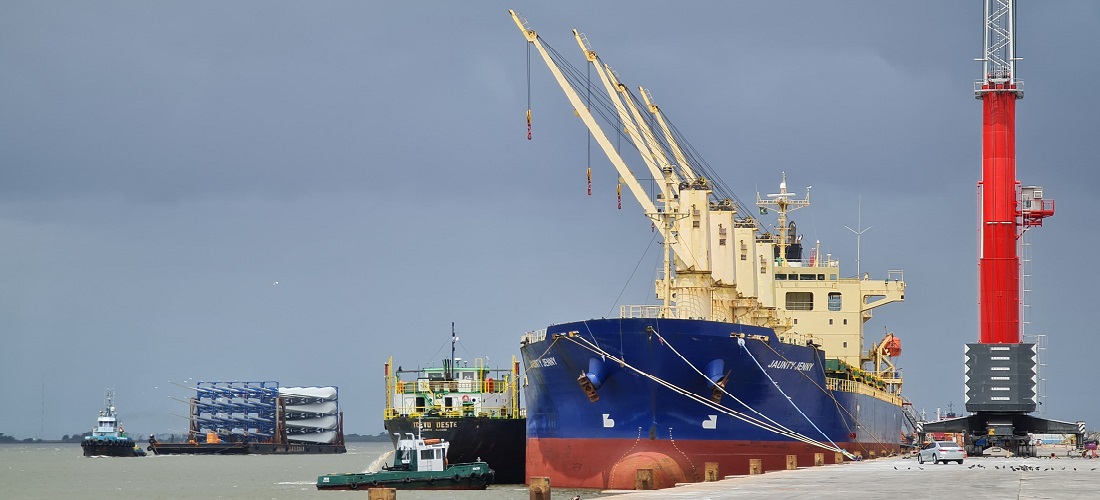
Port of Rio Grande advances new pulp terminal project
Sep, 14, 2026 Posted by Gabriel MalheirosWeek 202637
Plans for a new private-use terminal at the Port of Rio Grande moved forward on Friday, September 11, with the signing of the land-use contract for the project area.
The agreement was signed between Brazil’s Ministry of Management and Innovation in Public Services, known as MGI, and Terminal Rio Grande do Sul S.A.
The signing marks another step in the development of the Port of Rio Grande pulp terminal. In January, the project had already secured an authorization contract for the operation of the port facility, signed by Brazil’s ports and airports ministry MPor and the waterway regulator Antaq.
Ports and Airports Minister Tomé Franca said the integration of industrial production with port infrastructure is essential to keep pace with economic growth and improve conditions for cargo outflows.
“A project of this scale requires planning and legal certainty so that each stage can move forward in a coordinated way. It is the role of the public sector to create the conditions for infrastructure to meet the needs of the productive sector, with operational safety and environmental responsibility,” Franca said.
The project includes the construction of two ship berths, two barge berths and a warehouse with static storage capacity of 194,000 metric tons of pulp. The terminal is expected to have capacity to handle about 5 million metric tons of pulp per year.
According to seaborne shipment data obtained by Datamar, the Port of Rio Grande recorded 726,342 metric tons of pulp exports in the first seven months of the year. See the breakdown below:
Pulp Exports | Port of Rio Grande | Jan 2023 – Jul 2026 | WTMT
Source: DataLiner (click here to request a demo)
Connecting port logistics and waterways
The terminal is also expected to strengthen the integration of inland waterway transport with cargo handling at the Port of Rio Grande.
The facility is part of CMPC’s Natureza Project, which includes plans for a new pulp production unit in Barra do Ribeiro and infrastructure to move that output to market. The system was designed to receive cargo by waterway, store the product and load ocean-going vessels, connecting industrial production with waterborne transport infrastructure.
The initiative is aligned with federal government efforts to restore and upgrade waterway infrastructure in Rio Grande do Sul. MPor is working to recover navigability and improve safety and reliability conditions for cargo transport on the state’s waterways.
“Brazil needs to make better use of its waterways, and the South of the country has a concrete opportunity to move in that direction. With planning, social participation, environmental responsibility and cooperation between the public and private sectors, we will create the conditions for inland navigation to play an increasingly relevant role in regional and national development,” Franca said.
Also under development is the proposed concession of the Integrated Southern Waterway System and Mirim Lagoon, which includes waterway access to the ports of Rio Grande, Pelotas and Porto Alegre, as well as stretches of rivers and lagoons in Rio Grande do Sul.
The initiative calls for integrated management of the system, with the goal of giving navigation greater predictability and making cargo transport more regular.
For Franca, expanding and integrating port and waterway infrastructure is important to support the development of productive activities and improve cargo outflow conditions.
“The role of the Ministry of Ports and Airports is to help ensure that infrastructure investments keep pace with economic growth, reduce bottlenecks, increase logistics efficiency and give Brazilian exports greater competitiveness,” he said.
Source: MPOR
-
Ports and Terminals
Apr, 26, 2019
0
Santos records a 1.5% drop in cargo handling in Q1, 2019
-
Shipping
Jan, 17, 2024
0
Maersk and Hapag-Lloyd enter into operational cooperation agreement
-
Trade Regulations
Jan, 14, 2020
0
Brazil and South Korea sign MoU on port sector investments
-
Ports and Terminals
Sep, 12, 2023
0
Brazil’s gov’t decides to extend ‘Reporto’ tax benefit through bill