


Port of Santos Extends Fee Discounts for “Green Ships”
Dec, 09, 2025 Posted by Lucas LorimerWeek 202550
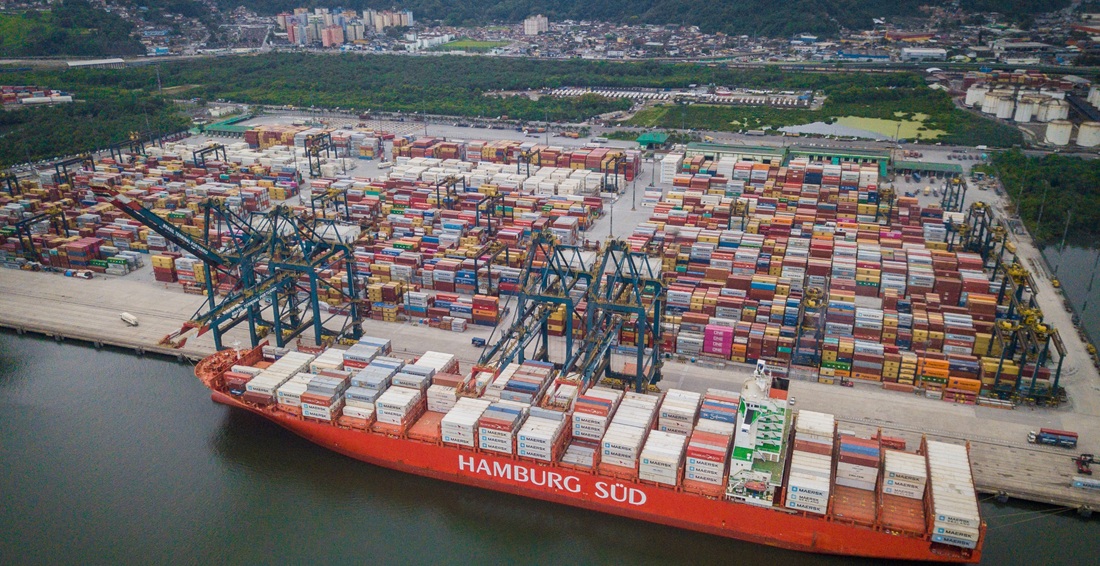
The Santos Port Authority (APS), the company responsible for the public infrastructure of the Port of Santos, is once again extending for an additional 90 days the discount applied since 2023 to fees charged to so-called “green ships”, which emit fewer pollutants.
The discounts are granted to vessels registered with a positive score in the Environmental Ship Index (ESI) of the International Maritime Organization (IMO) and can reach up to 15%. They apply to the use of waterway access infrastructure, charged on a per-vessel gross-tonnage basis.
The implementation of discounts for more environmentally efficient ships is one of the levers of APS’ efforts to combat climate risk. The maritime sector accounts for 80% of global trade and 3% of global greenhouse gas (GHG) emissions, according to IMO data, transforming ports critical to meeting the goals of the Paris Agreement (the international treaty adopted in 2015 to reduce GHG emissions to limit the increase in temperature to 1.5°C above pre-industrial levels). The Port of Santos aims to lead the energy transition in the national waterway sector.
Since 2023, the tariff discount offered to ships and terminals that adopt sustainable practices has exceeded R$40.6 million. In 2025 alone, the amount has already surpassed R$16.8 million. These are the revenues APS has chosen to forgo to encourage adaptation to global requirements.
Levers for a sustainable future
To enable decarbonization, ports must act in three areas: logistics efficiency, biofuels, and renewable electricity supply.
In October, APS signed a contract with the Valenciaport Foundation to develop a Decarbonization Plan and an Energy Master Plan (PDE) for the Port of Santos. The agreement stipulates delivery of the studies within 22 months.
The Decarbonization Plan aims to outline guidelines and targets to decarbonize operations throughout the Baixada Santista port complex – covering activities by both APS and port terminals, ships operating at the Port, and rail and road transport modes.
The PDE will outline guidelines and actions to help the Port of Santos transition from fossil-fuel-based energy with high CO2 emissions to increasingly cleaner energy sources.
Since 2024, the Port of Santos has also been developing a pioneering quayside electrification project—clean, renewable energy generated by the Itatinga Hydroelectric Plant supplies around 20 tugboats operating locally. Ongoing negotiations aim to expand the supply. The plant’s repowering, currently under study, intends to increase its generation capacity, including the production of green hydrogen. The facility, which already meets almost all of APS’ energy demand, could directly supply a significant share of the port’s energy needs.
Logistics efficiency is advancing with support from the São José dos Campos Technological Innovation Park (PIT), which is developing solutions to sequence trucks and ships, reducing waiting times and, consequently, emissions.
Since 2021, APS has operated with scientific rigor in managing its emissions. The institution prepares its annual greenhouse gas (GHG) inventory using the methodology of the Brazilian GHG Protocol Program, certified by the São Paulo Environmental Company (Cetesb).
Source: APS
-
Other Cargo
Oct, 04, 2024
0
Brazil Furniture and Mattress Exports Up in 2nd Half of the Year
-
Fruits
Jul, 03, 2025
1
Mango Leads Brazilian Fruit Exports, Generating US$ 80 Million in First Five Months of 2025
-
Grains
Jul, 22, 2022
0
Consultancy predicts Brazil can export 91.5M tonnes of soybeans in 2023
-
Grains
Feb, 27, 2023
0
Wheat: Argentina declares 8.866 million tonnes in exports