

Port of São Francisco do Sul Completes Maintenance Dredging in Berthing Basin
Oct, 22, 2026 Posted by Gabriel MalheirosWeek 202643
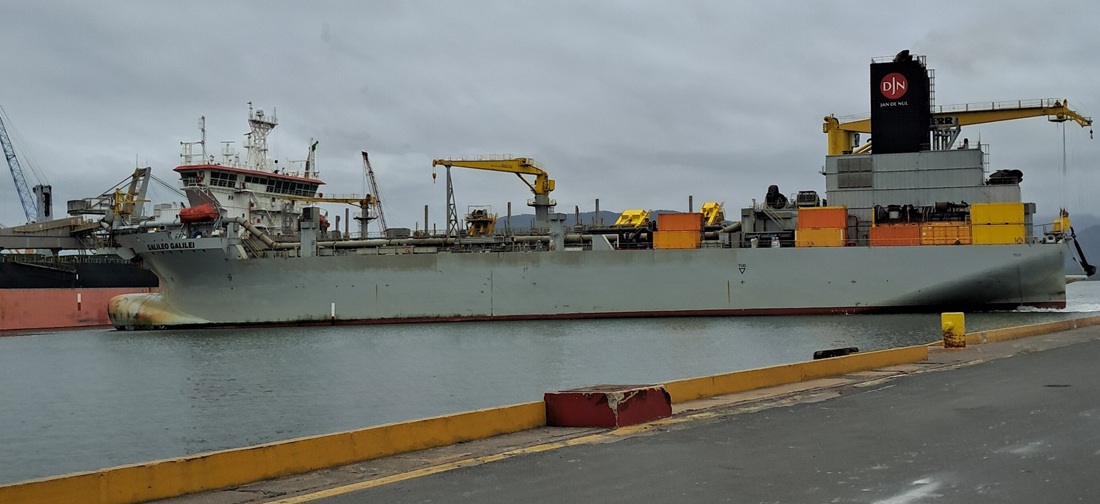
The Port of São Francisco do Sul has completed another round of maintenance work in its inner berthing basin. The maintenance dredging at the Port of São Francisco do Sul, carried out by the Belgian dredger Galileo Galilei, removed 170,000 cubic meters of sediment from the seabed.
The work was recently completed to maintain the 14-meter water depth required for port operations. The dredged area covered 133,000 square meters, equivalent to approximately 20 soccer fields.
The sediment removed during the operation was deposited at a designated offshore disposal site approved by environmental authorities, located 23 kilometers from the Port of São Francisco do Sul. The project received R$8 million in investment, funded entirely by the Port Authority’s own resources.
Ivan Amaral, Santa Catarina’s Secretary of Ports, Airports and Railways (SPAF), emphasized the importance of the area to port operations.
“The completion of this work demonstrates the Port of São Francisco do Sul management’s commitment to maintaining the port’s competitiveness and operational capacity,” he said.
For Port President Cleverton Vieira, the completion of the dredging represents the continuation of efforts to maintain port infrastructure.
“Maintaining the depth of the berthing basin is important to ensure adequate conditions for port operations. This is a request from the port community that we are addressing through this project, funded with our own resources, which will provide greater safety and efficiency during vessel berthing and unberthing maneuvers,” Vieira said.
The Dredger
The Galileo Galilei, operated by Jan De Nul do Brasil, is one of the world’s most advanced dredgers. The vessel measures 166 meters in length and has a hopper capacity of 18,000 cubic meters, equivalent to approximately 1,800 heavy-duty truckloads.
It is a self-propelled trailing suction hopper dredger (TSHD), commonly known as a hopper dredger, with accommodations for 32 crew members.
The same vessel was used for the beach nourishment project at Itapoá Beach, completed in late August as part of the ongoing dredging project to deepen the access channel to Babitonga Bay, also being carried out by the Port of São Francisco do Sul.
How Maintenance Dredging at the Port of São Francisco do Sul Works
The dredging cycle involves several stages: dredging and loading sediment into the vessel’s hopper; sailing to the designated disposal area with the hopper full; discharging the sediment at the offshore disposal site; returning to the dredging area with an empty hopper; and restarting the operation.
In practice, suction pipes are lowered to the seabed, where a system of powerful pumps draws up sediment and transfers it into the Galileo Galilei‘s hopper.
Once loaded, the dredger sails to the designated offshore disposal area, where the material is discharged and deposited on the seabed.
Source: Porto de São Francisco do Sul
-
Other Cargo
Feb, 26, 2026
0
Brazil footwear sector sees EU-Mercosur deal boosting competitiveness and diversification
-
Meat
Jun, 26, 2026
0
Brazil creates certification protocol to protect beef exports to EU
-
Shipping
Jun, 02, 2022
0
ONE places order for ten very large container ships
-
Ports and Terminals
Nov, 25, 2024
0
Ports in Rio Grande Do Sul Post 36 Million Tonnes in Cargo Movement, Marking Recovery After Floods