


Ports say integration with other transport modes is crucial for southern Brazil
Sep, 25, 2025 Posted by Lucas LorimerWeek 202540
The integration between port, waterway, road, and rail modes is, according to operators, one of the greatest challenges for transportation infrastructure in southern Brazil, considered one of the country’s main logistics pillars. A recent study by the National Confederation of Industry (CNI) points out that synergy between these modes could reduce costs, increase cargo capacity, and decrease environmental impact.
“Despite its relevance, the region’s port infrastructure faces bottlenecks that limit its potential,” said Rodrigo Cuesta, CFO and head of new business at Norsul, a shipping and logistics company. For him, investments in dredging, port and land infrastructure expansion, as well as more efficient systems, would bring immediate productivity gains. “The solution lies in a coordinated investment plan that aligns physical capacity, technology, and operational efficiency, ensuring that the region’s logistics potential is fully realized,” Cuesta said.
Cleverton Vieira, president of the Port of São Francisco do Sul (SC), also believes there is a need to improve the integration of modes for the sustainable expansion of ports in Santa Catarina, both public and private, which operate in tandem but face access problems. “Although [access] is not deficient, it is insufficient,” he said. The duplication of BR-280, which connects northwestern Santa Catarina to São Francisco do Sul and has been under study since 2012, is one of the demands. The need for a fourth lane of at least 1.4 km at the complex’s access is such that the port itself decided to pay the R$12.5 million cost of the project.
A public-private partnership between the operator, the state, and the Port of Itapoá will spend R$324 million to deepen (from 14 m to 16 m) and widen the access curve (to 260 m) of the outer channel of Babitonga Bay, where the two ports are located. The operator’s goal is to double the cargo handling capacity of the port complex by 2035 compared to the 17 million tonnes handled last year.
In the neighboring state, Portos do Paraná is investing R$600 million in the construction of the so-called Moegão, a rail unloading system for grains designed to increase efficiency and the port’s receiving capacity by 60%. “In addition to meeting current demand, [the Moegão] prepares the port to receive the larger cargo volumes that will arrive in Paranaguá by rail,” said Luiz Fernando Garcia, CEO of Portos do Paraná.
The complex will feature three independent rail lines, each capable of unloading 60 railcars every two hours, and will be connected by conveyor belts to 11 terminals. This will reduce urban rail crossings from 16 to 5.
The state-owned company will also hold an auction in October for the concession of the port’s access channel, with plans to increase the draft from the current 13.1 m to 15.5 m. “Two meters of draft means, on average, a thousand more containers on the ship or 14,000 tonnes more of a given product in a vessel,” Garcia explained.
See below a historical record of container exports via the Port of Paranaguá starting from January 2022. The chart was prepared with DataLiner data:
Container Throughput at the Port of Paranaguá | Jan 2022 to Jul 2025 | TEU
Source: DataLiner (Click here to request a demo)
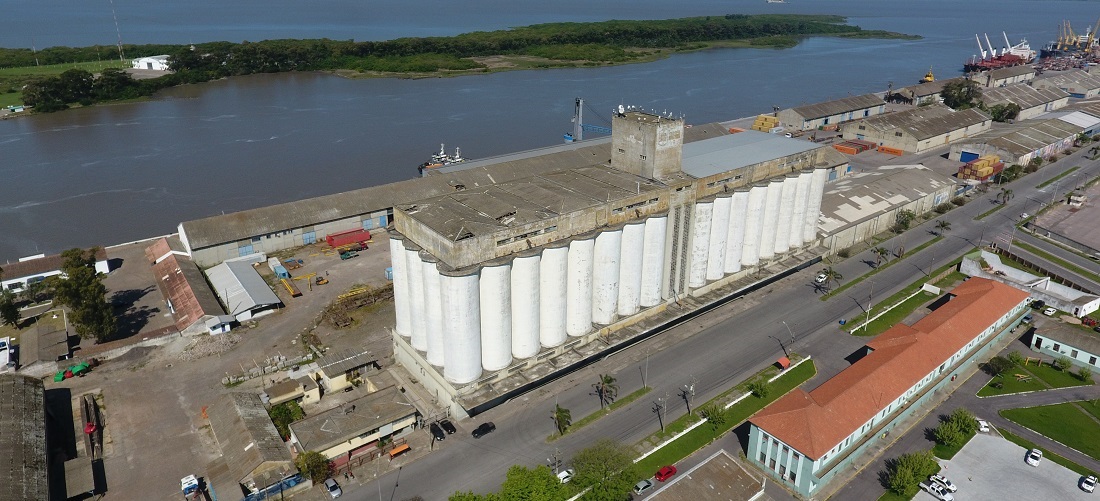
Portos RS, the state-owned company that manages the main ports of Rio Grande do Sul, also emphasizes the need for modal integration, which, according to its president, Cristiano Klinger, would yield significant gains and improvements in logistics efficiency throughout the state. “The state government has been working on the rail agenda, an important step that requires investment, so that we can achieve integration between modes and consequently improve the arrival or departure of cargo at our Rio Grande port complex,” Klinger said.
Highways are also crucial, he added, especially BR-392, which connects Santa Maria to Rio Grande and still has unduplicated sections. “This causes problems, increasing travel time and risk in stretches of the highway that are part of our port complex,” he said.
The executive also reported that, to improve navigability, Portos RS is investing R$731 million from the Rio Grande Plan Fund to restore inland navigation channels and the access draft at the Port of Rio Grande to 15 m, which were affected by the 2024 floods. This year, the state’s port complex is expected to surpass the 45 million tonnes handled in 2024.
The waterways of Rio Grande do Sul also face significant challenges, including silting of channels and rock outcrops that require removal, as well as ongoing dredging and maintenance needs. The Mercosur Waterway (Patos Lagoon and Jacuí River), a crucial logistics corridor for the transportation of grains and forest products, has stretches with navigability issues due to these problems.
Source: Valor Infraestrutura e Logística – Região Sul
-
Shipping
May, 27, 2022
0
Containership orderbook equivalent to the extent fleets of Cosco, Hapag-Lloyd and Evergreen
-
Apr, 22, 2025
0
Intermodal South America 2025 Expands Attractions to Boost Logistics and Foreign Trade in Latin America
-
Ports and Terminals
Nov, 17, 2021
0
YTD Portos RS handling already surpasses 2020 level
-
Economy
Aug, 11, 2022
0
Brazil’s fertilizer imports from Canada increase by 174%