


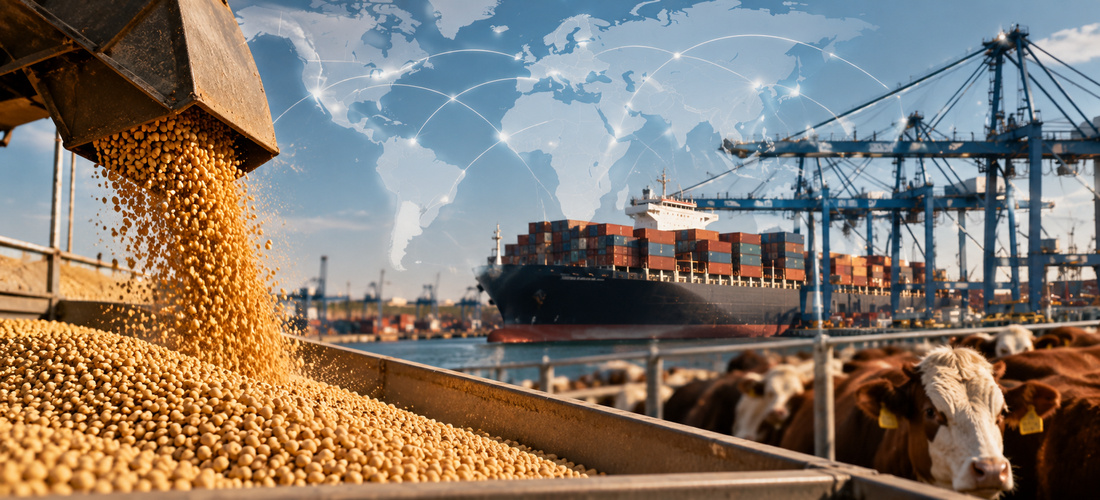
Countries Seek to Reduce Protein Import Dependence, Reshaping Global Trade
Oct, 27, 2026 Posted by Gabriel MalheirosWeek 202644
Governments around the world are restructuring agricultural and industrial policies to reduce their reliance on imported proteins, a shift that could reshape international trade flows in soybeans, animal feed, meat and food ingredients. Combining support for domestic production, investment in technology and greater control over supply chains, the trend is turning protein into a strategic national security resource rather than simply another commodity traded on international markets.
The shift has direct implications for Brazil. The country plays a central role in global soybean and animal protein supplies, but its export competitiveness now faces a new challenge: major buyers are increasingly willing to invest in producing domestically what they currently import.
The phenomenon, described as “protein nationalism” by political risk consultancy Eurasia Group in a report published in October 2026, extends beyond the threat of tariffs and quotas. It also raises the possibility of structural changes in demand, the emergence of subsidized competitors and growing competition for control over production and processing technologies.
The report identifies a convergence of geopolitical fragmentation, rising protein demand and greater government intervention in food production and trade. Under the scenario the consultancy considers most likely, countries will continue adopting measures to protect domestic supplies and increase production self-sufficiency, while trade restrictions become more widespread.
China at the Center of Protein Nationalism
China represents the most consequential shift for agricultural exporters. But Beijing is not alone. The United States is seeking to expand domestic beef production, the European Union wants to reduce its reliance on imported plant proteins used in animal feed, and India is investing in efforts to cut its dependence on imported pulses. Meanwhile, countries such as Denmark, the Netherlands, South Korea and Singapore are seeking to establish themselves in the alternative protein industry.
Although these initiatives reflect different national circumstances, they point in the same direction: governments want greater control over the origin, supply and cost of the proteins consumed by their populations and used by domestic industries.
China Pursues Self-Sufficiency and Could Reduce Imports
China poses the greatest potential threat to traditional protein suppliers. Having become the world’s largest importer of meat, dairy products and animal feed, the country is seeking to reduce its exposure to international markets, increase domestic productivity and develop technologies that would allow it to replace imports and eventually expand into export markets.
China’s 15th Five-Year Plan, covering 2026–2030, places food security among the country’s highest national priorities, alongside defense. Its strategy includes developing genetically modified seeds, expanding cultivated areas, improving feed production efficiency and investing in precision fermentation, cellular agriculture, amino acids and biomanufacturing.
The objective is not necessarily to eliminate imports in the short term, but to reduce China’s vulnerability to foreign suppliers and fluctuations in international trade. In May 2026, a Reuters analysis had already suggested that productivity gains and declining reliance on imported animal feed could bring about structural changes in Chinese demand for agricultural products, with particularly significant implications for Brazil and the United States.
For Brazil, the issue is especially sensitive because China is a major destination for Brazilian soybean and beef exports. If the Asian country succeeds in producing more animal protein while using fewer imported inputs, its demand for foreign soybeans and soybean meal could decline even as domestic meat consumption continues to grow.
Seaborne trade data obtained by Datamar illustrate the scale of the downturn: beef shipments to China fell 81% in July compared with the previous month. The chart below provides a detailed view of the volumes recorded:
Beef Exports to China | Jan 2024 – Aug 2026 | TEUs
Source: DataLiner – explore our trade data
There is, however, an important distinction between reducing dependence on imports and eliminating them altogether. China’s ability to replace foreign suppliers will depend on agricultural productivity, land and water availability, production costs and the pace of technological adoption. Eurasia Group projects a decline in Chinese soybean and animal feed purchases beginning in 2027, although it does not quantify the potential impact on Brazilian export volumes.
Competition presents a second risk. In addition to seeking to replace products currently imported, China intends to expand its exports of poultry meat, dairy products, eggs and aquatic products. If successful, this strategy could bring Chinese suppliers into direct competition with established exporters, supported by industrial policies and government investment.
U.S. Supports Domestic Cattle Industry While Relying on Imports to Contain Prices
In the United States, protein sovereignty is taking a different form. The government is seeking to rebuild domestic beef production while also addressing the impact of insufficient supplies on consumer prices.
The U.S. cattle herd is at its lowest level in 75 years, according to Eurasia Group and the U.S. Department of Agriculture (USDA). To encourage production, the government has introduced measures to support cattle ranchers, including loan guarantees, expanded access to grazing land and increased oversight of major meatpacking companies.
At the same time, Washington has expanded access for foreign beef suppliers in an effort to ease domestic prices. A measure that took effect in September 2026 temporarily increased the lower-tariff import quota for certain lean beef products by an additional 300,000 metric tonnes, with Brazil expected to be a major beneficiary.
This apparent contradiction illustrates the dilemma facing governments pursuing food sovereignty. Expanding domestic production is a long-term objective, but it does not immediately resolve supply shortages. Until production capacity responds, imports may remain necessary to contain inflation and ensure adequate supplies.
The episode also shows how trade policy can serve domestic interests while strengthening diplomatic relationships. The U.S. government has expanded trade benefits for Argentina, for example, in a strategy that Eurasia Group associates with the political relationship between Donald Trump and Javier Milei.
For Brazilian exporters, this means market access may depend not only on prices and competitiveness but also on political decisions, bilateral negotiations and the supply requirements of importing countries.
European Union Seeks to Reduce Dependence on Imported Soybeans
The European Union has also begun treating protein supplies as a matter of strategic autonomy. In July 2026, the European Commission presented a plan to strengthen the resilience and autonomy of Europe’s protein supply system, focusing on diversifying production and reducing external dependencies.
The objective is to expand European production of plant-based proteins used in both human food and animal feed. The plan calls for incentives to diversify crops, investment in research and innovation, and stronger processing supply chains.
Reliance on imported inputs is considered a vulnerability because it exposes European livestock production to price fluctuations, logistics disruptions and geopolitical tensions. The problem extends beyond soybeans, as fertilizers and energy are also critical inputs for the supply chain.
Europe faces natural and economic constraints that limit its ability to expand certain crops on the same scale as major exporters in the Americas. According to Eurasia Group, reducing dependence will therefore require gradual changes in production, incentives for farmers and the development of alternative protein sources.
For Brazil, the potential consequence is greater competition in the European market for animal feed ingredients. This does not mean that the EU will stop importing Brazilian soybeans, but rather that it intends to broaden its sourcing options and reduce exposure to a limited group of suppliers.
India Invests in Replacing Pulse Imports
India is also pursuing greater self-sufficiency through a roughly $1.3 billion program aimed at reducing its dependence on imported pulses, including supplies from Canada and Australia. The initiative covers the 2025–26 to 2030–31 period, with the goal of achieving self-sufficiency in pulse production by the end of the program.
The initiative illustrates how protein sovereignty extends beyond meat. Pulses, protein-rich grains and animal feed ingredients are also considered strategic because they influence dietary costs, food security and dependence on international trade.
In heavily populated countries, exposure to high international prices can have significant economic and political consequences. Encouraging domestic production therefore becomes a means of reducing vulnerability to external shocks, although replacing imports depends on productivity, land availability, farm profitability and weather conditions.
Technology Competition Extends Beyond Conventional Livestock Production
The drive for self-sufficiency is not limited to producing more meat, milk or eggs. Some governments are seeking to gain control over technologies that could fundamentally change the structure of the protein market.
The Netherlands, Denmark, the United Kingdom, South Korea and Singapore are investing in research, development and production of plant-based proteins, fermentation-derived ingredients and cultivated meat. China has also incorporated these technologies into its food security strategy.
The motivation is both economic and geopolitical. Control over industrial processes, patents, equipment and ingredients could create new revenue streams while reducing dependence on conventional animal production chains.
The report does not, however, anticipate a rapid replacement of conventional livestock production. Alternative proteins remain expensive to produce, and the industry faces regulatory barriers and consumer resistance. Eurasia Group therefore considers it more likely that animal proteins will continue to dominate the market through 2030.
Technological competition could nevertheless advance without a rapid shift in consumption patterns. Countries that develop industrial and regulatory capabilities may establish strategic positions as suppliers of ingredients and technologies, even if conventional meat remains dominant.
Rising Protein Demand and the Impact of Weight-Loss Drugs
Protein nationalism is gaining momentum at a time of rising global demand. The growing popularity of high-protein diets, aging populations and the expansion of urban middle classes are supporting consumption of meat, dairy products, eggs and nutritional supplements.
The increasing use of GLP-1 weight-loss medications is also influencing dietary habits. Because these drugs suppress appetite, healthcare professionals are placing greater emphasis on adequate protein intake to help patients preserve muscle mass.
In the United States, dietary guidelines published in 2026 raised the recommended daily protein intake to a range of 1.2 to 1.6 grams per kilogram of body weight, compared with the previous benchmark of 0.8 grams. The change gives protein greater prominence in public health policy and could influence dietary recommendations in other markets.
Growing consumption, however, does not guarantee a proportional increase in exports from countries that currently dominate global supplies. A larger share of demand could be met through domestic production as governments encourage substitutes, introduce trade restrictions or favor local producers.
Differences between the pace of changing consumption patterns and the time required to expand production could also create volatility. Agricultural output depends on biological cycles, input availability, weather conditions and investments made well in advance. When demand changes more quickly, prices can respond before producers have time to adjust supply.
Eurasia Group’s outlook combines these pressures with trade wars, volatile fertilizer and energy costs, and climate risks. The result could be greater government intervention in a market that has so far relied heavily on international specialization in agricultural production.
For Brazil, Diversification and Value-Added Exports Become More Important
Brazil’s position as a major producer and exporter of soybeans and meat provides significant advantages in a world where demand for protein is expected to remain strong. However, its reliance on major importing markets also exposes the country to changes in trade policy and its trading partners’ self-sufficiency strategies.
The challenge is to distinguish between two trends. The first is short-term protectionism, reflected in tariffs, quotas and regulatory barriers. The second is a structural transformation in the productive capacity of importing countries, which could reduce their demand for foreign supplies over several years.
Addressing the first requires trade negotiations, efforts to preserve market access and compliance with sanitary and technical requirements. The second calls for a long-term competitiveness strategy based on productivity gains, diversification of export destinations and greater domestic processing capacity.
Eurasia Group recommends that protein exporters diversify their markets, invest in higher-value products and participate in the development of trade standards. For Brazil, this means avoiding excessive reliance on continued growth in Chinese purchases and recognizing that the current international division of agricultural production may not remain unchanged.
Source: CNN Brasil
-
Other Logistics
Mar, 27, 2019
0
Truckers don’t rule out strike following Petrobras pricing policy announcement
-
Shipping
Sep, 12, 2019
0
Hapag-Lloyd online marine insurance
-
Other Logistics
Sep, 02, 2022
0
Port of Felixstowe workers’ walkout comes to an end; fears for further strike actions in UK
-
Steel and Aluminium
Sep, 19, 2024
0
Brazil Launches Dumping Investigation into Pre-Painted Steel Exports from China and India