


Railway expansion project completed at the Paranaguá Container Terminal
Jul, 23, 2026 Posted by Gabriel MalheirosWeek 202630
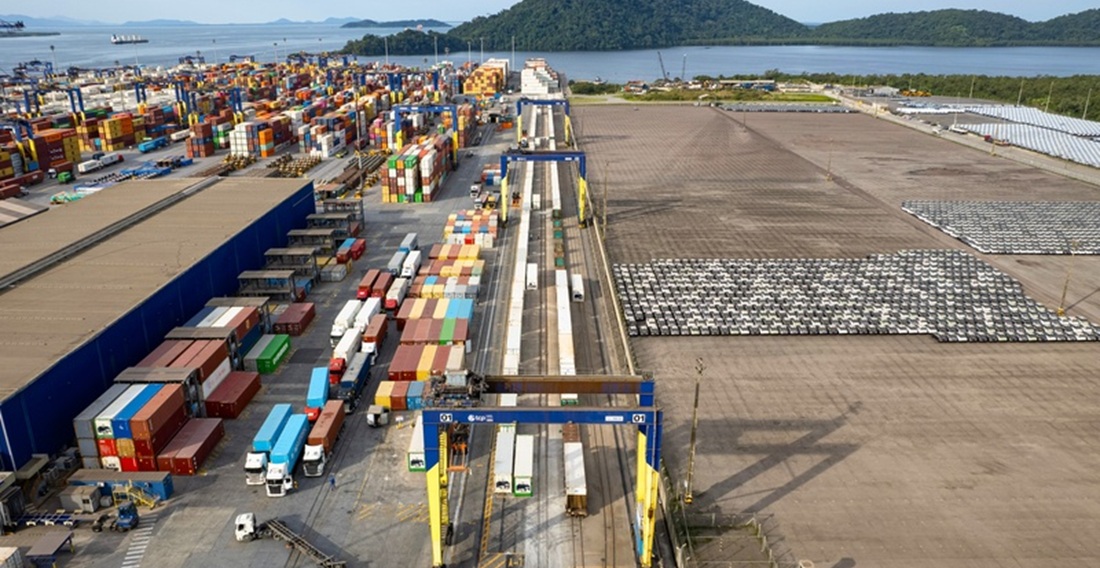
The Paranaguá Container Terminal, along with Brado Logística, a benchmark in multimodal container transport, recently completed the expansion works on the railway tracks within the Terminal’s operations yard. The venture is expected to increase operational efficiency and expand handling capacity in this transport mode by approximately 20%.
“The railway branch connects Paranaguá to Ortigueira, Cambé, and Cascavel, which are important production and export hubs for poultry meat, paper, and pulp. With the installation of the third rail line, it will be possible to expand the handling capacity of full containers on the railway from 55,000 containers to around 66,000 full containers per year, representing a significant gain in efficiency for clients served in these regions,” explains Fabio Mattos, Commercial Manager at TCP.
For Vinicius Cordeiro, Executive Manager of Commercial and New Business at Brado, the completion of the project represents more than just the delivery of new infrastructure. The project inaugurates a new stage for Paraná’s logistics, expanding connection possibilities between producers and domestic and international markets.
“As a multimodal operator, Brado’s role is to transform this structure into concrete solutions, supporting operational growth and expanding access to more efficient and sustainable logistics. This evolution at TCP is especially relevant for the state’s agribusiness and industrial sectors, which require alternatives capable of keeping pace with rising production and reaching increasingly distant markets. By strengthening railway integration, we contribute to boosting the competitiveness of Paraná’s products, offering greater efficiency and predictability to the outflow of production,” he states.
TCP is the only port terminal in the southern region of the country to have a direct connection between the operations yard and a railway branch. With the project’s completion, the Terminal receives a third rail line and a new switching area, totaling an additional 757 meters of railway.
“The railway mode consolidates itself as a strategic solution that strengthens cargo logistics. With lower risk of damage, greater safety, and assertiveness in transit time, rail transport in Brazil integrates the supply chain of various businesses. In 2024, out of the 310,000 full containers exported by TCP, about 52,000—equivalent to 17% of shipments—were transported by Brado,” comments Mattos.
Previously, the Terminal operated with two lines: while one train arrived at the operations yard, another left the area, allowing the loading and unloading of 41 containers at a time. With the new line and the switching area, two trains will be able to operate simultaneously while a third departs.
The completion of the work also alters the dynamics of vehicle traffic. In the previous model, trains arrived in Paranaguá with 82 wagons, and the compositions had to be split into two smaller ones of 41 containers each to cross the level crossing on Portuária Avenue. This process required two stops for both trains and road vehicles to enable the passage of the compositions.
Now, a single train can proceed continuously at maximum capacity, which decreases the frequency of crossings at the Portuária Avenue level crossing and ensures constant circulation at reduced speed, avoiding the old prolonged roadblocks.
Investments expand logistical capacity and strengthen railway operations
The railway expansion is part of a broad set of investments made by TCP to strengthen its logistical infrastructure. Over the past five years, the company has invested approximately R$ 500 million in operational improvements and terminal capacity expansion.
To meet the growth in railway handling, the area began operating with three RTG (Rubber Tyred Gantry) cranes—one more than before. This equipment underwent an electrification process with the installation of electrical busbars along the railway area, an initiative that generated a reduction in emissions of approximately 771 tons of carbon per year across the operation of the three units.
In addition, TCP invested in deploying new Terminal Tractors (TTs) to optimize railway operations and in retrofitting the Terminal’s gate, allowing access for the third line and smoother cargo movement.
The expansion also involved investments by Brado Logística in strategic assets and components for implementing the new railway infrastructure. According to the company’s executive, these contributions were decisive in raising operational capacity and ensuring a faster and more reliable service to customers.
“This was a strategy designed to deliver more productivity and efficiency directly to our clients. With the installation of new tracks and three turnout systems (turnouts/AMVs), we significantly expanded our switching capacity and composition flow, reducing waiting times and increasing turnaround at the terminal. The entire supporting foundation of this system, such as baseplates, anchor bolts, welds, and fastening clips, was sized to ensure maximum availability and operational reliability. The result is a more versatile operation with higher throughput and responsiveness to our clients’ growing demands,” states Cordeiro.
For Washington Renan Bohnn, Logistics Operations Manager at TCP, “these investments strengthen TCP’s logistical infrastructure and allow railway operations to evolve with more efficiency and predictability. By expanding the Terminal’s capacity and better integrating transport modes, we can offer more competitive solutions to our clients and contribute directly to the efficiency of the logistical chain of Brazilian foreign trade.”
Source: TCP
-
Other Cargo
Jun, 10, 2022
0
Uruguay dairy exports climb 49% YoY
-
Blog News (ENG)
Mar, 19, 2025
0
DataSmart Shipping Conference: Uncover the Future of Trade with Data-Driven Solutions
-
Ports and Terminals
Sep, 22, 2023
0
Brazil’s Minister of Ports announces permanent forum to address Port of Santos top concerns
-
Sugar and Ethanol
Oct, 03, 2022
0
Sugar/Brazil: line-up points to shipments of 3.988 million tonnes