



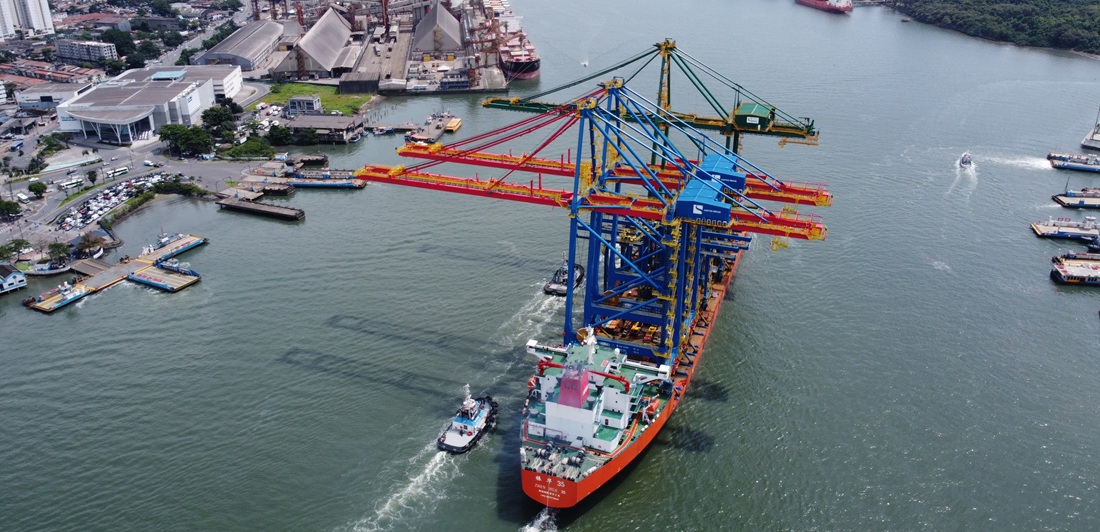
Ship Loaded With New Electric STS and RTG Cranes Sets Sail From China to Tecon Santos
Nov, 28, 2025 Posted by Sylvia SchandertWeek 202548
Two ship-to-shore cranes (STSs) and eight electric RGTs (yard gantry cranes) acquired by Santos Brasil have departed China aboard the vessel Zhen Hua 28, heading to the Tecon Santos terminal. The equipment, manufactured by the Chinese company ZPMC, is part of the terminal’s expansion, modernization, and decarbonization project, which involves investments of around R$300 million.
The new STSs feature TPS (Truck Position System) technology — a trailer-positioning system that precisely determines where trucks must stop for loading and unloading operations. This technology was already present in the last four units delivered to the terminal, but now it also offers a new capability: the cranes can be operated remotely. In other words, operators will no longer work from the crane’s cab at height, but instead from a remote operations center in the administrative building, just as already happens with the RTGs.
Each STS crane is 50 meters tall from the quay to the boom and has a 70-meter boom outreach. They can lift two fully loaded 20-foot containers simultaneously, each weighing up to 100 tonnes.
The new RTGs will join the eight existing electric units. They are next-generation models that allow remote operation — a feature introduced at the terminal at the end of 2024, pioneering in Brazil. Another 30 electric RTGs will be acquired in the coming years to replace diesel models. This initiative improves operator safety and ergonomics while reducing CO₂ emissions by around 20 tonnes per unit per month. Once the entire fleet is replaced, the terminal will avoid releasing 713 tonnes of CO² per month into the atmosphere, resulting in a 97% reduction in emissions from this equipment.
The Tecon Santos expansion and modernization project began in 2019. By 2031, approximately R$3 billion will have been invested (updated figures), of which R$2 billion has already been spent. The project is aligned with the company’s Climate Transition Plan, which targets becoming net zero by 2040.
According to Bruno Stupello, Santos Brasil’s Director of Container Terminal Operations, the company remains committed to creating solutions that provide Brazilian foreign trade and its customers with a differentiated competitive edge. “While we invest in technology and productivity gains, we also invest in improving working conditions for our employees, who undergo rigorous training to operate this new equipment,” he said.
The electric RTGs, for example, are equipped with 23 cameras, laser scanners, and sensors to support operations — all controlled via joysticks on a console with three large screens, with the option of working while standing. “In addition, these machines already operate with some level of automation, always supervised by a professional, ensuring greater precision and safety,” Stupello added.
Arrival
The Zhen Hua 28, which departed China on the 15th, is expected to arrive at the Port of Santos in the first half of January. The equipment is transported fully assembled on the ship’s deck. At the terminal, it will be unloaded via rails connecting the vessel to the quay.
Standard operations are expected to begin in February. Remote operation, however, will only start months later, as it depends on sensor testing, console configuration, and employee training — a process that may take up to a year.
Source: Santos Brasil
-
Grains
Aug, 07, 2026
0
Brazilian agribusiness GDP falls 2.01% in Q1, but exports support logistics demand
-
Nov, 09, 2023
0
Gasoline Exports Exceed Imports in Brazil For The First Time Since 2021
-
Ports and Terminals
May, 03, 2019
1
Codesp plans for an Initial Public Offering
-
Shipping
Jul, 16, 2024
0
Global liners flock to Mexico