


Soy accounts for 21% of annual throughput and leads exports at ports in Paraná
Nov, 25, 2025 Posted by Lucas LorimerWeek 202548
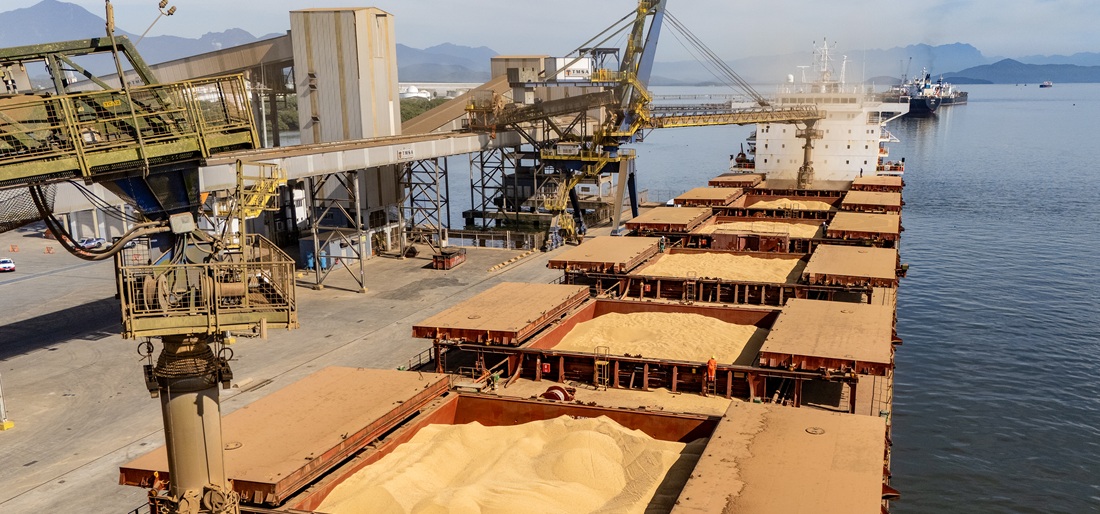
Soybeans in grain form were the commodity with the highest volume handled at Paraná ports between January and October of this year, according to the operational report from Portos do Paraná. Year-to-date, 13,015,446 tonnes have been shipped, representing FOB value (value of the product at the point of loading) of US$5.2 billion. The volume corresponds to 21.2% of all cargo handled by ports in Paraná in 2025 (61,213,363 tonnes).
Brazil is the world’s largest exporter of the product, and Paraná stands out in this movement. In total, 91% of the soybeans leaving Paranaguá are destined for the Chinese market. “We are confident that soybean movements will remain high in the coming months,” said the CEO of Portos do Paraná, Luiz Fernando Garcia.
In October, the commodity’s throughput grew by 60% year on year, rising from 508,876 tonnes in 2024 to 815,327 tonnes in 2025. Currently, 15 terminals in Paraná can handle soybeans in grain form.
Among the main factors driving the increase in soybean exports are record Brazilian harvest production and China’s strong demand, following the country’s virtual halt to imports from the United States due to tariff disputes.
Soy complex
The Port of Paranaguá has the second-largest soybean meal throughput in Brazil, accounting for 28% of national exports. From January to October this year, 5,517,043 tonnes of meal were handled, representing US$1.8 billion in FOB value. The product, used in animal feed production, rose 3% compared with last year (5,333,259 tonnes). The Netherlands, France, Spain, and South Korea were the main importers.
Paranaguá remains the national leader in soybean oil exports. Through the end of October, the Port was responsible for shipping 63% of all national production, destined for countries that total more than 860 thousand tonnes. The oil can be used in the food, pharmaceutical, chemical, and textile industries, among others.
More cargo in less time
The Port of Paranaguá is preparing to further increase handling capacity within the soy complex. Construction of the Moegão — the largest public port project currently under way in Brazil — scheduled for January 2026, will make it possible to increase the reception of grains and meal in the coming years.
The complex will centralize rail unloading of dry bulk, connecting 11 terminals through a conveyor-belt system. Soybeans will be one of the commodities most benefited by this investment.
Currently, about 550 railcars can be unloaded daily at the export terminals. With the Moegão, this process will be standardized at a single unloading point, increasing capacity to as many as 900 railcars per day.
“With the project completed, the Moegão will be able to receive 24 million tonnes of grains and meal per year, serving the terminals of the East Export Corridor and boosting productivity, especially in soybean exports,” said the Port Operations Director, Gabriel Vieira.
Another project soon to be developed is construction of the T-Pier, which will feature four new berths and a loading system considered the fastest in the world. The equipment currently in operation is capable of loading three thousand tonnes of grains and meal into ship holds per hour. The new structure will be able to load up to eight thousand tonnes per hour into a vessel.
The third factor that will further expand exports is the deepening of the access channel, which will allow the berthing of larger vessels with space to carry even more products. This will be possible through the concession of the Access Channel to the Port of Paranaguá, carried out via a public auction on Brazil’s stock exchange — B3.
The consortium that won the bid will be required to make all necessary investments within five years after taking over the contract. This includes increasing the draft — the distance from the deepest point of the vessel to the water surface — from the current 13.3 meters to 15.5 meters within five years.
The 2 meters and 20 centimeters increase in draft will allow a vessel to carry an additional 14 thousand tonnes of solid vegetable bulk without any additional operating cost.
All these changes will significantly increase the competitiveness of the Port of Paranaguá, which is one of the world’s leading bulk ports. Another significant advantage will be increased safety in vessel maneuvers and reduced operating time, which considerably lowers the transportation cost of cargo leaving Paraná.
Source: Portos do Paraná
-
Economy
Aug, 22, 2025
0
Brazil’s farm exports to Saudi Arabia surge nearly 30% in July
-
Oil and Gas
Jan, 09, 2025
0
Oil becomes Brazil’s top export, challenging Lula’s environmental agenda
-
Sugar and Ethanol
Jul, 11, 2023
0
How Brazil ethanol benefits from the US biofuel breakthrough
-
Ports and Terminals
Sep, 29, 2023
0
Itaqui Port ready to launch Brazil’s first decarbonization plan