


TCP joins USP-led simulation to test berthing maneuvers at Paranaguá
Sep, 11, 2025 Posted by Lucas LorimerWeek 202538
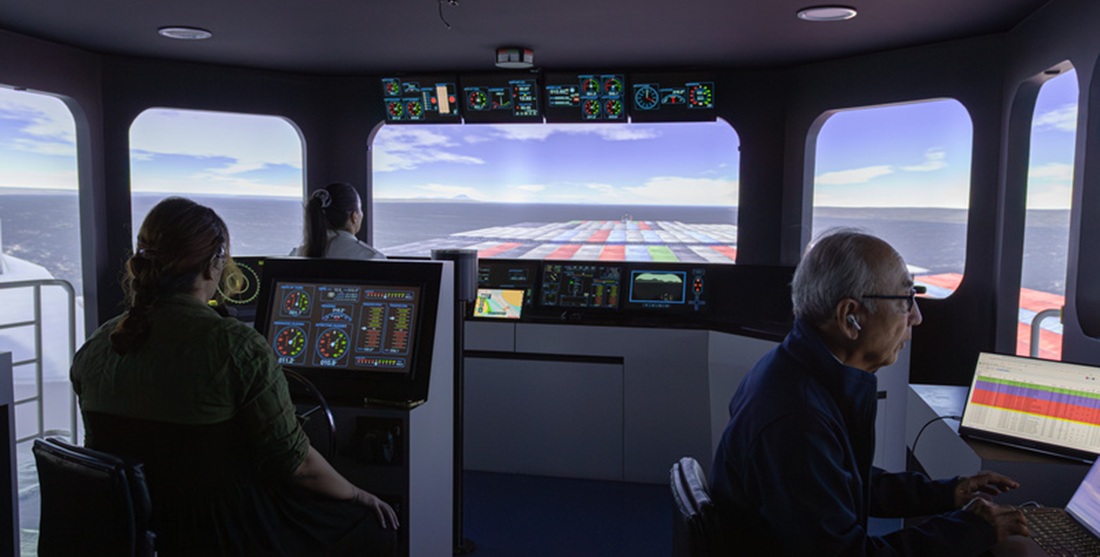
Between September 8 and 10, TCP, the company that manages the Paranaguá Container Terminal, took part in maneuver simulations at the Numerical Test Tank of the University of São Paulo (TPN-USP). The study also included representatives from Portos do Paraná, the Brazilian Navy, and the Paranaguá Pilots’ Association.
The technical study, commissioned by TCP, focused on simulating ship berthing and unberthing maneuvers under different scenarios and is expected to support the review of the ordinance that defines the operational draft (the depth between a ship’s keel and the waterline) of the access channel to the Port of Paranaguá.
“The simulations will be essential for enabling safe and efficient increases in the operational draft. The expectation is that the draft will soon be expanded from 12.80 meters to 13.30 meters, allowing larger vessels to dock and depart with more cargo, which means a significant gain in both operational capacity and economic impact for Paranaguá,” explained Rafael Stein Santos, Institutional and Legal Manager at TCP.
“These simulations are fundamental to ensure safety and agility in berthing and unberthing maneuvers at the Port of Paranaguá. In this specific project, we are working to increase the draft by 50 centimeters, from the current 12.80 meters to 13.30 meters. This will allow container ships to operate with greater efficiency. We also took the opportunity to discuss operational improvements for other cargo segments, which will also benefit from the increased draft,” added Gabriel Vieira, Operations Director at Portos do Paraná.
“It is important to highlight that the entire technical study was carried out with the necessary safety margins, ratified in the Risk Analysis Study contracted by TCP and overseen by the Paranaguá Pilots during the maneuver simulations,” commented Marcos Vinicius de Lima Martini, a Paranaguá pilot.
The scenarios simulated at the Numerical Test Tank included the berthing and unberthing of container ships up to 368 meters in length (LOA) and 51 meters in beam (width).
On January 29, 2024, TCP became the first port terminal in Brazil to receive a 366-meter vessel, the MSC Natasha XIII from Mediterranean Shipping Company (MSC). Since then, other ships of the same size have also docked at the terminal. However, an increased draft is necessary for these large vessels to operate at full cargo capacity.
Currently, TCP is the largest container terminal in southern Brazil and the third largest in the country, according to Aquaviary Statistics from the National Waterway Transport Agency (ANTAQ). In the first half of the year, the terminal handled a total of 744,650 TEUs across exports, imports, and transshipment operations.
Rock removal works
Since 2024, the access channel to the Port of Paranaguá has already had its operational draft increased from 12.10 meters to 12.80 meters at zero tide. With the additional 70 centimeters, ships can carry 560 more TEUs per voyage.
The increase followed the completion of underwater rock removal works at part of the Palanganas Rocks in the access channel area. Around 20,000 cubic meters of rock were removed from the seabed, later fragmented and donated to municipalities along the Paraná coast for use in public works such as road paving.
The works were carried out in compliance with Federal Environmental License No. 1144/2016 issued by Ibama. Several preventive and mitigation measures were implemented to minimize risks to local fauna and flora, along with periodic monitoring to ensure environmental quality.
Concession of the Paranaguá access channel
The auction for the access channel to the Port of Paranaguá is already scheduled for October 22 and will take place at the B3 exchange in São Paulo. The National Waterway Transport Agency (Antaq) is expected to publish the tender in the coming days, with a projected investment of R$1.23 billion over 25 years.
The concession will cover the expansion, maintenance, and operation of the waterway access channel. Planned improvements include deepening, widening, and enlarging the channel, expanding the turning basin, and deepening anchorage area No. 6.
The goal is to increase the average depth to 13.3 meters in the initial phase and reach 15.5 meters by the end of the concession, enabling larger vessels to call at the port. The future concessionaire will be responsible for all necessary investments to achieve the target, including dredging, rock removal, nautical signaling, bathymetric surveys, environmental monitoring, and other related services.
Source: TCP
-
Vessel Calls
Feb, 11, 2022
0
Containership calls at Brazilian ports fall 0.5% year-on-year
-
Meat
May, 09, 2022
0
Pig farming chain sees signs of a milder crisis ahead
-
Ports and Terminals
Jan, 06, 2025
0
Port of Santos: Operators Swap 120-Step Climb for Remote Crane Control
-
Other Cargo
Mar, 16, 2023
0
Brazilian businesses look to expand halal food exports to Arab countries