


Trump–Milei trade move threatens Mercosur unity and EU deal
Nov, 17, 2025 Posted by Lucas LorimerWeek 202548
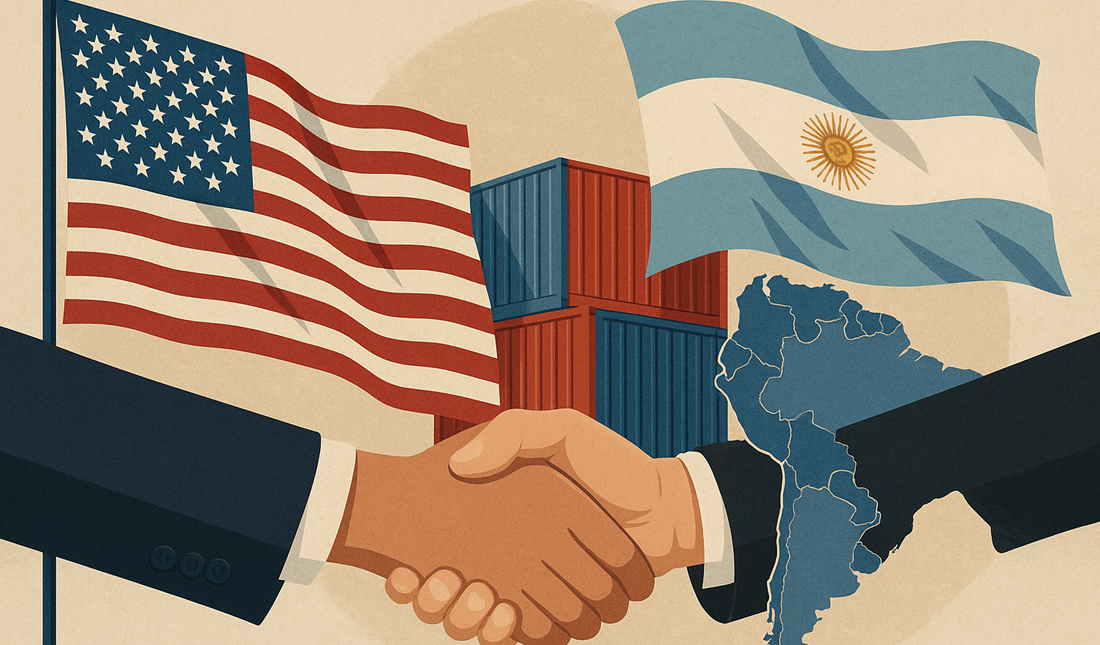
The Trump administration made a new move to regain ground lost by the United States in Latin America by announcing, last Thursday, trade agreements with ideologically aligned governments such as those of Argentina, El Salvador, Guatemala, and Ecuador. With these right-leaning countries, Trump offered some tariff reductions on their main export products while securing lower tariff and non-tariff barriers for American products and services, especially digital ones.
The case of Argentina poses serious problems for Brazil. As a customs union, Argentina would need to obtain special authorization to offer any concession related to tariffs and market access, or to make a controversial change to its list of tariff exceptions. This is particularly divisive because President Javier Milei has committed to eliminating restrictions on American vehicles, for example, while maintaining a decades-long automotive agreement with Brazil that enabled productive integration of the sector between the two countries.
The “agreements” that Trump announces are far from documented, formally signed commitments approved by the respective legislatures. They are verbal promises, with some rough drafts stitched together in statements with few details and a very precarious level of information. Their validity is as durable as Trump’s moods — as demonstrated by the episode in which he raised tariffs by 10% on Canada, a country with which the U.S. has a formal free-trade agreement, merely because the province of Ontario released an advertisement in which former president Ronald Reagan criticizes tariffs.
Moreover, opening the Argentine market to American goods and some reciprocity from the U.S. to Argentine products reopens old divisions within Mercosur. Carlos Menem, a Peronist who governed the country from 1989 to 1999 and was idolized by Milei, intended to reach an agreement with the U.S. outside Mercosur, with whom he expressed a desire for “carnal relations.” Uruguay, when governed by liberal parties, showed on several occasions the intention to pursue separate agreements with China and the U.S. These were manifestations of dissatisfaction with Mercosur’s paralysis, also shared by the Bolsonaro government, which believed the bloc was an obstacle to Brazil’s expansion of its trade networks worldwide.
Trump’s move may have a greater destructive impact on the bloc. The understanding with Argentina involves tariffs, intellectual property, labor, and digital trade. Milei promised to eliminate all kinds of barriers on the import of vehicles and chicken meat — of which Brazil is one of the world’s largest producers — as well as beef, unspecified agricultural products, pharmaceuticals, chemicals, and machinery.
Argentina is a major global producer of soybeans, and Brazil is the largest producer of beef; both compete with the U.S. in the global market. The details of the agreement are not known, but it is likely to be controversial and unpopular for Milei to accept open competition in the domestic market for one of the country’s symbolic products, beef, while putting in doubt the integration of the auto market with Brazil — possibly the most successful initiative ever carried out within Mercosur.
There is much more at stake. After more than 20 years of back-and-forth negotiations, Mercosur could finally sign a trade agreement with the European Union. Argentina has been one of the obstacles to the agreement, and the protection of the automotive industry was one of the sticking points in the long negotiations. Peronist presidents Cristina Kirchner and Alberto Fernández opposed globalization and trade openness. Milei advocates free markets but appears to be setting aside decades-old treaties signed with neighboring countries.
Cars and agricultural products have special clauses in the agreement with the European Union — a period of 15 to 30 years for the end of tariffs on the former, and quotas and various access restrictions for the latter. The understanding between Milei and Trump sidelines negotiations with the EU, which could be finalized by the end of the year. Conversations with the U.S. government may be the reason why Argentina has been avoiding participation in the Mercosur heads-of-state meeting scheduled by Brazil for next month.
Trump’s agreements in Latin America may have several objectives. One of them is to isolate left-wing governments by offering concessions — few — to allies and treating others harshly. In that case, the newly initiated negotiations with Brazil are unlikely to go far. Or, more likely, Trump wants to regain ground lost to China. In that scenario, he would make important concessions to Brazil, even if conditional. In this case, Argentina, which has a swap agreement originally the same size as the one granted by the U.S. (US$ 20 billion), would have a difficult choice to make.
Trump’s move reshuffles all the cards. It puts the unity of Mercosur at risk, challenges the bloc’s agreement with the Europeans and seeks to curb China’s growing influence in the region. It is divisive, but it is a game the American president knows how to play well.
Image generated by AI
Source: Valor Econômico
-
Dec, 11, 2023
0
Hapag-Lloyd increases rates from Asia to Latin America
-
Blog News (ENG)
May, 29, 2026
0
Port of Recife to Invest US$19.7 Million in Dredging to Expand Operational Capacity
-
May, 09, 2025
0
Brazilian Delegation Aims to Conquer Chinese Market for Fruit Exports
-
Ores
Jul, 17, 2023
0
Lithium cycle likely to thwart industrialization hopes in South America