


Trump’s tariff hike: check out all the measures announced in the federal government’s package to help Brazilian companies
Aug, 13, 2025 Posted by Lucas LorimerWeek 202534
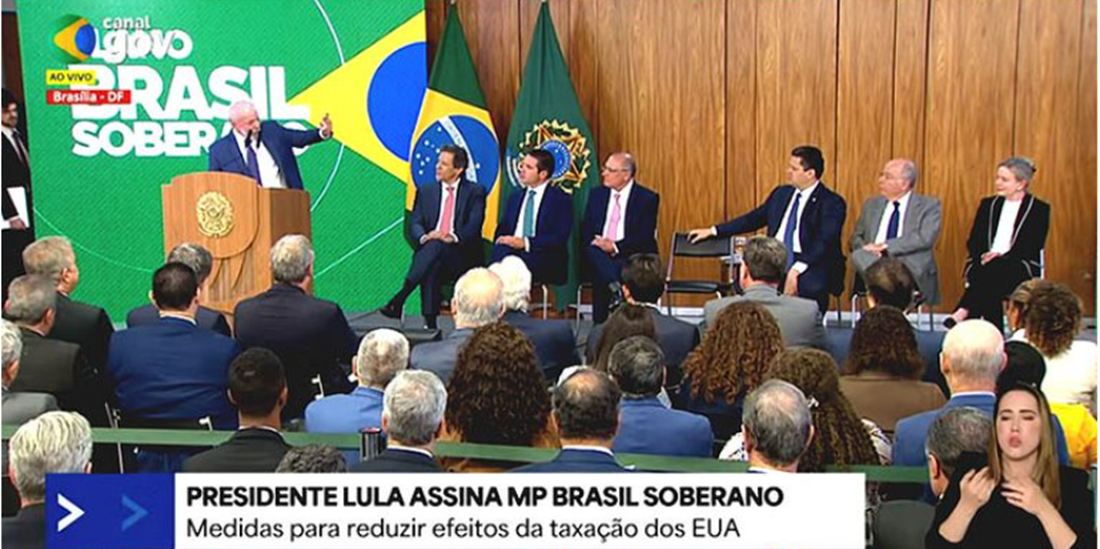
The federal government announced this Wednesday (August 13) a relief package for Brazilian companies affected by the 50% tariff imposed by the United States. The package includes a series of instruments to support the impacted exporters, ranging from subsidized credit lines to government purchases, all of which can be used in accordance with the guidelines of the provisional measure (MP) submitted to the National Congress.
Credit lines
R$30 billion from the Export Guarantee Fund (FGE) will be used as funding for providing credit at accessible rates.
Priority will be given based on: dependence on revenue from exports to the U.S., type of product, and company size. Those most affected will be prioritized.
Small and medium-sized companies will also be able to access guaranteed funds to obtain credit. Access to these credit lines will be conditional on maintaining current employment levels.
Extension of drawback deadlines
An exceptional extension will be granted for the deadline to prove the export of products manufactured from imported or domestically acquired inputs under a tax suspension regime (drawback).
The government will extend the deadline for companies to export goods produced with inputs covered by the drawback regime by one year. These products can be exported to the U.S. or other destinations. As a result, companies will not have to pay fines and interest if they fail to export to the U.S. within the originally established timeframe.
This measure applies to companies that had export contracts to the United States scheduled to be fulfilled by the end of this year. Of the US$40 billion exported to the United States in 2024, US$10.5 billion was carried out under the drawback regime.
The extension does not have a fiscal impact, as it only postpones the deadline for companies to fulfill their export commitments.
Deferral of federal taxes
The Federal Revenue Service is authorized to defer tax collection for the companies most affected by the tariff hike.
How it will work: affected companies will be allowed to delay tax payments for the next two months.
Public procurement
As an extraordinary measure, through a sub-regulatory act, the federal, state, and municipal governments will be permitted to make purchases for their food programs (e.g., school meals, hospitals) using simplified procedures and average market prices, with transparency and control ensured.
This measure applies exclusively to products impacted by the unilateral tariff increases.
Modernization of the export system
Rules for export guarantees will be expanded, providing exporters with protection against risks such as non-payment or contract cancellations.
The changes aim to strengthen exporting companies in medium- and high-tech sectors and encourage productive investments in the green economy.
The plan will enable banks and insurers to utilize this guarantee in a wider range of operations.
It also includes mechanisms for risk-sharing between the government and the private sector, utilizing the Foreign Trade Guarantee Fund (FGCE) as a first-loss mechanism, thereby enhancing credit access and reducing costs.
Guarantee funds
Additional contributions will be made to ensure sufficient funds: R$1.5 billion to the FGCE, R$2 billion to the Investment Guarantee Fund (FGI), managed by BNDES, and R$1 billion to the Operations Guarantee Fund (FGO), managed by Banco do Brasil. These are primarily aimed at improving credit access for small and medium exporters.
New Reintegra for affected companies
The Special Regime for the Reinstatement of Tax Amounts for Exporting Companies (Reintegra) reimburses Brazilian exporters for part of the taxes paid throughout the production chain, in the form of tax credits, helping reduce costs and increase competitiveness abroad.
Currently, large and medium-sized companies exporting industrialized goods receive a fixed rate of 0.1%; micro and small enterprises, through the Acredita Exportação program, receive a rate of 3%.
The new measure increases the benefit by up to 3 percentage points for companies whose exports were harmed by unilateral tariffs imposed by other countries. That is, to remain competitive in the U.S. market, large and medium-sized companies will now be eligible for rates of up to 3.1%, while micro and small businesses will be eligible for rates of up to 6%.
These new Reintegra conditions will be valid until December 2026 and are expected to have an impact of up to R$5 billion.
Worker protection
The government has established the National Employment Monitoring Council to monitor employment levels in affected companies and their supply chains, oversee labor obligations and benefits, and propose measures to preserve jobs.
The council will operate at both national and regional levels via Regional Labor Superintendencies.
Its responsibilities include:
- Monitoring data and studies on employment levels in companies and subsectors directly affected by the U.S. tariffs
- Expanding analysis to identify indirect impacts on job generation and retention in supply chains
- Tracking obligations, benefits, and payroll effects resulting from agreements to preserve jobs and mitigate the impact of the tariffs
- Promoting collective bargaining and mediating conflicts to preserve employment
- Applying emergency measures such as temporary layoffs and contract suspensions, as permitted by law
- Enforcing compliance with agreed obligations and job maintenance via labor inspections
- Using the regional structure of the Labor Superintendencies to engage employers and workers in negotiations to meet the needs of affected companies
- Monitoring the granting and payment of labor benefits to employees of companies directly affected
Trade diplomacy and multilateralism
Finally, the government announced it will act on the international front to expand and diversify export markets, reducing Brazil’s dependence on the United States. Current actions include:
Completed negotiations: European Union; EFTA (European Free Trade Association)
Ongoing negotiations: United Arab Emirates and Canada
In dialogue: India and Vietnam
“Brazil remains open to constructive dialogue with the United States, seeking negotiated solutions to restore fair and balanced conditions for bilateral trade, in the interest of producers, workers, and consumers in both countries,” the government said.
Source: Extra
-
Economy
Jun, 03, 2024
0
Brazil Expands Global Agribusiness Reach with Record Market Openings
-
Ports and Terminals
Nov, 19, 2019
0
Santos Port Authority publishes list of winning offers of areas in Saboó
-
Grains
Jul, 14, 2021
0
High corn consumption sustains imports to meet domestic demand
-
Grains
May, 19, 2022
0
Federation confirms the shipment of 30 thousand tonnes of paddy rice to Mexico