


Two months after tariff hike, impact on Brazilian exports smaller than expected
Oct, 06, 2025 Posted by Lucas LorimerWeek 202542
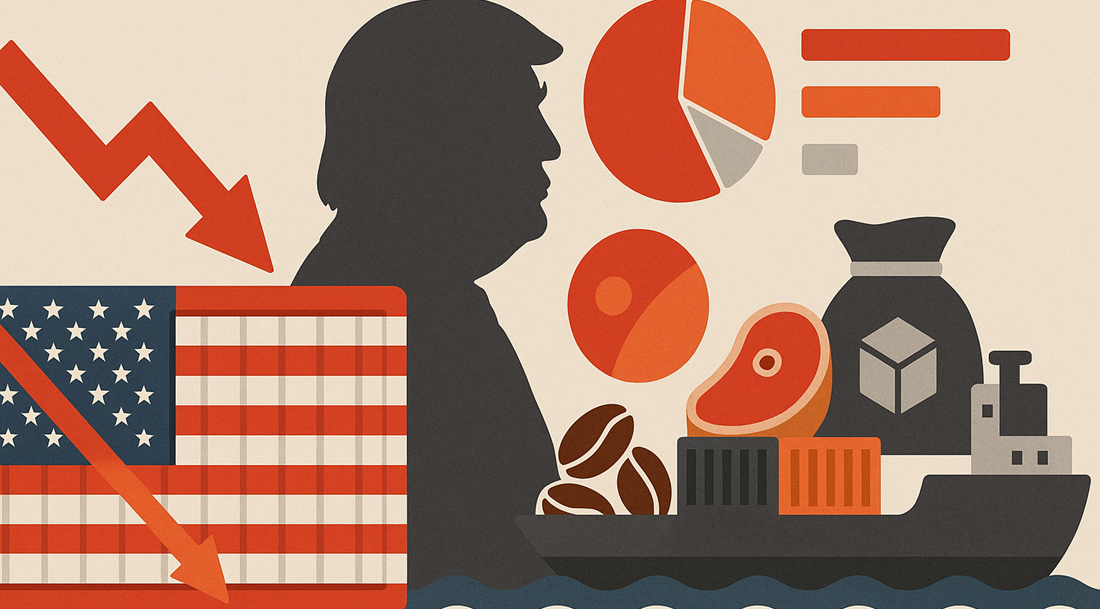
Two months after the implementation of the tariff hike announced by U.S. President Donald Trump, the impact on the Brazilian economy has been smaller than initially estimated. Of the export basket, 44.6% — less than half of the products — are subject to the maximum rate of 50%. Another 29.5% face lower tariffs, while 25.9% of items remain exempt.
The data come from a survey by the American Chamber of Commerce for Brazil (Amcham Brasil), based on an analysis of the 2024 trade relationship between the two countries, provided to O Globo using figures from the Ministry of Development, Industry, Commerce, and Services (MDIC).
The breakdown of the tariff impact shows that the products facing the highest rates are commodities such as coffee, beef, and sugar, which are easier to redirect to other markets, explained Fabrizio Panzini, Amcham Brasil’s Director of Public Policy and Government Relations. This ability to divert production elsewhere has reduced the overall impact compared with initial forecasts.
Sectoral and regional effects
In the coffee sector, exports to the U.S. — the world’s largest market for the beverage — plunged 56% in September compared with 2024 and are expected to reach zero in the coming days, while countries such as Germany have become alternative destinations.
Marcos Matos, Executive Director of the Brazilian Coffee Exporters Council (CECAFÉ), stated that the tariff hike has led to a sharp increase in prices for U.S. consumers. On July 30, the price of coffee was $0.284 per pound; it now stands at around $0.380.
“This has caused a major reallocation in the market. Colombia exports 40% of its goods to the U.S. and 20% to Europe. Brazil exports 16% to the U.S. and 50% to Europe. The 20% of Colombian exports to Europe is expected to decline as the country focuses on the U.S., while Brazil will concentrate on other countries. We’ll see sales to the U.S. drop sharply and likely reach zero at the start of this month,” said Matos.
In other sectors, however, the tariffs are taking a heavier toll, leading to stockpiles, cost pressure, and layoffs as firms seek credit and new markets. In the wood industry alone, more than 4,000 workers have been laid off. In other areas less dependent on U.S. exports, companies are shifting toward the domestic market.
“The impact is especially significant when viewed sectorally and regionally. Outside of commodities, the rest becomes much more fragile — like honey from the Northeast, wood and furniture from the South, and machinery and equipment from the Southeast. These are sectors where the tariffs will collapse exports unless action is taken,” said Panzini.
Looking at total exports to the U.S. last year, 74.1% have been affected this year by some type of surcharge. Commodities were hit twice — first by the reciprocal 10% tariff announced by Trump in April, followed by an additional 40% surcharge implemented in August, which together totaled the maximum 50% rate.
Products such as cast iron, aircraft, and orange juice were subject only to the 10% tariff. A smaller group, including pharmaceuticals and fish fillets, faced the August surcharge of 40%.
Under Trump’s tariff framework, some goods were also affected by sector-specific tariffs under Section 232 of the U.S. Trade Expansion Act, which allows duties on items deemed critical to national security. This category includes steel, aluminum, and copper (subject to a 50% tariff) and automobiles and auto parts (subject to a 25% tariff). Combined, sectoral tariffs account for 9.8% of the export basket.
Federal government data show that from January to August, Brazilian exports to the U.S. rose 1.6% year-on-year — but this increase was driven by the first half of the year; in August, exports plunged 18.5%.
In the machinery sector, the U.S. accounted for 26.9% of exports last year. August data indicate that the decline in U.S. sales has not yet affected the entire industry. The Brazilian Machinery and Equipment Industry Association (Abimaq) initially projected exports could fall to zero in September, but expectations have since improved slightly.
“Companies that used to send most of their exports to the U.S. are now redirecting those products to other countries. The international market is restructuring,” said Cristina Zanella, Abimaq’s Director of Competitiveness, Economics, and Statistics.
Some firms have already reduced deliveries and faced cancellations. Employment in the industry rose in September, as some companies depend more on domestic demand, but others have had to cut staff due to project losses and reduced contracts.
While a meeting between Presidents Lula and Trump is awaited, Panzini noted that there are other ways to mitigate the impact of the tariffs. In the U.S., companies that rely on Brazilian goods are lobbying the government, while Brazilian producers, such as those in the pulp and pig iron industries, have successfully been added to the exemption list.
Brazilian Container Exports to the United States | Jan 2022 to Aug 2025 | TEU
Source: DataLiner (Click here to request a demo)
‘More harmful for the U.S.’
In early September, businessman Joesley Batista, shareholder of J&F, met with Trump to discuss the 50% beef tariff.
Other strategies are also being explored. According to sources, some furniture and machinery companies are relocating operations to other Latin American countries to process and export products to the U.S.
Tax expert Leonardo Briganti, partner at Briganti Advogados, said the tariff shock was damaging in the very short term. China and other Asian and European markets absorbed part of the demand, but it remains unclear whether this shift is temporary. For Brazil, he said, the main concern lies in the coming months.
“The effect was actually more harmful for the U.S. The idea of reindustrializing the country hasn’t worked. Costs have risen, and small and medium importers are struggling,” Briganti said.
In the U.S., meanwhile, the Trump administration is discussing a US$10 billion aid package for the agricultural sector, primarily for soybean producers who have seen their costs rise amid the trade war.
Search for new clients
Wood industries are seeking new customers abroad, but for some, a large share of production was dedicated to the U.S. In Paraná-based Randa, 100% of frame production and half of the plywood output were sent to the U.S. With the new tariffs, revenue has fallen by 30%.
Approximately 200 employees have been laid off, and the remaining 600 are taking 30-day collective vacations. Half of the production is idle. The company is seeking new markets in South America and Europe, while also attempting to sell domestically; however, oversupply has led to a 20% price decrease.
“Warehouses are full, and we’re paying for storage at ports, which increases costs. We’re hemorrhaging cash, and the BNDES loan hasn’t materialized. The question is how long we can hold on,” said CEO Guilherme Ranssolin.
At Engemasa, a foundry and machining company specializing in stainless steel and alloys, 60% of revenue was tied to U.S. clients. With inventories stalled, the firm laid off 10% of its 500 employees in August and plans collective vacations for the remainder of the year. The company turned to the federal relief package for firms affected by the tariffs.
Partner and CFO Paula Sverzut Stecca explained that redirecting products is difficult since they are custom-made and have few buyers.
“We tried to deliver before the tariffs took effect, but several projects were left behind. We’re storing goods on a soccer field because we have nowhere else to put them. We’ve tried negotiating, but for these companies, a single day of delay can cost millions. They can easily find another supplier,” she said.
São Paulo-based Fider Pescados has been expanding its domestic sales, reaching new customers across the state and in nearby regions, including supermarkets and wholesalers it had not previously served. The U.S., which previously took 5% of its tilapia exports, remains relevant; to keep sales channels open, the company cut prices by up to 15%.
Exports to the U.S. fell from 150 tonnes to 20 tonnes per month. The rest was absorbed by Brazil and Canada, with Canadian purchases rising from 10–15 tonnes to 50 tonnes.
“We started looking for domestic clients that weren’t in our portfolio. As it’s a period of higher fish consumption — since fish is more popular in warmer months — we’ve had favorable weather and stronger domestic demand,” said Juliano Kubitza, Fider’s Director.
Source: O Globo
-
Ports and Terminals
Apr, 09, 2026
0
R$100 mln pier expansion to boost capacity at Santa Catarina’s busiest port
-
Other Logistics
Apr, 15, 2024
0
VLI Invests R$ 200 Million in 168 New Wagons to Enhance Cargo Transport
-
Other Cargo
Feb, 10, 2026
0
Cotton exports seen rising 3.3% in 2026
-
Other Cargo
Nov, 07, 2022
0
Brazil footwear exports slow down in October