


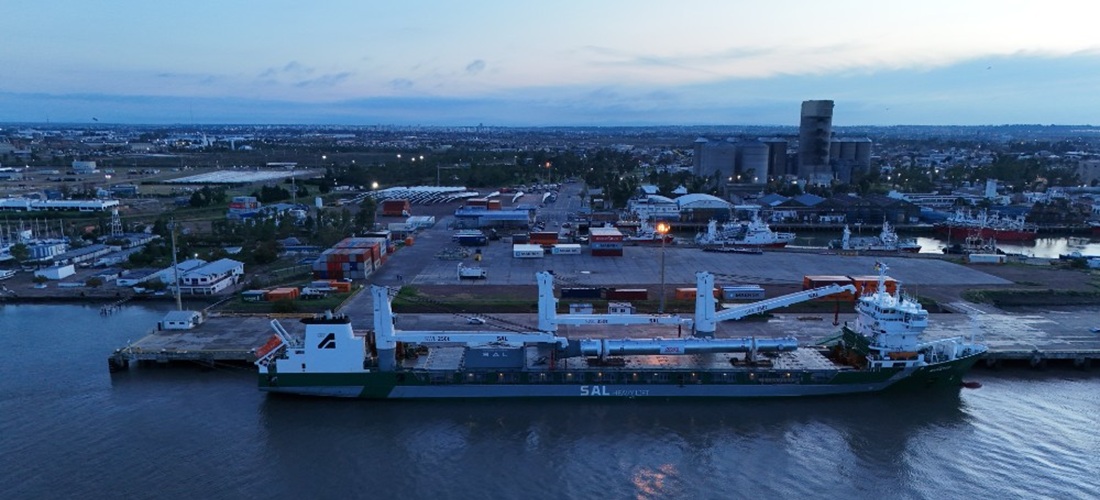
Bahía Blanca Port publishes first joint environmental report with nine companies
Sep, 23, 2026 Posted by Gabriel MalheirosWeek 202639
The Bahía Blanca Port Management Consortium, known as CGPBB, has published its first Port Community Environmental Report, bringing together in a single document the environmental performance of the port authority and nine companies operating within the complex.
The companies are Profertil, Louis Dreyfus Company, Cargill, ADM Agro, Boortmalt, Compañía Mega, Bunge, Terminal Bahía Blanca and Puerto Frío.
The report was prepared with technical support from Fundación Valenciaport under an assistance program that, according to the foundation, began in October 2022.
According to the port authority, the Bahía Blanca Port environmental report is intended to serve as both a management and communication tool, strengthening environmental transparency across the port community. Each company outlines its certifications, monitoring systems and projects under development.
Renewable energy gains ground across terminals
Several companies reported progress in the use of renewable energy.
Profertil sourced 76% of its electricity from renewable sources in 2024 and plans to reach 100% in the short term.
Through its “La Isla” project, which is aimed at reducing consumption per metric ton produced, the fertilizer plant cut water use by 6%, electricity consumption by 24% and natural gas consumption by 10%.
Compañía Mega supplies all of its operations with renewable energy under an agreement with YPF Luz.
Bunge, meanwhile, has incorporated a partial supply of wind power from Pampa Energía and YPF Luz and plans to increase the share progressively.
On a smaller scale, Puerto Frío already operates one warehouse using off-grid photovoltaic power and has replaced six forklifts and pallet trucks with electric equipment.
Its planned projects include a 350-kW grid-connected solar system.
Cargill installed solar panels on its administrative building in October 2024.
Dust and emissions controls
For grain operations, particulate matter is a central concern.
Cargill has operated a dust suppression system for vessel loading since early 2024 and periodically monitors PM10 levels around the perimeter of its facility.
Terminal Bahía Blanca has replaced more than 30 low-efficiency cyclone filters with bag filters and continues to pursue a plan launched in 2016 to reduce its environmental footprint by 10% over 10 years.
The company also exported PCB-containing equipment from the facility for treatment and final disposal.
ISO 14001 environmental management certification is held by several operators within the complex, including Profertil, which obtained it in 2003, as well as Louis Dreyfus Company, ADM Agro, Boortmalt and Compañía Mega.
The port authority itself obtained the certification in 2019.
Monitoring the estuary
The Consortium operates an Environmental Management Plan under Resolution 263/2019 issued by the Buenos Aires provincial Environment Ministry.
The regulation requires continuous water and sediment monitoring to assess estuary quality following dredging works.
The program is complemented by air-quality monitoring across the port area, including continuous noise measurements.
For water monitoring, the port operates three environmental buoys that continuously measure pH, temperature, conductivity, turbidity and dissolved oxygen, with data available for online consultation.
Beyond regulatory requirements, the Consortium also monitors biological communities in the estuary, hydrocarbons in the water and airborne pollen, the latter in partnership with the Instituto de Alergias del Sur.
Projects under development include early-warning hydrocarbon sensors for water, a solar-powered electric vehicle charging point and photovoltaic panels on port warehouse roofs and parking areas.
Environmental goals through 2030
The report establishes six environmental priorities through 2030: emissions reduction, energy transition, sustainable resource management, protection of the natural environment, innovation and digitalization, and engagement with the surrounding community.
The document also serves as the starting point for ECOBAHÍA-PORT, a working group the Consortium plans to establish with companies operating in the port complex and with support from Fundación Valenciaport.
Its areas of work will include circular economy initiatives, joint measurement of the port’s carbon footprint, energy efficiency and climate change adaptation, with the possibility of creating an observatory to monitor progress.
Source: Bahía Blanca Port Management
-
Shipping
Jul, 01, 2020
0
ONE improves online booking system
-
Ports and Terminals
Jan, 10, 2025
0
Governor of Santa Catarina Inspects Long-Awaited Project at São Francisco do Sul Port
-
Other Cargo
Jun, 24, 2026
0
Argentina’s vegetable exports hit 22-year high in first four months
-
Ports and Terminals
Jun, 20, 2025
0
Bill to Restore Decision-Making Power to Port Authority Councils Advances in Brazil’s Lower House