



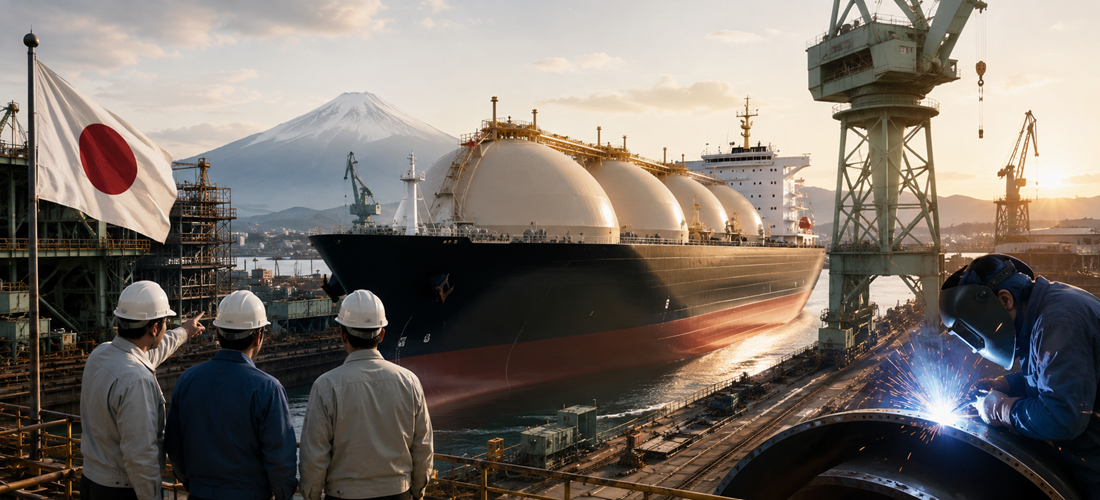
3 Japanese shipbuilders to revive domestic production of LNG carriers
Jun, 15, 2026 Posted by Sylvia SchandertWeek 202625
Three Japanese shipbuilders will jointly resume domestic construction of liquefied natural gas carriers around 2035, aiming to build three to five vessels a year with the possible help of South Korean technologies, Nikkei has learned.
Imabari Shipbuilding, Kawasaki Heavy Industries and Namura Shipbuilding will share expertise and supply skilled welders to revive made-in-Japan LNG carriers, whose construction ceased after the last delivery in 2019.
The leading plan involves using Kawasaki Heavy’s Sakaide shipyard in Kagawa prefecture. Japan will consider offering subsidies to potential buyers to aid the effort.
Resuming domestic construction of LNG carriers will be included in a public-private investment road map to be compiled this month by the Council for Japan’s Growth Strategy. Shipbuilding is one of 17 priority areas listed by Prime Minister Sanae Takaichi’s government, and assisting the revival of LNG carriers will be a pillar in that effort.
Japan relies on imports for 98% of domestically consumed LNG, used as a fuel for power generation as well as city gas supplied to households. Though the carriers are essential for Japan’s imports, low-cost ships by South Korea and China have pushed Japanese builders out of the market.
Other shipbuilders could join the effort. About 100 LNG carriers now operate to supply gas to Japan. Given their lifespan of 20 years, building three to five ships yearly could sustain shipping capacity needed to transport Japanese imports.
But as construction has been suspended for more than five years, Japan lost the supply chain needed to support the industry. The shipbuilders also lack the technology to build spherical LNG tanks, which have become the mainstream.
The partners will consider asking for technological assistance from South Korea, which possesses know-how in spherical tanks. They also will seek cooperation from a French company holding related technology licenses.
South Korea builds roughly 70% of LNG carriers worldwide, with China supplying the rest. As South Korean shipbuilders smarting from a labor shortage worry about technological advances by Chinese players, cooperation with Japan could give them an advantage.
But producing LNG carriers is more complex than building regular ships, and those in the shipbuilding industry say private-sector efforts would not be enough to revive the sector. Japan’s potential subsidies would compensate buyers for the price gap between Japanese ships and cheaper South Korean and Chinese models.
Major Japanese shipbuilders dominated the global LNG carrier market in the 1980s and 1990s. In addition to Imabari and Kawasaki Heavy, Mitsubishi Heavy Industries also built LNG ships.
But their share plunged as government-backed South Korean shipbuilders offered lower prices in the 2000s. Chinese players have made advances as well.
Japan now regards building its own LNG ships as crucial amid rising geopolitical risks that threaten energy shipments.
Source: Nikkei Asia
-
Ports and Terminals
Oct, 25, 2021
0
ANTAQ provides port environmental performance panel on its portal
-
Ports and Terminals
Dec, 11, 2024
0
New organizations join Port of Santos ESG Manifesto initiative
-
Meat
Apr, 23, 2026
0
Uruguay’s meat exports: China loses ground while other markets gain strength in 2026
-
Ports and Terminals
Oct, 30, 2023
0
Port of Antonina signs contract to export 1.4 million tons of sugar