


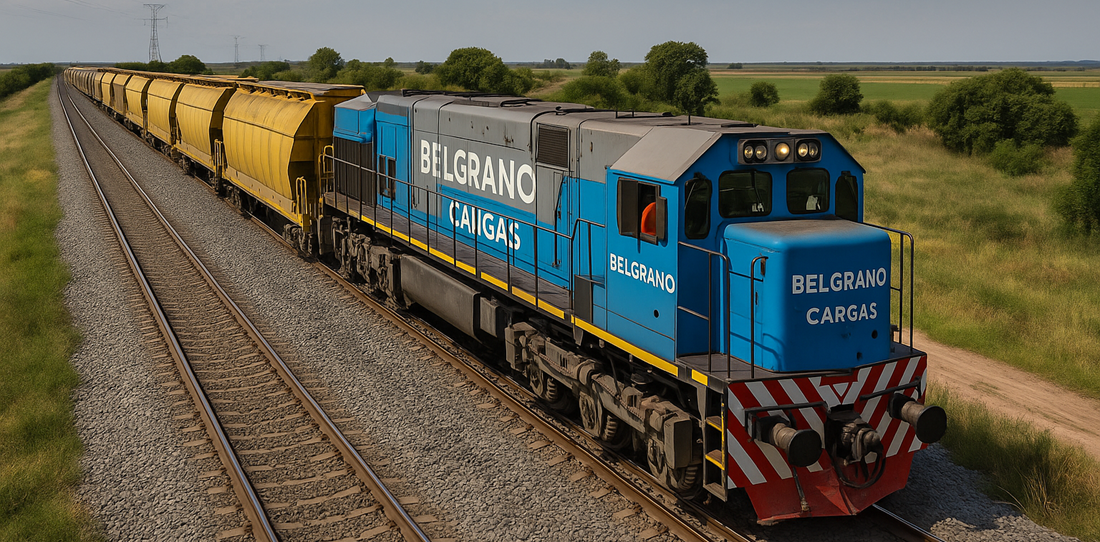
Argentina seeks to boost grain and mineral exports with railway privatization
Dec, 08, 2025 Posted by Lucas LorimerWeek 202550
One of the world’s leading food suppliers, Argentina plans to boost its exports of grains and minerals with the privatization and an ambitious modernization of its old railway network, which, according to industry leaders, will cut freight costs in half for regions far from the ports.
The first tender is for the Belgrano Cargas network, which operates the country’s three largest cargo railway lines. Scheduled to launch early next year, the initiative could expand production of globally traded products, including soybeans, corn, copper, and lithium. It could also support the transportation of sand to Vaca Muerta, the massive shale formation in southwestern Argentina.
The privatization of the network is part of President Javier Milei’s plan to transfer struggling state-owned companies into private hands and attract investment to rebuild depleted reserves after years of economic crisis.
LESS CARGO BY TRAIN
Modernizing the railway system after years of neglect will be a considerable challenge.
“The volume of cargo transported by train today is lower than in 1970, even though agricultural production has increased almost sixfold in the same period,” said Alejandro Núñez, president of the state-owned Belgrano Cargas y Logística, which manages the Belgrano Cargas network.
The network includes three lines that extend over nearly 8,000 kilometers and currently transport around 7.5 million tonnes of cargo per year, 60% of which are agricultural products and derivatives.
Trains often run so slowly on deteriorated tracks that soybean cargoes are easily stolen. Derailments are also common.
Another 11,000 kilometers of lines will be put out to tender. These lines are currently completely out of service.
In Argentina, most cargo is transported by road. Rail freight accounts for only 5% of total cargo transport — a tiny share compared with 20% in Brazil and more than 40% in the United States and Canada.
TRANSPORT COSTS
The government views improving the railways as essential to achieving its goal of increasing total annual exports by US$100 billion in seven years, according to Foreign Affairs Minister Pablo Quirno. Through October this year, Argentina recorded total exports of US$71.5 billion.
Privatization could help by reducing the cost of transporting goods from farms in the north and west of the country to the main port area around Rosario.
Currently, the cost per tonne to transport cargo from the province of Salta to Rosario is higher than the cost to ship it from Rosario to Vietnam, said Gustavo Idígoras, president of the CIARA-CEC grain exporters chamber.
Improving the railways will not come cheaply. Núñez estimated that at least US$800 million would be needed to modernize the infrastructure.
One likely bidder in the tender is Grupo México Transportes (GMXT), which operates Mexico’s most extensive rail network and several freight lines in the United States, according to a source with direct knowledge of the matter, who requested anonymity. Given the scale of the required modernization, GMXT plans to invest US$3 billion if it wins the bid, the source said.
An agricultural consortium comprising Bunge Global, Cargill Inc., Louis Dreyfus Co., Asociación de Cooperativas Argentinas, and Aceitera General Deheza SA has also expressed interest in the tender, as has the Anglo-Australian mining company Rio Tinto, according to local media reports.
Company representatives declined to comment.
EXPANDING THE FRONTIER
According to Alfredo Sesé, technical secretary of the transport committee of the Rosario Stock Exchange, reducing freight costs could help expand agricultural production in the north of the country.
At least half of Argentina’s agricultural production takes place more than 300 kilometers from Rosario. Sesé estimated that transporting one tonne by truck costs between 7 and 9 cents of a dollar per kilometer, while rail transport costs less than 5 cents. The further the farm is, the greater the boost a modern rail system could provide.
Argentina’s mining sector could also benefit. The country is the world’s fourth-largest exporter of lithium and has copper mining projects that could begin production in the coming years.
“The mining industry needs logistics solutions that allow it to supply projects and move output,” said Roberto Cacciola, president of the Argentine Chamber of Mining Companies.
Imagem gerada por Inteligência Artificial
Source: Terra
-
Ports and Terminals
Dec, 18, 2023
0
Port of Itaqui celebrates 1000th ship mark in a single year
-
Jul, 02, 2025
0
Haddad Meets with Mercosur Ministers Amid EU Negotiations
-
Grains
Sep, 14, 2022
0
U.S. railways to halt grain shipments ahead of potential shutdown
-
Ports and Terminals
Sep, 16, 2020
0
SUAPE PORT INAUGURATES NEW ENVIRONMENTAL READINESS CENTER