


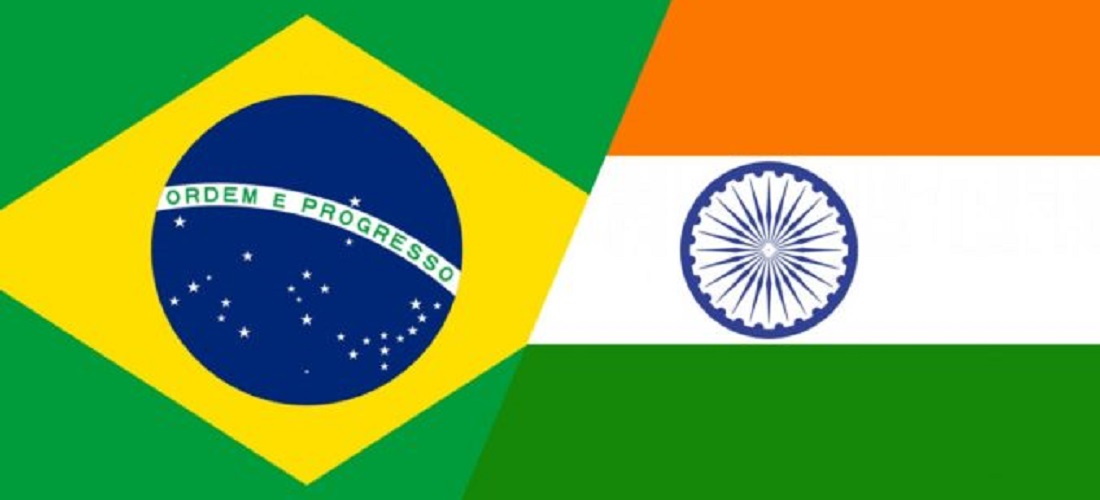
Brazil and India seek closer ties after years of modest engagement
Feb, 18, 2026 Posted by Sylvia SchandertWeek 202608
Brazil and India are two middle powers with much in common in their international agendas, yet their economic ties remain modest given the size of their economies. It is against this backdrop that President Lula arrived in the country on Wednesday (18) for a four-day visit that includes a state visit, participation in an international summit on artificial intelligence and the India-Brazil Business Forum 2026. The forum will be organized by the Brazilian Trade and Investment Promotion Agency (ApexBrasil) in partnership with the Ministry of Development, Industry, Trade and Services and the Ministry of Foreign Affairs.
“This trip comes at a time of profound transformation in the international order, and both countries are highly mobilized diplomatically to increase their strategic autonomy, diversify partners and adapt more broadly to a highly unpredictable global scenario, with the United States being the main source of instability,” said Oliver Stuenkel, senior fellow at the Carnegie Endowment for International Peace in Washington and associate professor of international relations at Fundação Getulio Vargas (FGV) São Paulo.
“Neither country intends to distance itself from the United States, but in both New Delhi and Brasília there is consensus that exposure and vulnerability must be reduced in key areas such as technology, defense and trade.”
India is viewed by the Brazilian government as a key partner in South-South cooperation, one of the pillars of Brazil’s foreign policy. Both countries advocate multilateralism and reform of the United Nations. They work together in forums such as BRICS and the G20.
Political ties between Brazil and India have always been strong, and their alliance was crucial in shaping the early configuration of Brics, said Ambassador José Alfredo Graça Lima, former undersecretary-general for Asia and the Pacific at the Foreign Ministry and now vice president of the Brazilian Center for International Relations (Cebri).
“However, trade between Brazil and India follows a pattern similar to Brazil’s trade with the European Union, for example,” he said. “Indian agriculture is highly regulated, which affects, for instance, imports of Brazilian chicken.” There has also been the beginning of a dispute over sugar.
Data compiled by ApexBrasil show that India applies import tariffs of 30% on whole chicken and 100% on cut or prepared chicken. On sugar and confectionery, tariffs reach as high as 110%.
The agency has prepared seven sectoral projects focused on India, including one aimed at boosting sales of chicken, pork and eggs. The others target cotton, ethanol and derivatives, natural stones, and machinery and equipment. In total, 378 business opportunities have been identified in sectors such as mineral fuels, raw materials transactions, and machinery and transport equipment. Around 300 business leaders are expected to attend the forum, which will be joined by Lula and Indian Prime Minister Narendra Modi.
Brazil and India are in talks to expand the Mercosur-India agreement. Currently, 450 products enjoy preferential tariffs. However, of nearly 5,000 Mercosur Common Nomenclature (NCM) codes exported by Brazil to India, only 110 are included in the list.
The two countries aim to increase bilateral trade to $20 billion by 2030. Last year, merchandise trade totaled $15 billion, up 25.5% from the previous year. “It is the highest figure in the historical series of trade relations between the two countries, but still far below potential, considering the size of the population and the capabilities of both nations,” said Ambassador Susan Kleebank, secretary for Asia and the Pacific at the Foreign Ministry.
India has a population of 1.5 billion and a gross domestic product of $4.18 trillion. It is the world’s fourth-largest economy and on track to become the third-largest. Growth has been sustained at 7% to 8% per year. Demand for food, energy, industrial inputs and sustainability solutions is rising, which explains Brazil’s interest in expanding trade.
According to Datamar data, Brazilian container exports to India totaled 122,319 TEUs in 2025. The following chart shows how this performance compares to previous years:
Container Exports | Brazil – India | Jan 2022 – Dec 2025
Source: DataLiner (click here to request a demo)
Brazil’s top exports to India last year were crude oil, sugars and molasses, vegetable fats and oils, and iron ore. The main imports were chemical compounds, petroleum-based fuel oils, pharmaceuticals and insecticides.
When Modi visited Brasília in July last year, the partnership between the two countries was structured around five pillars: defense and security; food and nutrition security; energy transition and climate change; digital transformation and emerging technologies; and industrial partnerships in four strategic sectors—aerospace, pharmaceuticals, oil and gas, and critical minerals.
Among the agreements to be signed during Lula’s visit is a memorandum of understanding on critical minerals. There will also be a Brazil-India declaration on a digital partnership for the future and an announcement extending business visa validity in both countries from five to ten years. Embraer is expected to formalize cooperation with Indian firm Adani Defence and Aerospace. Health Minister Alexandre Padilha intends to sign production partnerships with Indian companies in pharmaceuticals and smart hospitals.
In addition to attending the business forum, Lula is scheduled to inaugurate ApexBrasil’s local office.
Two days of the president’s agenda are reserved for the international AI summit. Brazil and Japan co-chair a working group on safe and trustworthy artificial intelligence. Brazil is also expected to host an event titled “AI for the Good of All and Brazilian Perspectives for the Future of Artificial Intelligence.”
More than 20 heads of state are expected to attend the summit. A schedule of bilateral meetings was still being finalized last week.
Stuenkel noted that Europe is experiencing “near panic” after having heavily bet on its partnership with the U.S., which it can no longer fully rely on. “In Brazil and India it was never like that,” he said. “There has always been caution about fully embracing the U.S.-led order, and also a perception that the so-called rules and norms promoted in American rhetoric have been applied unevenly.”
This has left both countries better prepared for the current instability in international relations. Ideas now debated in Europe and statements by Canadian Prime Minister Mark Carney about a new order “reflect things that India and Brazil have been doing for a long time,” he said.
Still, relations between Brazil and India remain “incipient.” Brazil has vulnerabilities in technology, digital sovereignty and defense, which helps explain its outreach to India and its recent visit to Vietnam, he added. It is an adaptation to the new environment.
“In this entire debate, Brazil is seen as a very relevant partner by other middle powers, and it may be useful for Brazil to think along those lines as well,” he said. “The European Union, India and Canada see Brazil as a partner with whom they want to do more.”
Lula will stay in New Delhi until February 22. On the next day he will make a state visit to South Korea.
*The reporter’s travel costs were covered by ApexBrasil
Source: Valor International
-
Other Logistics
Jun, 14, 2024
0
Kuehne+Nagel announces new fleet of electric vehicles for last mile operations in Brazil
-
Ports and Terminals
Jan, 04, 2023
0
Santos Brasil enters Brazilian Exchange’s Sustainability Index
-
Coffee
Mar, 05, 2025
0
Coffee prices soar while orange juice tumbles in global markets
-
Grains
Feb, 08, 2024
0
China Takes Lion’s Share of Brazilian Soybean Exports at 75%