



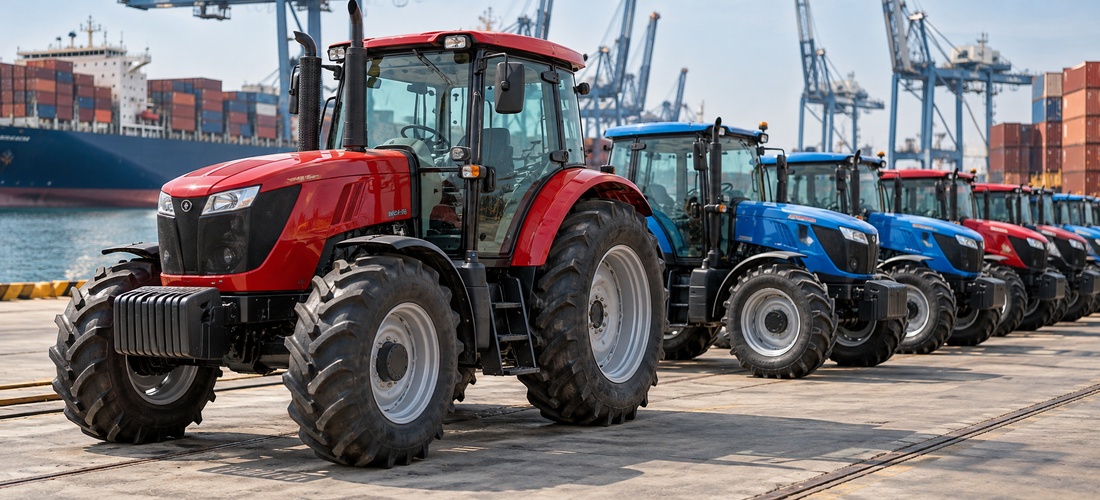
Brazil’s Tractor Imports from China Surge 117% in 2026, Raising Concerns at Anfavea
Oct, 23, 2026 Posted by Gabriel MalheirosWeek 202643
Brazil’s agricultural tractor imports from China surged 117% between January and September 2026, reaching approximately 5,200 units, according to a survey by the Brazilian Automotive Industry Association (Anfavea). The increase contrasts with the contraction in Brazil’s domestic market, where tractor sales fell 14.1% through August.
India has also become a major supplier, shipping a volume comparable to China’s. Together, the two countries accounted for 93% of Brazil’s imported tractors during the period.
Anfavea says the trend raises concerns about competitive conditions and the criteria used in public procurement, particularly regarding maintenance, spare parts availability and technical support throughout the equipment’s service life.
Public Procurement Drives Demand for Imported Tractors
Anfavea’s analysis of data from Brazil’s National Public Procurement Portal (PNCP) shows that 65% of the 3,318 agricultural tractors covered by public tenders in 2025 were imported.
Across agricultural and construction machinery, public tenders involved 10,600 units worth R$3.7 billion that year. Chinese-made equipment accounted for 33.5% of the units and 26% of the total value, or approximately R$960 million.
Other foreign countries combined accounted for less than 1% within this category. The classification is based on the country of manufacture, meaning equipment produced in Brazilian factories is classified as domestically manufactured even when it carries a foreign brand.
Agricultural Machinery Retail Sales Fall 15.8%
Domestic retail sales of agricultural machinery totaled 27,000 units through August, down 15.8% from the same period last year. Combine harvester sales recorded a sharper decline of 39.4%.
In contrast, agricultural machinery imports increased 42% between January and September, reaching 11,200 units. That was more than twice the approximately 5,000 machines exported during the same period.
According to Anfavea, the growth in imported equipment comes as Brazil’s domestic agricultural machinery market has been contracting since 2021.
Tractors of Up to 100 HP Dominate Imports
Lower-horsepower equipment accounts for most foreign purchases. According to the survey, 90% of imported tractors have engines rated at 100 horsepower (HP) or less.
The 50-to-100 HP category accounted for 6,412 imported units, an increase of 56% over the period analyzed.
This shift is taking place amid growing financial pressure on Brazilian farmers. Rising debt, lower profitability and high borrowing costs are making it more difficult to renew equipment fleets and purchase new machinery.
Credit Constraints and Industrial Costs Put Pressure on the Sector
Central Bank data compiled by Anfavea shows that the delinquency rate on rural credit extended to individuals reached 9.7% in August. Financial constraints, combined with declining commodity prices, are reducing farmers’ willingness to make new investments.
Meanwhile, manufacturers operating in Brazil are reporting higher production costs. Among the factors cited are the 20% import tariff on resins and polymers and antidumping measures applied to certain products.
According to estimates from Anfavea member companies, these measures could increase the cost of plastic components used in agricultural machinery by between 4% and 7%.
The situation differs in the construction and road-building equipment segment. Real estate developments and infrastructure investment have supported demand for excavators, motor graders and wheel loaders.
Anfavea Calls for Life-Cycle Cost Assessments
According to Anfavea President Igor Calvet, purchase prices should be assessed alongside operating costs and conditions throughout the equipment’s service life.
Calvet emphasizes that keeping machinery operational depends on spare parts availability, maintenance, technical assistance and the capacity to provide ongoing support. He therefore argues that public tenders should consider the total cost of ownership rather than focusing exclusively on the initial purchase price.
Anfavea maintains that the entry of new brands and technologies into the Brazilian market should be subject to comparable requirements for quality, safety, technical support and product responsibility, ensuring more balanced competitive conditions between domestic manufacturers and importers.
Source: Portal do Agronegócio
-
Ports and Terminals
Sep, 30, 2025
0
Paranaguá Port holds first simulation of rescue in ship’s hold
-
Other Cargo
Jun, 13, 2024
0
Brazilian dairy producers call for stricter measures to curb imports
-
Trade Regulations
Sep, 18, 2024
0
Brazil Signs Agreements to Boost Agribusiness Exports by R$ 185 Billion
-
Ports and Terminals
Oct, 03, 2022
0
Rio de Janeiro ports see 40M tonnes cargo throughput YTD