


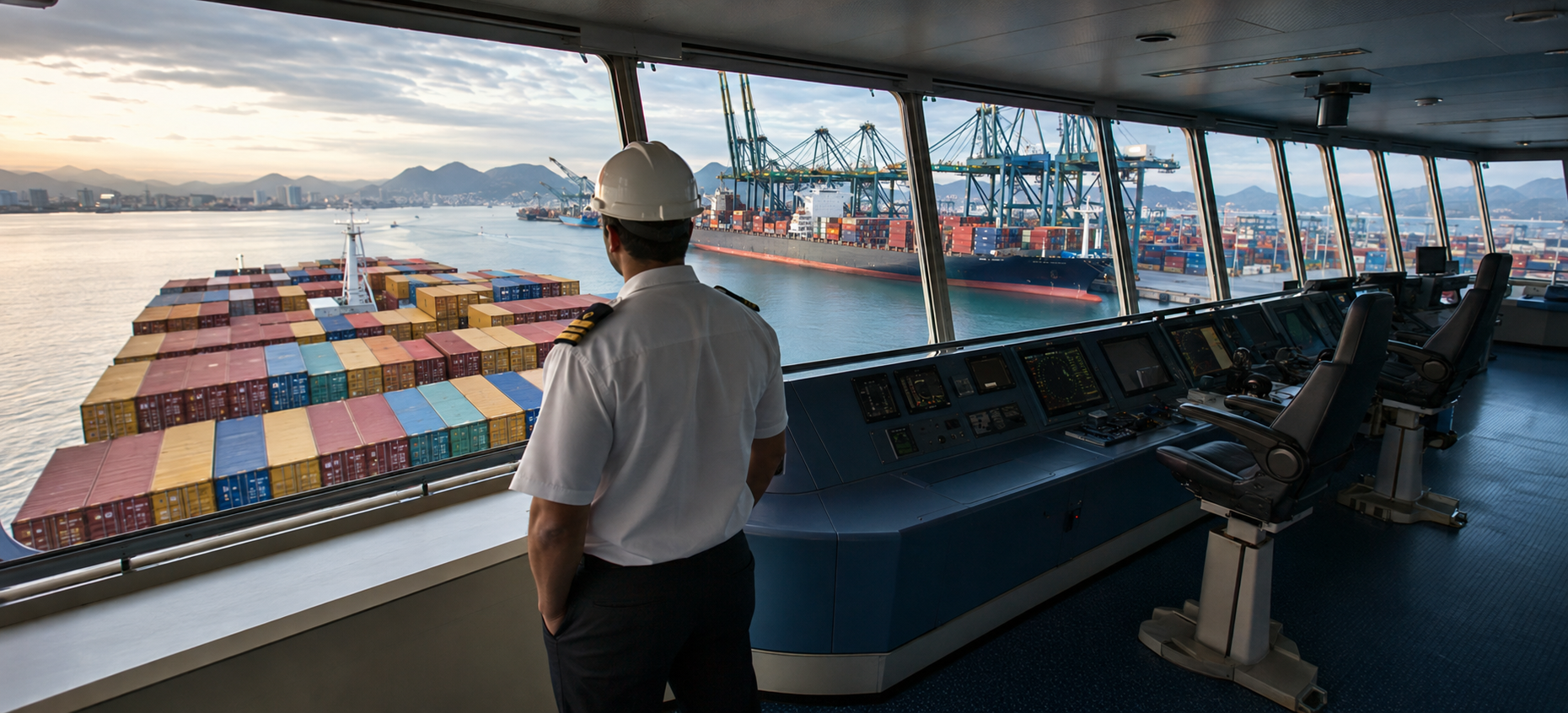
Brazil’s merchant marine could face shortage of 500 officers by 2030
Aug, 03, 2026 Posted by Gabriel MalheirosWeek 202632
Brazil’s merchant marine could face a shortage of roughly 500 officers by 2030, equivalent in practical terms to leaving about 30 cargo vessels without crews.
The projection comes from a study by the Center for Innovation in Logistics and Port Infrastructure, or Cilip, at the University of São Paulo, conducted in partnership with Fundação Vanzolini. The 2024 study is updated every six months, with the latest revision released in June.
The survey was commissioned by the Brazilian Association of Cabotage Shipowners, known as Abac; the National Union of Maritime Navigation Companies, Syndarma; and the Brazilian Association of Offshore Support Companies, Abeam.
The latest update confirms a scenario already identified in the first edition of the study, published in April 2024. Although more openings at training schools have reduced part of the initial projected shortage of maritime workers, the supply of new officers is still not expected to meet rising demand.
One of the clearest signs of the imbalance, according to the study, is the increase in unfilled positions and the hiring of foreign professionals.
The number of foreign officers employed, combined with vacant positions, rose from 376 in the second half of 2025 to 458 in the most recent update. The figures point to the difficulty shipping companies face in finding qualified labor in Brazil.
Researchers said the balance between supply and demand will depend on the growth of cabotage, offshore support, oil and gas operations and offshore wind projects. Even without factoring in the new offshore wind market, the study still projects a shortage of around 500 officers by the end of the decade.
To reverse the trend, the study recommends expanding openings in adaptation courses for second engineering officers and deck officers, which are considered the fastest way to increase the supply of professionals over the medium term.
It also recommends maintaining continuous officer training at Brazil’s Merchant Marine Officer Training Schools, known as Efomm, using all available capacity regardless of economic cycles.
According to the researchers, cutting student intake during periods of weaker activity undermines companies’ planning and contributes to new cycles of labor shortages, affecting the competitiveness of Brazilian shipping.
Cabotage sector on alert
The shortage of merchant marine professionals, especially engineering officers, is already putting pressure on cabotage operations and could hinder the expansion of Brazil’s fleet, said Luís Fernando Resano, executive director of Abac.
Resano said the Cilip study made it possible to measure the labor shortage in the sector more precisely. The largest gap, he said, is in a role that is critical to vessel operations.
“Merchant marine officers are in short supply, especially engineering officers. This shortage has been building for several years, and its main cause is the restriction of resources from the Maritime Professional Education Development Fund, or FDEPM, which limits the Navy’s ability to expand the number of openings in training courses,” he said.
Cabotage growth lifts demand
According to Resano, the expansion of cabotage following Law No. 14,301/2022, known as BR do Mar, increased the need for qualified professionals.
Because the training of new officers did not keep pace with demand, companies adopted emergency measures to keep operations running.
“As the training of new officers failed to match this demand, companies adopted emergency solutions to maintain operations, such as paying double wages to officers who agreed to work during their rest periods,” he said.
Resano said the strategy helped avoid transport interruptions but increased shipowners’ costs.
“In this way, cabotage was able to serve the market without disruption, but with a significant increase in operating costs,” he said.
The Cilip study indicates that permanently increasing the number of openings at Navy training schools, as well as resuming and expanding adaptation courses, would help reduce the deficit.
“There is strong interest in maritime careers, both in Brazil and abroad. The main challenge today is not attracting candidates, but expanding training capacity,” Resano said.
In the meantime, Abac member companies have begun investing directly in the training of new professionals through a partnership with Fundação de Estudos do Mar, or Femar.
“Member companies will fully cover the training costs of their employees,” Resano said.
He stressed that Brazil’s Maritime Authority plays a fundamental role in training merchant marine professionals, maintaining schools and courses at different levels of maritime professional education.
“Initiatives that increase the number of openings, strengthen funding for maritime professional education and encourage partnerships with accredited institutions are important paths to meeting the sector’s growing demand,” he said.
Navy says training slots are increasing
The Brazilian Navy, when contacted, said it has been gradually increasing the number of places offered in officer training and adaptation courses, in line with identified needs and training capacity.
The Navy said this increase can be seen in recent years.
“In 2024, 333 openings were offered in officer training and adaptation courses. In 2025, that number increased to 374, and in 2026 it reached 389, demonstrating the Brazilian Navy’s continued effort to expand professional training capacity,” it said.
Source: A Tribuna
-
Ports and Terminals
Jan, 16, 2026
0
Brazil delays Santos STS10 port terminal auction again amid regulatory debate
-
Economy
May, 05, 2022
0
Brazilian trade balance had a US$ 8.1 billion surplus in April
-
Other Cargo
Nov, 04, 2025
0
China’s export controls drive up global fertilizer prices
-
Ports and Terminals
Feb, 25, 2026
0
Port of Suape Records 38.6% Increase in Cargo Throughput Compared to the First Month of the Previous Year