

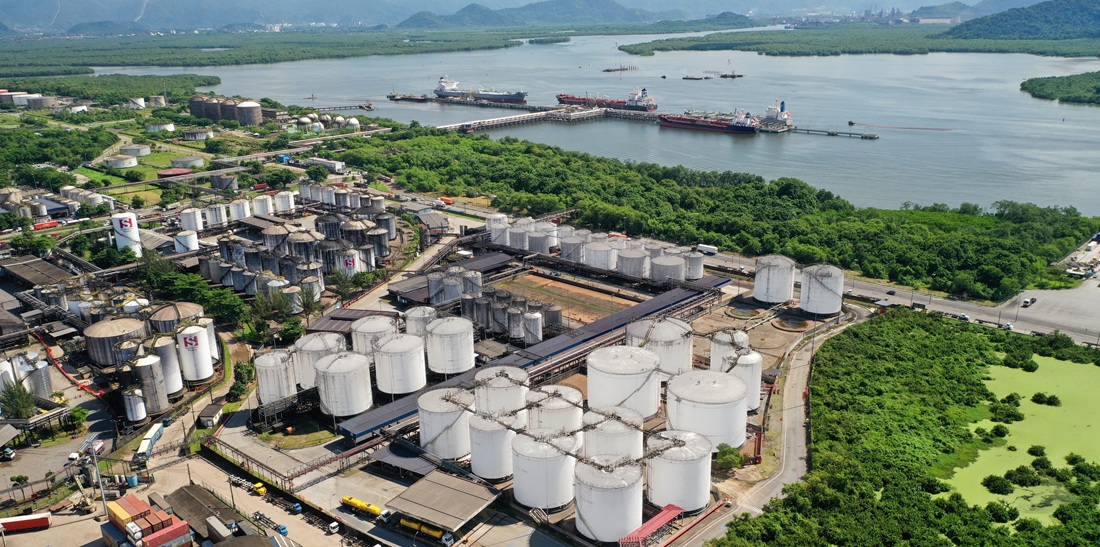
Consortium Invests in New Berths to Expand Liquid Bulk Handling at the Port of Santos
Oct, 15, 2026 Posted by Gabriel MalheirosWeek 202642
A consortium formed by Ultracargo, Stolthaven Terminals, Granel Química and Vopak has signed an agreement with the Santos Port Authority (APS) to build two new public berths in the Alemoa area, on the northwestern side of the Port of Santos. With construction expected to begin in 2027, the project aims to increase the efficiency and operational capacity of infrastructure dedicated to liquid bulk handling at the Port of Santos, Latin America’s largest port.
The new berths will expand mooring options at the complex and create conditions for vessels of up to 70,000 deadweight tonnes (DWT) to call. The project is expected to enable larger-scale operations, improve logistics predictability and strengthen the competitiveness of fuel and chemical handling through the Port of Santos.
The planned deepening of the channel to 14 meters will be essential to accommodate larger and more heavily loaded vessels, with capacity around 17% above the current limit. In practice, the additional scale could reduce the need to split cargoes across multiple voyages, increase the tonnage handled per port call and make maritime transportation of these products more efficient.
The new infrastructure is also expected to optimize the use of landside assets. With more berthing options and larger vessels, operations could become faster, improving tank turnover and increasing productivity across the Alemoa complex.
Combined, the gains expected from the project should add approximately 3 million tonnes per year to liquid bulk throughput in the area. The development is intended to prepare the Port of Santos for future demand growth and strengthen its role in strategic supply chains for the Brazilian economy.
Liquid Bulk Handling at the Port of Santos to Gain Capacity and Predictability
Among the expected benefits is a reduction in vessel waiting times. During periods of stronger demand, ships can currently spend several days waiting for berth availability in Alemoa. The infrastructure expansion is expected to provide greater operational flexibility and predictability for companies that rely on the complex to handle fuels and chemicals.
“We are talking about an investment in infrastructure that is strategic for the country. The Port of Santos occupies a central position in Brazilian logistics, and initiatives like this help prepare the port complex for future demand by increasing efficiency, safety and competitiveness,” the consortium said.
The project also involves technical challenges associated with carrying out major construction work within a fully operational port complex. Construction will take place while existing operations continue, requiring planning and coordination to preserve safety and operational continuity in Alemoa.
Another challenge will be the availability of dredging equipment, given the number of port infrastructure projects currently under development in Brazil.
For the four companies, the investment is part of the broader evolution of Brazil’s logistics infrastructure. Growth and changes in supply chains require ports that are increasingly prepared to operate at greater scale and with higher levels of efficiency and integration.
“Port infrastructure needs to evolve ahead of demand, creating the conditions to keep pace with economic development and customers’ future needs. Projects like this strengthen Santos and help improve the country’s logistics efficiency,” the companies said.
The consortium is currently discussing the project’s engineering specifications and overall schedule. The new berths are expected to strengthen Alemoa’s position as one of Latin America’s leading liquid bulk hubs while helping increase the competitiveness of Brazil’s port infrastructure.
Sources: Ultracargo, Stolthaven Terminals, Granel Química and Vopak
-
Meat
Feb, 03, 2023
0
Beef: Uruguay exports fall 39% in january, compared to 2021
-
May, 05, 2023
0
Corn cancellations exceed sales by 315,600 t, says USD
-
Ports and Terminals
Dec, 20, 2019
0
Port of Santos releases 2019 balance sheet and prospects for 2020
-
Grains
Jul, 15, 2026
0
Iran becomes Brazil’s largest export market in the Gulf