


Eight Chinese automakers commit to manufacturing in Brazil
Jun, 26, 2026 Posted by Sylvia SchandertWeek 202626
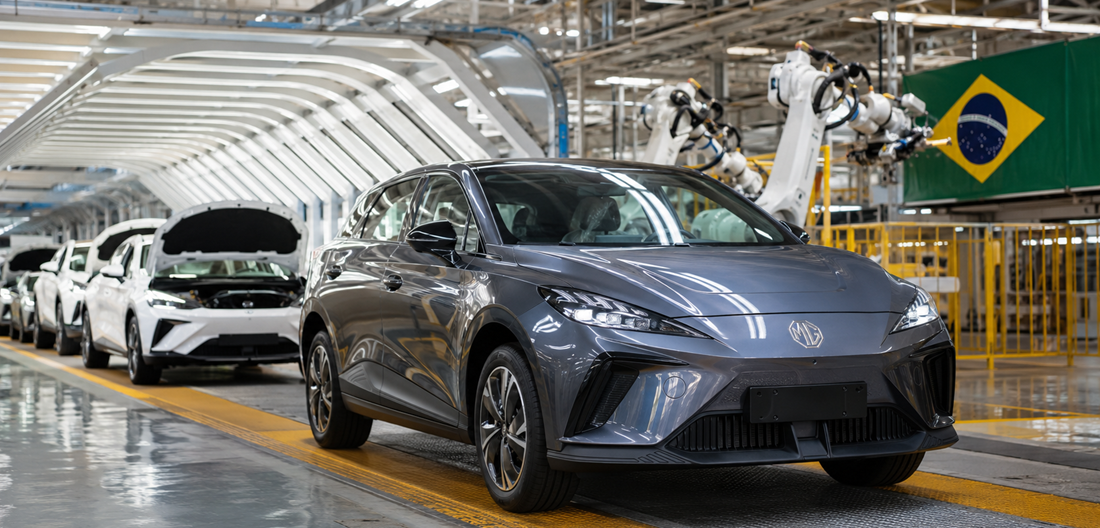
Eight Chinese automakers have now confirmed manufacturing operations in Brazil. On Thursday (25), MG, a brand owned by China’s SAIC Group, announced it will begin assembling two electric vehicle models in Brazil by year-end. Although the investment decision had been made earlier, MG will benefit from the Brazilian government’s recent six-month extension of duty-free import quotas for semi-knocked-down(SKD) vehicles, as its local assembly operation will use that system. The tax incentive was approved by Brazil’s Foreign Trade Chamber (Camex) on Tuesday (23).
MG vehicles will be assembled at a plant owned by Brazilian trading company Comexport in Horizonte, in the northeastern state of Ceará. The facility has also been assembling General Motors EVs shipped semi-knocked down from China since December under GM’s partnership with SAIC.
Chinese automakers are expanding their manufacturing footprint in Brazil through three different models. BYD, which successfully lobbied for the extension of the tax exemption on SKD imports, and GWM have opted to build their own factories—BYD in Camaçari, Bahia, and GWM in Iracemápolis, São Paulo.
Geely, Leapmotor, and GAC have chosen partnerships that allow them to use existing facilities operated by Renault, Stellantis, and HPE Mitsubishi, respectively. Geely is scheduled to begin production later this year at Renault’s plant in São José dos Pinhais, Paraná. Under Stellantis’ global partnership with Leapmotor, production is expected to start at the automaker’s Goiana plant in Pernambuco. GAC, meanwhile, will manufacture vehicles in Catalão, Goiás, where Brazilian group HPE already assembles Mitsubishi vehicles under license.
In addition, Chery vehicles have been produced at Brazilian automaker CAOA’s plant in Anápolis, Goiás, since 2017. Earlier this year, the same facility also began assembling luxury vehicles under the Changan brand.
MG has now chosen a different route, relying on Comexport’s contract manufacturing services. Comexport aims to become a multi-brand vehicle assembler.
Another Chinese automaker, Omoda & Jaecoo, is also expected to reach an agreement to use Jaguar Land Rover’s plant in Itatiaia, Rio de Janeiro, although neither party has confirmed the negotiations.
Founded in the UK more than a century ago, MG came under Chinese ownership in 2007. The company announced an initial investment of R$60 million to prepare the assembly line in Horizonte. According to MG, the operation will initially create 600 direct and indirect jobs and produce two models. One is the MG4 Urban, a compact hatchback that has not yet been launched in Brazil and whose pricing has not been disclosed.
The other is the MGS5, an SUV already imported and sold in Brazil for between R$220,000 and R$240,000, depending on the version. Both models assembled in Ceará will be fully electric.
MG announced local production just seven months after entering the Brazilian market. According to Thiago Marques, MG Motor Brazil’s chief marketing and product officer, the rapid growth of vehicle electrification in Brazil accelerated the company’s decision to manufacture locally.
He said MG had planned local production from the outset. “But that strategy gained momentum. Brazil is a 2.5 million-vehicle-a-year market, and it’s hard to find an automaker that doesn’t want to be here,” he said.
The executive said operations in Ceará will initially use the SKD system, and the company plans to apply for the import quotas exempt from import duties. “But we have other plans in motion.”
Those plans include developing flex-fuel hybrid vehicles capable of running on ethanol. “We entered Brazil intending to manufacture fully electric vehicles. But we realized that flex-fuel hybrids are what consumers are asking for,” Marques said after the production announcement ceremony at the Ceará government headquarters in Fortaleza.
According to MG, commitments under its agreement with Comexport include joint investments totaling R$340 million over the coming years in innovation, technological development, and workforce training.
Sales of hybrid and electric passenger cars and light commercial vehicles more than doubled in the first five months of the year, reaching 190,400 registrations, up 105.4% from the same period in 2025, according to the Brazilian Electric Vehicle Association (ABVE). Electrified vehicles now account for 17.3% of the Brazilian market.
Source: Valor International
-
Ports and Terminals
Jul, 28, 2022
0
Freight to Asia diverts attention from container charges in Brazil’s northeast
-
Ports and Terminals
Oct, 17, 2025
0
Cargo movement at the Port of São Francisco rises in September and year to date in 2025
-
Meat
Sep, 16, 2021
0
Another four countries suspend Brazil’s beef exports due to mad cow disease
-
Coffee
Nov, 04, 2024
0
Coffee sector turns to tech to meet anti-deforestation law