


Espirito Santo seeks to attract new cargoes and business
Apr, 20, 2026 Posted by Gabriel MalheirosWeek 202615
Planned investments in the ports of Espirito Santo could reshape the profile of cargo moving through the state, specialists say. Over the next five years, port terminals in Espirito Santo are expected to receive 6.5 billion reais in investment, according to the state industry federation, Findes. When connected transport modes are included, the projected amount is even higher. It is precisely this modal integration that underpins hopes for greater cargo diversification and the attraction of new business.
One of the main projects under way is Parklog, a logistics park in Aracruz, in the northern part of the state, that will integrate ports, airfields, railways, highways, back areas and Brazil’s first private Export Processing Zone. The development, a public-private partnership between the state government and several companies, involves 12.3 billion reais in investment.
One of the participants, Vports, the concessionaire for the ports of Vitória, Vila Velha and Barra do Riacho, is developing a 522,000-square-meter multipurpose terminal. The company is also making improvements at the port of Vitória that have enabled it to receive Panamax vessels and, in Vila Velha, has earmarked 35 million reais to expand the container area by 70,000 square meters, or 60% of the current total.
The Vila Velha terminal also benefited from another investment: the restoration of the internal railway connecting the port to the Centro-Atlântica Railway and the Vitória-Minas Railway, which is expected to boost cargo flows. “It will open the way for a new logistics route between the Center-West, especially Goiás, the Triângulo Mineiro region and Espirito Santo,” said Vports President Gustavo Serrão.
Since taking over the concession for the state’s ports in 2022, Vports has invested about 600 million reais. Together with partners, the funds were used to modernize infrastructure and acquire new equipment. The results have already begun to appear. The Vitória Port Complex handled 8.4 million tonnes last year, up 15% from the previous year. Growth was recorded in its main cargo segments, including coffee, granite, cars and containers.
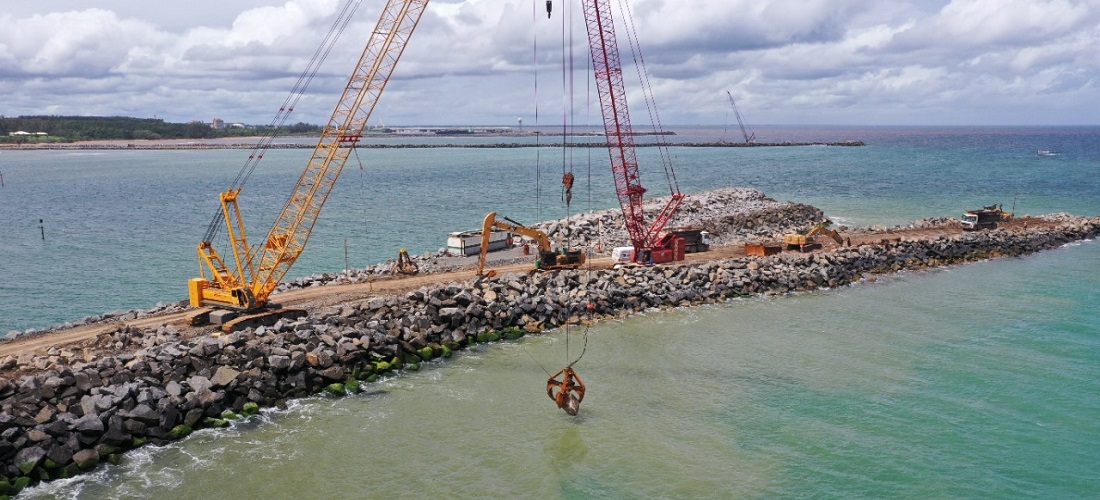
Also under construction in the Parklog area is Imetame’s port, which is expected to begin operating next year with 2 billion reais in investment. The priority will be general cargo, with container operations to be introduced gradually, while the terminal is also expected to serve as an alternative outlet for oil production. “Especially for the onshore fields in northern Espirito Santo, which lack adequate options. It will also serve the Espirito Santo and Campos basins,” said Anderson Carvalho, operations director at Imetame Logística Porto.
With a total area of more than 1 million square meters and a multipurpose profile, the port will be able to handle large vessels and include a railway branch of about 6.5 kilometers. That short rail line will connect to the Vitória-Minas Railway and, from Belo Horizonte onward, to the Centro-Atlântica Railway, favoring the movement of large volumes such as grains and minerals.
For Paulo Baraona, president of Findes, the investments under way could change the profile of the state’s ports. “We are facing an opportunity to transform port operations, shifting from feeder ports, with limited draft and unable to receive large vessels, into hubs and ports with greater capacity to handle long-haul ships,” he said.
Another factor that could support this shift is the construction of the Southeast Rail Ring, a rail line planned to run from Nova Iguaçu in Rio de Janeiro state to Santa Leopoldina in Espirito Santo, linking the ports of Rio de Janeiro and Espirito Santo to the Vitória-Minas Railway and the Southeast rail network. “[The ports] can move from being mineral hubs to diversified ports, with the inclusion of grains and containers,” said Gustavo Gusmão, a partner at EY-Parthenon for government and infrastructure.
This transition, Baraona said, should reduce logistics costs, expand the number of routes and shorten transit times between origin and destination. “These are factors that make products from Espirito Santo more competitive,” he said. The new infrastructure, he added, also has the potential to attract additional investors.
Source: text by Simone Goldberg for Valor Econômico
-
Grains
Jun, 20, 2023
0
Brazil needs to increase rice, beans output to avoid imports
-
Meat
Feb, 08, 2023
0
Chicken: Uruguay negotiates entry of products in China
-
Tank and Reefer
Apr, 22, 2019
0
DataLiner Tank and Reefer Exports | January 2011 to February 2019
-
Ports and Terminals
Sep, 29, 2023
0
Bahia ports achieve 0.32% increase in August following general trend