


EU unlikely to resume Brazilian beef imports for at least two years, industry official says
Aug, 04, 2026 Posted by Gabriel MalheirosWeek 202632
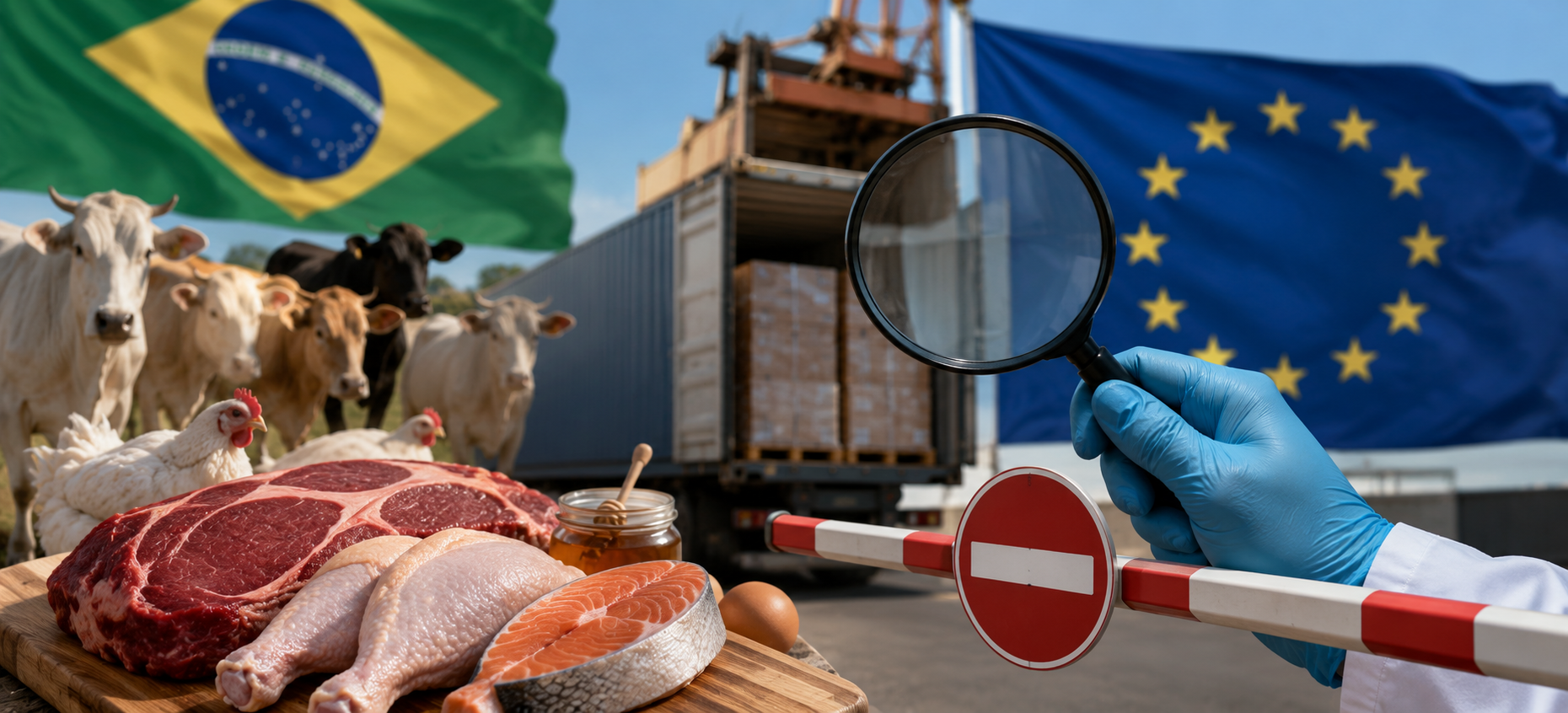
The European Union’s ban on some Brazilian animal-origin products is set to take effect in one month, with no agreement yet in place to reverse the measure.
The decision was announced in May after the EU removed Brazil from the list of countries considered compliant with its rules on the use of antimicrobials in livestock production. No irregularities were found in Brazilian meat, but the European Union considers Brazil’s controls over the use of these substances insufficient.
“Europe says it will not resume buying Brazilian beef for at least two years,” said cattle producer André Bartocci, who chairs the Beef Sector Chamber, an advisory body linked to Brazil’s Ministry of Agriculture.
Bartocci said he received the information during a meeting with ministry officials two weeks ago. He explained that the two-year period is tied to the cattle production cycle. The understanding is that if an animal begins following new antimicrobial protocols today, it would take around 24 months for it to be ready under the new standards.
The European Commission’s animal health and welfare office did not mention a two-year timeline in a response to g1, but confirmed that the resumption of exports “will depend on the animals’ production cycles.” Brazil’s Ministry of Agriculture did not respond to requests for an interview.
In the first half of 2026, Brazilian beef exports to EU countries rose 15.9% from the previous year. That upward trajectory could be sharply disrupted by the bloc’s new trade barriers.
Beef Exports | H1 | 2022-2026 | TEUs
Source: DataLiner (click here to request a demo)
For poultry, the production cycle is much shorter, as chickens typically take around 45 days from birth to slaughter.
At a press conference on Tuesday, July 28, Ricardo Santin, president of the Brazilian Animal Protein Association, or ABPA, said an EU mission is expected to visit Brazil in late August to review new protocols created by the Brazilian government to meet the bloc’s requirements.
According to Santin, the main change is that the government will increase inspections at feed mills, farms and meatpacking plants. These inspections are already provided for under Brazil’s National Plan for the Control of Residues and Contaminants, known as PNCRC.
“We will continue doing what we have always done. We do not use growth promoters for the European Union or antibiotics used in human medicine. Brazilian companies are not doing anything differently from what they have always done. We have always kept production segregated,” Santin said.
Bartocci, who owns a farm in Mato Grosso do Sul, said he has not used antimicrobials in his herd for many years because he exports under the Hilton Quota, a reduced-tariff quota for high-quality beef that prohibits the use of those substances throughout the animal’s life.
“Those who export under the Hilton Quota have not used antimicrobials for a long time,” Bartocci said. “But most of the beef shipped to Europe is not Hilton beef. It is exported under the Trace list, a category in which producers only need to prove that antimicrobials were not used in the final 100 days of the animal’s life. Now that will change. The entire cycle will need to be documented.”
Santin said he hopes Brazilian poultry exports to the EU can resume as early as September, after the EU visit in late August.
However, the reports produced during that mission will still need to be reviewed by a European Commission body known as SCoPAFF, the Standing Committee on Plants, Animals, Food and Feed, which is next scheduled to meet in November.
If the ban is not reversed or is extended, Santin said Brazil will be able to redirect poultry production originally bound for Europe to the domestic market and to the roughly 150 countries that import Brazilian poultry.
“We went four months last year without selling to the European Union because of avian influenza,” he said. “The difficult thing would be if we were shut out of the Middle East.”
Brazil adopts measures, but EU keeps ban in place
Before the EU announced the ban, Brazil’s Ministry of Agriculture issued an ordinance prohibiting the use of certain antimicrobials, including avoparcin, virginiamycin and bacitracin.
In May, the Brazilian government proposed a transition period to the EU, but the bloc rejected the proposal.
In June, the ministry also created a new protocol to control the use of antimicrobials in livestock production. So far, however, the European Union has not reversed its decision.
Representatives of Brazilian agribusiness have described the measure as protectionist, noting that it was announced days after the free trade agreement between the EU and Mercosur began to take effect.
The treaty faced strong opposition from European farmers, who fear competition from cheaper South American products, particularly from Brazil, Mercosur’s main agricultural exporter to the European Union.
The bloc’s other members — Argentina, Paraguay and Uruguay — remain authorized to export to the European market.
Honey exports were growing before EU veto
Although honey is not among Brazil’s major exports to the European Union, sales to the bloc had been growing because of the tariff increase imposed by Donald Trump, said Renato Azevedo, president of the Brazilian Association of Honey Exporters, or Abemel.
As exports to the United States became more expensive because of the surcharge, producers redirected part of their honey to Europe. As a result, exports to the bloc doubled in the first half of the year to $6.3 million, Azevedo said.
“The EU veto ended up being a cold shower for exporters, who were already seeing results from their efforts to expand the market,” Azevedo said.
“In the specific case of honey, we do not see a risk that these controls will find contamination problems. Most Brazilian honey exported is organic and already has a certification chain designed to guarantee a product free of residues and antibiotics,” he said.
According to Azevedo, the main risk for the sector is cross-contamination.
“If there is a hive near a cattle-raising area, for example, there is a possibility that residues could reach the honey. That is why controls are important to avoid this type of contamination,” he said.
Source: G1
-
Ports and Terminals
Dec, 31, 2019
0
Port of Itajai registers consistent growth in vehicle carriers
-
Other Cargo
Oct, 08, 2025
0
Fuel shipments from Rio Grande do Norte reach R$ 1.73 billion
-
Grains
Mar, 25, 2020
0
US soy exports to China increase six-fold in first two months
-
Trade Regulations
Mar, 04, 2022
0
Russia cites ‘sabotage’ and suggests halting fertilizer shipments