


Federal Court of Accounts blocks R$2.6bn for Santos-Guarujá tunnel
Mar, 19, 2026 Posted by Sylvia SchandertWeek 202612
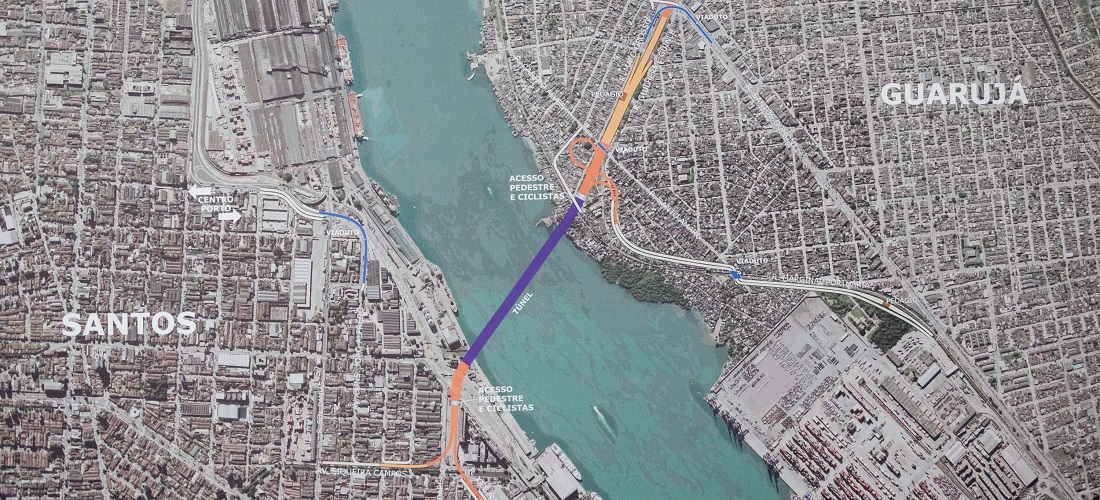
Brazil’s Federal Court of Accounts has unanimously barred the Santos Port Authority, known as APS, from making a R$2.6 billion contribution to the construction of the Santos-Guarujá tunnel before the court conducts a prior review.
Under the ruling, APS will have 30 days to present a formal instrument governing the oversight of the federal contribution to the public-private partnership project for the Santos-Guarujá tunnel, which will be one of the country’s largest infrastructure projects, aimed at linking the two cities on the coast of São Paulo state.
There had been expectations that the transfer would be made as early as this month to move the project forward.
In his opinion, reporting Justice Bruno Dantas said the heart of the dispute lies in what he described as an “apparent institutional resistance” by the state of São Paulo and the São Paulo state transport agency, Artesp, to give APS “an appropriate legal position, in the understanding of the port authority, with respect to the concession project.”
Governance dispute
The project is to be funded by both the state government and the federal government. Those disagreements, Dantas said, have prevented the project’s governance structure from being formalized.
“The establishment of some suitable legal instrument between the state of São Paulo and APS to regulate federal financial participation would serve precisely to provide transparency, legal certainty and minimum prerogatives to the entity contributing 50% of the public counterpart,” he wrote in his opinion.
“The context of an imminent disbursement without the prior establishment of governance instruments requires this Court to adopt precautionary measures,” the justice wrote.
“Despite the peculiar intergovernmental structure established for this project, protecting federal assets and ensuring transparency in the use of large federal resources is not merely an option for this Court, but an unavoidable duty, especially in complex and relatively unprecedented arrangements, in which segregation of functions and public governance must be preserved,” he added.
Source: Valor International
-
Meat
May, 15, 2020
0
Brazilian agribuisness exports break records in first four months of 2020
-
Ports and Terminals
Feb, 08, 2021
0
Ports of Paraná trade balance registers USS $ 6.52 bn surplus in 2020
-
Steel and Aluminium
Jun, 18, 2021
0
Construction sector asks Guedes to reduce steel import tariff
-
Grains
Dec, 14, 2021
0
China buys nearly 60 million tons of soybeans from Brazil in 2021