


Four groups target Brazil’s Southeast Rail Belt concession
Jun, 22, 2026 Posted by Sylvia SchandertWeek 202626
Brazil’s Ministry of Transport plans to publish this month the bidding documents for the Southeast Rail Belt concession, linking the states of Rio de Janeiro and Espírito Santo. According to a source familiar with the matter, at least four groups have expressed interest in the project so far. They include Spain’s Acciona, China’s PowerChina, and a consortium formed by asset managers 4UM (formerly J. Malucelli) and Opportunity.
Asked for comment, Acciona said in a statement that it is “constantly evaluating opportunities in the infrastructure sector that align with its business strategy and objective of generating a positive impact on society.” PowerChina, 4UM, and Opportunity did not respond to requests for comment.
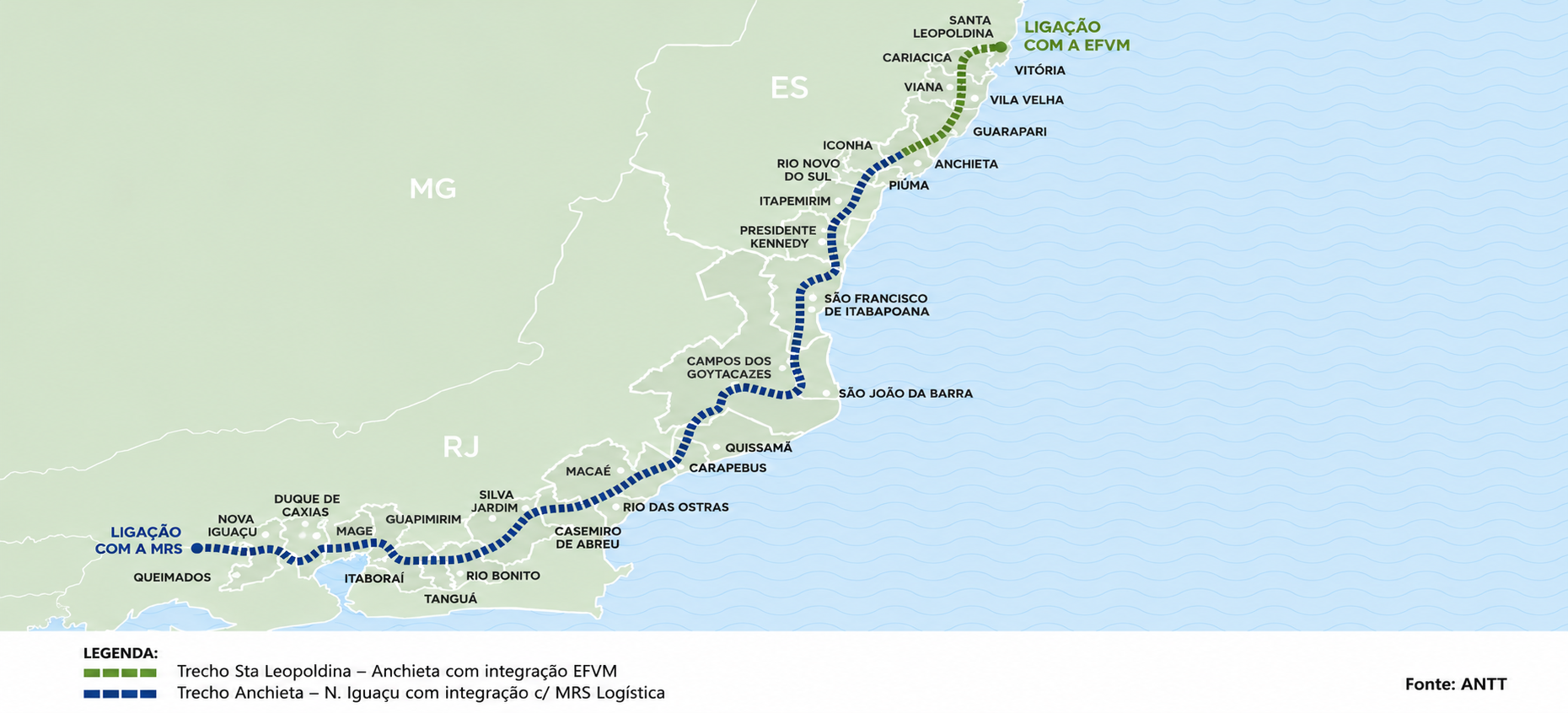
The auction for the EF-118 railway, scheduled for October, is expected to include a corridor connecting Santa Leopoldina, near Vitória (Espírito Santo), to São João da Barra in Rio de Janeiro state, with the possibility of an extension to Nova Iguaçu, also in Rio de Janeiro state. The project calls for approximately R$4 billion in investments, almost entirely funded by the federal government.
The funding required for the investments has already been secured. The resources stem from agreements signed by the Ministry of Transport with rail operators Rumo and MRS as part of renegotiations of amendments to their existing rail concession contracts.
The project is currently under review by Brazil’s public spending watchdog, the Federal Court of Accounts (TCU). According to Transport Minister George Santoro, the main challenge holding up the review is the escrow-account model, which involves using resources from rail concession renegotiations as cross-investments within the rail sector itself. “This project will serve as the benchmark, which is why it is taking longer,” he said.
The federal government is racing to advance several rail projects before the end of the current administration this year. In addition to the Southeast Rail Belt auction—the most advanced of the projects under development—the government also plans to launch in June a public call for proposals for the Minas-Rio Corridor. The objective is to offer the market railway stretches between Arcos, in Minas Gerais state, and Barra Mansa, in Rio de Janeiro state, to be rehabilitated and operated under Brazil’s authorization model, which allows fully private investment and operation.
In July, the government also plans to auction existing rail terminals located along the North-South Railway. According to Santoro, a total of 20 assets will be offered individually. An initial batch of five terminals is expected to be auctioned in September, while the remaining 15 should be tendered before year-end, likely in November.
The assets include cargo terminals handling products such as liquid bulk and grains, used by companies transporting freight via rail. Of the 20 terminals, 19 are currently in operation.
The expectation is that the concessions could generate approximately R$100 million per year in revenue for Infra S.A., the state-owned company currently responsible for the terminals. One of the government’s objectives, according to Santoro, is to make Infra S.A. financially self-sustaining. This could be achieved through concession fees and compensation for projects structured by the company, which could eventually provide similar services to state governments, he said.
Additional projects are scheduled for 2026. A new tender for the West Rail Network (Malha Oeste), currently operated by Rumo, is expected after the concession expires and is re-auctioned. Under the government’s timetable, the bidding documents are scheduled to be published in August, with the auction planned for November.
Another issue the ministry is seeking to resolve is the renegotiation agreement with Vale related to the early renewals of the Carajás Railway and Vitória-Minas Railway concessions. According to the government’s schedule, the agreement is expected to receive final approvals by September this year. The settlement between the government and the mining company still requires approval from the sector regulator and the TCU.
Source: Valor International
-
Ports and Terminals
Apr, 29, 2021
0
CLI evaluates possible capacity expansion at Tegram terminal
-
Ports and Terminals
Jul, 16, 2019
0
Ports of Paraná yield a positive balance of US$1.87bn
-
Shipping
Aug, 30, 2022
0
SHI lays keel for ZIM’s 1st dual-fuel 15,000 TEU boxship
-
Shipping
May, 17, 2024
0
Bloomberg: Shipping is a dirty business. Cleaning it up is lucrative