


Greater Rosario port complex overtakes New Orleans as top agri-export hub
Jun, 01, 2026 Posted by Gabriel MalheirosWeek 202623
The Greater Rosario port complex became the world’s leading agricultural export hub in 2025, according to an analysis by the Rosario Board of Trade, after terminals along Argentina’s Up-River Paraná region shipped 75.7 million tonnes of grains, oils and byproducts during the year.
The ranking does not refer to a single port or to total port throughput across all cargo types. It compares major port regions and export hubs based on shipments of agricultural commodities and agroindustrial products, including grains, vegetable oils and byproducts.
On that basis, Greater Rosario moved ahead of the New Orleans port region in the United States, which shipped 74.8 million tonnes in 2025. Brazil’s Port of Santos ranked third, with 60 million tonnes.
The result highlights the role of Greater Rosario as Argentina’s main agroindustrial export platform and one of the most important foreign trade corridors in the River Plate region.
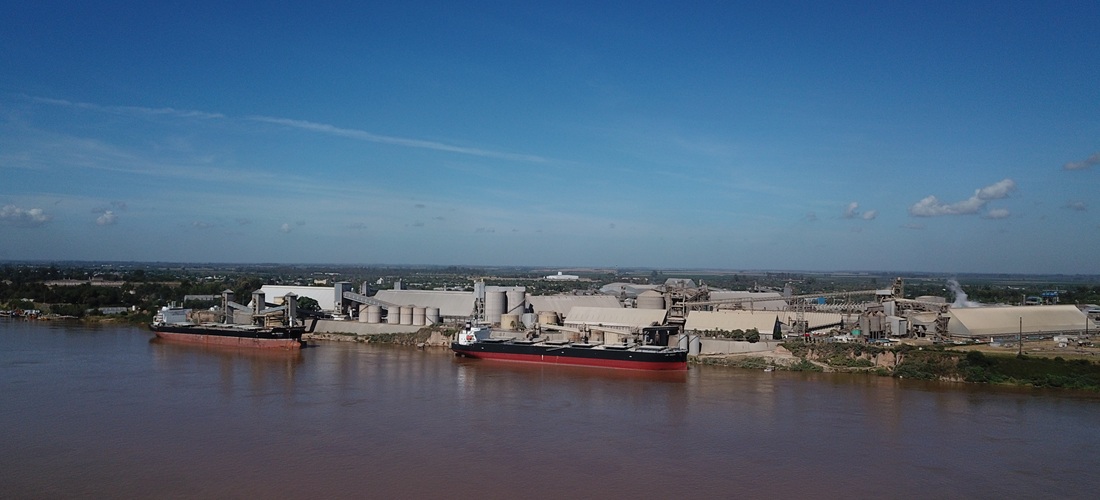
The Greater Rosario hub brings together 30 port terminals along a 70-kilometer stretch of the Paraná River, between Timbúes to the north and Arroyo Seco to the south. Of those facilities, 18 handle agroindustrial products that account for nearly one in every three dollars Argentina earns from goods exports.
The region has a distinctive logistics structure. In most major export corridors, grains move long distances to reach seaports. In Greater Rosario, vessels sail upriver along the Paraná to load cargo directly in the heart of Argentina’s main grain-processing and export region. From there, shipments move through the Paraná-Paraguay waterway and the Río de la Plata before reaching the Atlantic.
Greater Rosario’s weight in foreign trade is also tied to its industrial base. The region concentrates more than 52 million tonnes of annual oilseed crushing capacity, equivalent to 75% of Argentina’s total. Few export regions combine port infrastructure, agroindustrial processing capacity and foreign trade flows on a similar scale within such a concentrated area.
The chart below shows the top 10 commodities exported through the Port of Rosario between January and April 2026, according to data compiled by Datamar:
Top Export Cargoes | Port of Rosario | Jan-Apr | TEUs
Source: DataLiner (click here to request a demo)
The 2025 performance marked a recovery for the Up-River Paraná region after several years in which weaker agricultural output had pushed it down the global ranking. In 2023, when Argentina was hit by a historic drought, the region fell to third place.
Argentina ranked third among global exporters of agricultural commodities in the 2024/25 season, with 97.5 million tonnes shipped. Brazil led the ranking with 174.2 million tonnes, followed by the United States with 170.6 million tonnes.
The scale of Greater Rosario is such that, if its 2025 shipments were counted separately, the port complex alone would rank behind only Brazil and the United States among global agricultural commodity exporters.
By segment, the soybean complex was central to the region’s performance. A strong exportable supply of soybeans, against the backdrop of trade tensions between the United States and China, boosted shipments in the second half of the year. Together with Argentina’s traditional exports of soybean oil and soybean meal, this placed Greater Rosario second among soybean complex export hubs, behind Santos and ahead of New Orleans.
Shipments of soybeans and derivatives from Greater Rosario terminals reached 40.9 million tonnes in 2025, up from 35 million tonnes a year earlier.
In corn, Greater Rosario shipped 22.8 million tonnes last year, making the Up-River Paraná region the world’s second-largest port hub for corn cargoes, behind New Orleans. The Rosario Board of Trade noted that the volume shipped from Greater Rosario exceeded total corn exports from Ukraine, the world’s fourth-largest exporter of the grain.
For wheat, Greater Rosario ranked second among the port regions analyzed, with 8.8 million tonnes shipped. The report noted, however, that some port areas in countries such as Russia, Ukraine or Australia may have handled larger volumes. The same caveat applies to other cereals and oilseeds.
Overall, stronger soybean and corn production in the previous season drove a recovery in shipments from Argentine ports in 2025. That pushed New Orleans into second place in the ranking, while Santos remained third.
The outlook for 2026 is also strong. In the first four months of the year, Argentine port terminals shipped 34.6 million tonnes of grains, oils and byproducts, a record for the period. Of that total, 25.2 million tonnes were shipped through Up-River Paraná ports, also a record for the first four months of a year.
If the trend continues, Greater Rosario could remain the world’s leading agricultural export port complex for a second consecutive year, a result not previously recorded.
Source: Rosario Board of Trade
-
Fruit
Apr, 03, 2019
0
Brazil’s orange juice export revenue falls 38.6% in March year-on-year
-
Grains
Jun, 02, 2021
0
Brazil is the 4th largest grain producer, behind China, the US, and India, says study
-
Jan, 14, 2025
0
Brazil’s Naval Sector Caps 2024 with R$30 Billion in Investments and Record-Breaking Growth
-
Trade Regulations
Nov, 06, 2025
0
China to lift import duties on U.S. soybeans and farm goods after trade truce