


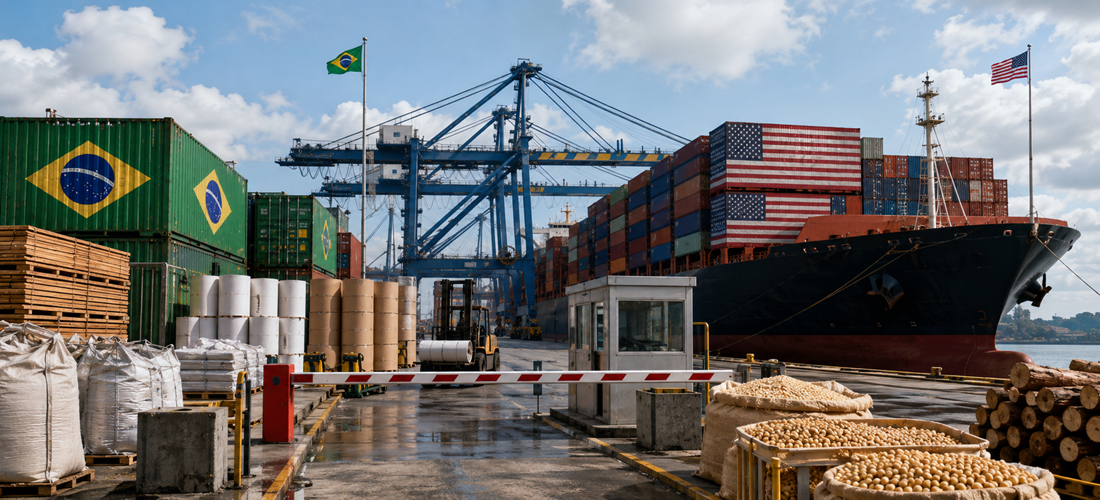
Higher prices support Brazil exports to the US in August
Sep, 08, 2026 Posted by Gabriel MalheirosWeek 202637
Brazil exports to the US rose in August, the same month new tariffs imposed by the Donald Trump administration took effect, as higher average prices helped sustain growth in sales to the American market.
Brazilian exports to the United States totaled $3.19 billion in August, up 12.1% from $2.85 billion in the same month of 2025.
According to Herlon Brandão, director of the Department of Foreign Trade Statistics and Studies at Brazil’s Ministry of Development, Industry, Trade and Services, known as MDIC, the increase was driven mainly by higher prices for goods sold to U.S. buyers.
“This increase in Brazilian exports for the month is based on an 8.6% rise in export prices to the United States,” Brandão said while presenting Brazil’s August trade balance data.
The products that contributed most to the increase in export value included aircraft and other equipment, beef, semi-finished iron or steel products, lime, cement and construction materials, iron or steel tubes, pulp and coffee.
Aircraft and beef are among the products exempted from the new tariffs applied by the United States.
Tariff effect
Despite the 8.6% increase in average prices, Brazilian exports to the United States fell 3.1% in volume in August. From January to August, export volumes to the U.S. market were down 13.6%, while export value fell 9.7% to $24.11 billion.
Recent data obtained by Datamar show a mixed picture among Brazil’s main containerized export products to the United States. In the first seven months of the year, plywood shipments rose 9%, while beef exports remained up 14%. The other products recorded declines.
The table below provides more detail, based on DataLiner data:
Top Products Exported to the United States | Jan-Jul 2026 | TEUs
Principais produtos exportados aos EUA | Jan-Jul 2026 | TEUs
wdt_ID wdt_created_by wdt_created_at wdt_last_edited_by wdt_last_edited_at DTM HS4 DESCRIPTION YTD Value Last Year %Growth %MarketShare
1
I_write_a_lot
08/09/2026 03:41 PM
I_write_a_lot
08/09/2026 03:41 PM
PLYWOODVENEERED & LAMINATED
18.882
17.325
9.0%
9.65%
2
I_write_a_lot
08/09/2026 03:41 PM
I_write_a_lot
08/09/2026 03:41 PM
FROZEN BOVINE MEAT
15.968
13.974
14.3%
8.16%
3
I_write_a_lot
08/09/2026 03:41 PM
I_write_a_lot
08/09/2026 03:41 PM
BUILDING STONE MOSAIC CUBES
12.429
16.060
-22.6%
6.35%
4
I_write_a_lot
08/09/2026 03:41 PM
I_write_a_lot
08/09/2026 03:41 PM
WOOD SAWN OR CHIPPED
12.228
12.377
-1.2%
6.25%
5
I_write_a_lot
08/09/2026 03:41 PM
I_write_a_lot
08/09/2026 03:41 PM
PNEUMATIC TYRES OF RUBBER
8.953
10.059
-11.0%
4.58%
6
I_write_a_lot
08/09/2026 03:41 PM
I_write_a_lot
08/09/2026 03:41 PM
COFFEE BEANS
6.688
10.016
-33.2%
3.42%
7
I_write_a_lot
08/09/2026 03:41 PM
I_write_a_lot
08/09/2026 03:41 PM
BUILDERS JOINERY & CARPENTRY OF WOOD
6.655
8.814
-24.5%
3.40%
8
I_write_a_lot
08/09/2026 03:41 PM
I_write_a_lot
08/09/2026 03:41 PM
CHEMICAL WOOD PULP FOR DISSOLUTION
5.898
7.540
-21.8%
3.02%
9
I_write_a_lot
08/09/2026 03:41 PM
I_write_a_lot
08/09/2026 03:41 PM
STRIPS OF WOOD
5.536
12.303
-55.0%
2.83%
10
I_write_a_lot
08/09/2026 03:41 PM
I_write_a_lot
08/09/2026 03:41 PM
UNCOATED PAPER & PAPERBOARD
5.387
7.552
-28.7%
2.75%
DTM HS4 DESCRIPTION YTD Value Last Year %Growth %MarketShare
Source: DataLiner (click here to request a demo)
Brazilian imports of U.S. goods also declined in the year to August. They totaled $27.32 billion in the first eight months of the year, down 8.6% from the same period in 2025. As a result, Brazil’s trade deficit with the United States reached $3.21 billion in the period.
In August alone, Brazilian purchases from the United States rose 1.1% to $4.01 billion, producing a bilateral trade deficit of $824 million.
Brandão said swings in trade flows are expected given the different forms of disruption affecting commerce between the two countries.
“Given the multiple interferences in trade with the United States, we have observed major fluctuations in this flow. So these fluctuations are expected, because of those interferences, not only in the products directly affected, but also because of the uncertainty they create for economic agents,” he said.
According to MDIC, slightly more than 20% of Brazilian trade with the United States was affected by the tariffs.
Brandão said it is still too early to measure the effects of any redirection of Brazilian exports to other markets.
“We need a little more time to speak with greater confidence about the effect of this redirection,” he said.
European Union
While sales to the United States fluctuated under the effect of tariffs, Brazilian exports to the European Union posted strong growth in August.
Exports to the bloc totaled $5.82 billion, up 46.4% from the same month last year. Shipment volumes increased 30.3%.
The main products sold to Europe included oil, copper, soybeans, fuel oils, coffee, tobacco and beef.
For Brandão, the performance reflects several factors, including market conditions and the effects of the Mercosur-European Union agreement.
“These are products in which Brazil is very competitive and for which international demand is growing,” he said.
“There are several factors. We have reports from exporters who are already benefiting from the agreement during this period, but market and supply conditions are also having an influence,” he added.
Among those conditions, Brandão cited higher fuel demand linked to the conflict in the Middle East and stronger demand for copper associated with growth in the technology sector.
He cautioned, however, that complete data from European importers is still needed to measure more precisely the agreement’s impact on Brazilian exports.
Trade balance
Brazil posted a trade surplus of $7.39 billion in August, up 23.8% from the same month in 2025.
Among Brazil’s main trading partners, the United States was the only one to register a deficit for Brazil, at $824 million.
From January to August, Brazil’s accumulated trade surplus reached $55.32 billion, up 28.2% from the same period last year.
The August figures show that Brazil exports to the US are being shaped not only by tariffs, but also by prices, exemptions and uncertainty over future trade flows.
Source: Agência Brasil
-
Shipping
Mar, 16, 2023
0
Maersk pilots warehouse automation solution
-
Ports and Terminals
Mar, 25, 2026
0
Truck drivers cancel strike at the Port of Santos
-
Meat
Jul, 25, 2025
0
Brazil’s chicken exports hold steady in 2025 despite bird flu cases
-
Grains
Dec, 10, 2024
0
Brazil Increases December Export Projections for Soybeans, Corn, and Soybean Meal