


Meat exporters to China face environmental risks in the Amazon, study says
Mar, 26, 2026 Posted by Sylvia SchandertWeek 202613
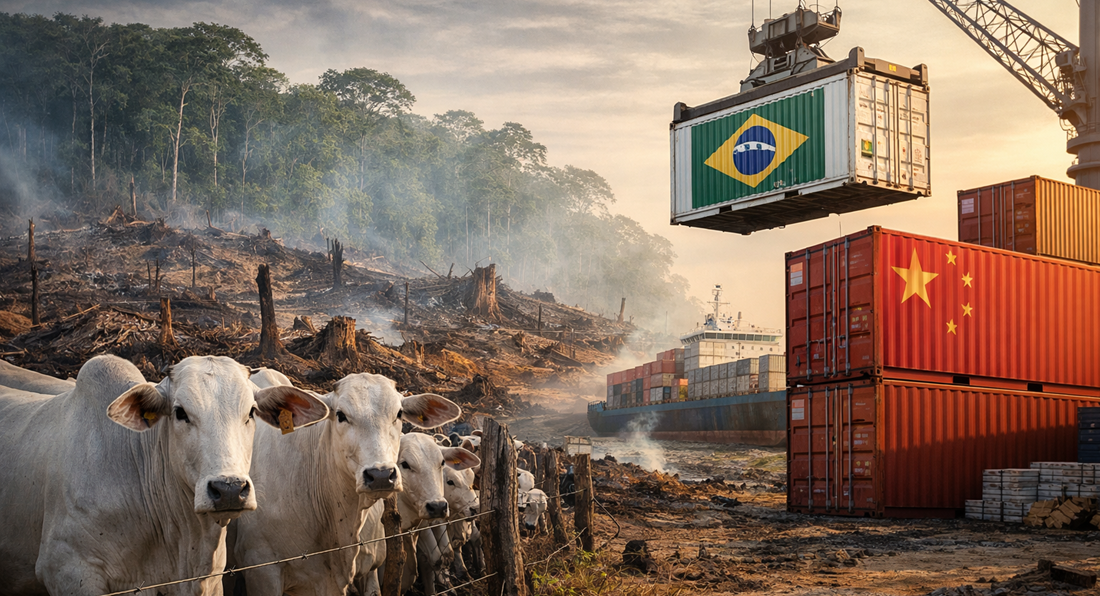
None of the meatpacking companies operating in the Legal Amazon and authorized to export beef to China and Hong Kong fully meet the environmental specifications recommended by the China Meat Association (CMA), according to an analysis by Radar Verde obtained by Valor. The main shortcomings lie in gaps in control over indirect suppliers and exposure to the risk of sourcing cattle from deforested areas.
Paulo Barreto, an associate researcher at the Amazon Institute of People and the Environment (Imazon) and one of the coordinators of Radar Verde, notes that the current level of compliance does not disrupt export flows but could serve as a basis for allocating export quotas for Brazilian beef. This is the proposal the organization plans to present during meetings in China that began Monday and are expected to last two weeks.
“In China, we will meet with universities, civil society organizations, industry representatives, and academics who advise the government on the design of these quota policies for beef. Companies with lower risk and higher scores could gain access to larger shares of the quota—that is what we are proposing,” he explains.
Following a safeguard investigation, China imposed quotas on its main suppliers. Brazil was allocated 1.1 million tonnes, subject to a reduced tariff of 12%, while volumes exceeding that quota will face a 55% tariff. In January and February, Brazilian meatpackers had already used 33.6% of the quota.
Radar Verde assessed meatpackers against the “Specification for Meat Industry Green Trade,” a standard issued by the Chinese association that sets criteria for traceability, transparency, and zero-deforestation commitments across supply chains. In the Amazon, among the 31 plants authorized to export to China, 21 exhibit low levels of socio-environmental control, and 10 exhibit very low levels. Only 20 monitor direct cattle suppliers, and none demonstrated effective mechanisms for controlling indirect suppliers.
Among the 71 plants authorized to export to Hong Kong, around 61% show low levels of socio-environmental control, and 55% monitor only their direct suppliers, according to the data.
The survey also mapped the potential cattle-sourcing areas of these meatpacking plants in the Legal Amazon and identified risks of sourcing cattle from deforested areas ranging from about 31,000 hectares to nearly 3.8 million hectares.
Only one company, Plena Alimentos, responded to the Radar Verde 2025 questionnaire, which allows companies to provide evidence and additional information on their socio-environmental policies and practices. According to Barreto, all companies were contacted. Large groups such as MBRF (formerly Marfrig), JBS, Minerva, and Frigol are classified as having very high effectiveness in controlling direct suppliers but very low effectiveness in monitoring indirect suppliers and, as a result, receive low overall scores.
In a statement to Valor, MBRF said it monitors 100% of both direct and indirect suppliers through a system that combines geospatial technologies, cross-referencing of public databases, and proprietary protocols, and that it complies with environmental requirements in all the markets in which it operates, including China. Minerva also stated that it has robust socio-environmental monitoring and control systems and is fully capable of meeting regulatory and commercial requirements across its markets.
Frigol said it had not yet had access to the Radar Verde report but noted that, since 2023, it has verified 100% of its tier-one indirect suppliers in the state of Pará. JBS did not respond to requests for comment by the time this edition was published.
The Brazilian Association of Meat Exporting Industries (ABIEC), when contacted, reiterated to Valor that Radar Verde has the “commendable” objective of helping consumers make purchasing decisions, noted that there is room for improvement in its methodology.
“Company policies related to strict sourcing standards are not taken into account. As a result, even companies with high approval rates in audits under consent decrees may appear negatively in Radar Verde’s analyses,” the association said. It declined to comment on the possibility that Radar Verde could be used as a criterion for China’s quota allocation.
Translation: Todd Harkin
Source: Valor International
-
Ports and Terminals
Oct, 18, 2022
0
Ships return to Itajaí and Navegantes ports after solution of Ituporanga dams problems
-
Shipping
Aug, 29, 2025
0
Brazilian port operators push to end repeated dredging licenses
-
Ores
May, 06, 2019
0
Brazil’s iron ore exports hit 7-year low in April
-
Other Cargo
Aug, 15, 2023
0
Chile reports “unprecedented declines” in wine exports