


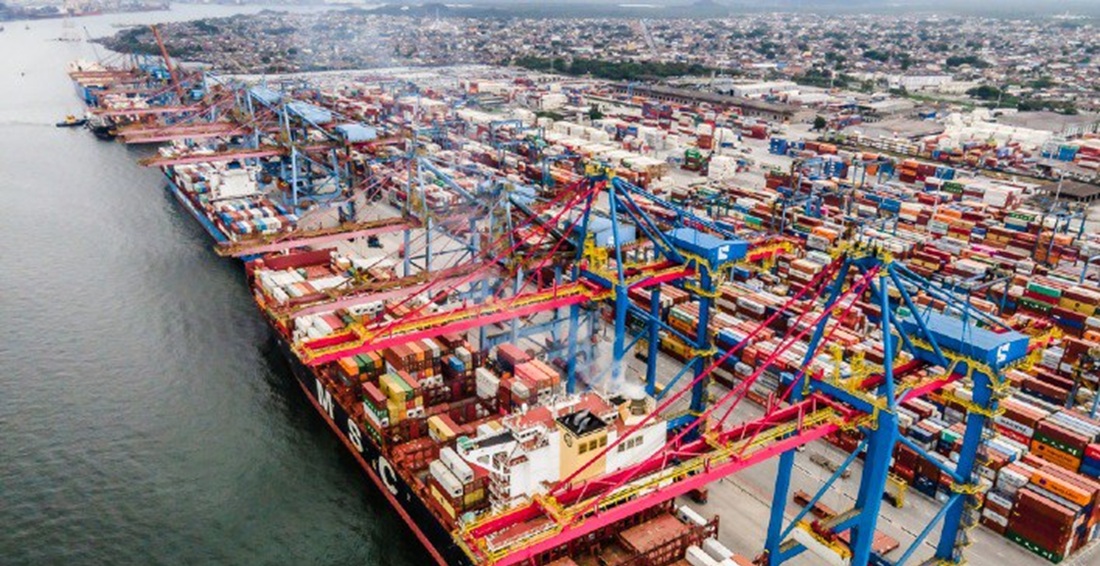
Middle East war impact on Port of Santos raises concerns over shipping routes
Mar, 24, 2026 Posted by Gabriel MalheirosWeek 202613
The Middle East war impact on Port of Santos is becoming a growing concern for shipping and logistics operators, even though the most immediate disruptions remain concentrated on Persian Gulf routes. Major shipping lines have adopted contingency measures, limiting the number of vessels and cargoes moving in and out of the region.
The main point of concern is the Strait of Hormuz in the Persian Gulf, through which about 20% of all oil transported worldwide passes. “Any tension there has an immediate impact on maritime trade. Shipowners and insurers become more cautious, insurance and freight costs rise, and some routes begin operating with greater risk and instability,” logistics specialist Lucio Lage said.
The escalation of the conflict has led, among other factors, to the suspension or sharp reduction of navigation in the region, the detention of dozens of tankers in anchorage areas, attacks on commercial vessels and the cancellation of insurance coverage, according to insurance specialist Tatiana Algodoal.
“Beyond the Strait of Hormuz, the effects spread to other strategic corridors, such as the Red Sea and Suez Canal, which connect Asia and Europe; the Bab el-Mandeb Strait, which separates Asia and Africa and links the Red Sea to the Gulf of Aden and the Indian Ocean; and Asia-Europe and Asia-Americas routes, affected by diversions, revised port calls and higher logistics costs.”
Companies
Maersk has suspended bookings involving reefer cargo to and from the United Arab Emirates, Oman, Iraq, Kuwait, Jordan, Qatar, Bahrain and Saudi Arabia.
“For shipments containing essential food, medicines and perishable goods, we will do our best,” the company said.
Dry cargo bookings were also suspended, according to Maersk, to and from the United Arab Emirates, Iraq, Kuwait, Qatar, Saudi Arabia (Dammam and Al Jubail), Oman (Sohar) and Bahrain, with the same caveat regarding essential food, medicines and perishables.
CMA CGM had closed all import bookings for Iraq, Kuwait, Qatar, Bahrain, Saudi Arabia and the United Arab Emirates. The company, however, has since reopened orders.
On the 9th, the company had announced the suspension of exports to the Persian Gulf. “All shipments in transit will be diverted to the next safe discharge port. There, the cargo will be unloaded and made available to customers for local delivery and pickup,” it said. MSC had also indicated a mandatory surcharge of $800 per container on all affected shipments to cover diversion costs.
Silence and concern
Asked about the issue, Centronave, which represents 19 shipping lines, did not comment. In a statement, the Santos Port Authority, or APS, said it is “closely monitoring developments in the Middle East,” but that “so far, there is no indication of direct impacts on the shipping routes operating at the Port of Santos.” The federal state-run company added that its operations board has been holding periodic meetings to monitor the situation.
“It is important to consider that maritime logistics today is global and highly integrated, which means regional tensions can generate indirect effects such as route adjustments or operational rescheduling. In wartime scenarios, it is difficult to predict every consequence, even from a geographic distance,” APS said.
Iran receives more than 30% of corn exported
Corn is the main cargo exported to Iran via the Port of Santos. The equivalent of 30.51% of corn shipments through the Santos port complex is destined for that country, according to data from APS.
Another product requiring attention, this time on the import side, is urea, according to APS. It is the main nitrogen fertilizer used by farmers.
It is applied to crops such as corn, wheat, cotton and sugarcane, all of which require high nitrogen levels and benefit from higher productivity.
Data from Datamar, available via its flagship DataLiner platform, reveals that urea imports at the Port of Santos reached 134,417 tonnes in January 2026, marking a 32.6% year-over-year (YoY) increase. The following overview provides a breakdown of inbound nitrogenous fertilizer volumes—including urea, ammonium sulfate, and others—at the Port of Santos:
Nitrogenous Fertilizer Imports | Port of Santos | Jan 2023 – Jan 2026 | WTMT
Source: DataLiner (click here to request a demo)
“For Santos, the most important transmission channel is the fertilizer and chemical input chain. The port has relevant infrastructure for inbound mineral bulk cargo, including fertilizers, sulfur and salt, as well as several terminals dedicated to this profile,” said John Edwin Mein, executive coordinator of Alianca Procomex.
Although Iran accounts for only a small share of agricultural input imports through the Port of Santos, just 0.01% of the total, other Persian Gulf countries account for more than 40% of urea discharges at the Santos complex, with Qatar alone representing 34.5%.
“The most likely effects are more expensive fertilizers or less certain delivery schedules,” Mein said.
Losses have not yet been calculated
The specialists consulted were unanimous in saying that it is still too early to measure direct and consolidated losses for the Santos port complex. The duration of the conflict is expected to be a key factor.
“Geopolitical conflicts usually affect energy prices and logistics costs first, and only later does that show up more clearly in international trade. If tensions persist, then we may start to see more concrete effects on operations and cargo flows,” logistics specialist Lucio Lage Rodrigues said.
Tatiana Algodoal, a lawyer specializing in insurance and reinsurance, took a similar view and called for close monitoring. “The conflict is still recent and dynamic, and the initial effects are concentrated on costs, insurance and logistics planning, not on disruptions in Brazil. The financial impacts, in turn, tend to appear gradually. That is why the current scenario requires attention and monitoring, and it is not possible to quantify potential losses at this time,” she said.
Mein said the effect on Santos is likely to show up in prices before volumes. Even so, he said it is already possible to state that Santos “is exposed to the shock, especially through fertilizers, chemicals, fuels and logistics costs; we may feel the early warning signs in insurance, bunker, diesel, delays and supply risk.”
Still, he said, it is not yet possible to estimate losses at the port without March and April statistics, shipping-line notices and cargo throughput data. “Today, we can say that the most immediate risk for Santos is not that it will stop, but that it will become more expensive and more uncertain,” he said.
Large-scale effects
Although far from the conflict geographically, global ports such as Santos end up feeling the effects, according to logistics specialist Lucio Lage.
“The first impact is usually the increase in oil prices, which is already pushing up fuel costs worldwide, including in Brazil. As bunker fuel becomes more expensive, that tends to raise ocean freight costs and affect imports and exports,” said Lage, who is also director of Process Log & Comex.
Main channels
Insurance specialist Tatiana Algodoal said the potential impact does not stem from any physical closure of the port, but from Brazilian foreign trade’s exposure to international maritime logistics. According to her, it can be analyzed through three main channels.
One is energy and logistics dependence. “A significant part of the fleet operating in Santos uses fuel whose pricing depends on Middle East oil, and higher operating costs can reduce call frequency or raise freight costs.”
If diesel and bunker remain under pressure, the effect will spread to warehousing, inland removal, distribution and the costs faced by agribusiness and industry served by Santos, Mein said. “We may see window and port-call rescheduling. Not because Santos is closed or under military threat, but because ships, insurers and trading companies begin to weigh cost, risk and vessel availability on a global scale.”
The cargo profile is the second point on the list, according to Tatiana. “The Port of Santos is highly dependent on agribusiness. Brazil is one of the world’s largest agricultural exporters and imports significant volumes of fertilizers from the Middle East, whose transport may be impaired by the conflicts affecting the Strait of Hormuz, without which crop production may be affected,” she said.
Finally, according to the lawyer, there is also insurance risk. “The cancellation of war-risk coverage and the increase in premiums may make some operations economically unfeasible, even outside the conflict zone,” she said.
Low to moderate
Mein said the risk to Santos can be classified as low to moderate in the very short term for the port’s physical operations, and moderate to high for costs and specific supply chains, especially fertilizers, chemicals, fuels and cargoes highly sensitive to freight rates.
“Santos does not physically depend on the Strait of Hormuz to function day to day, but it does depend economically on global chains that pass through it. And the port is large enough to feel any change in prices and vessel availability,” he said.
Source: A Tribuna
-
Ports and Terminals
Dec, 16, 2020
0
MINFRA receives R$3.6 billion investment proposal for new port in Natal
-
Shipping
Feb, 22, 2021
0
Maersk confirms 260 containers lost in Japan
-
Ports and Terminals
Nov, 24, 2023
0
Ports in Rio Grande do Sul Report Growth Across the Board from January to October
-
Ports and Terminals
Feb, 07, 2020
0
Aliança to resume cabotage route at the Port of Itaqui