


Northern Rivers Transport 107 Million Tonnes of Cargo
Dec, 16, 2025 Posted by Lucas LorimerWeek 202550
Rivers have long played a central role in transportation in the Amazon. Predominant fluvial access has always prevailed, especially in riverside cities that often depend entirely on boats for supplies. Intensive logistics, however, are relatively recent. The mode was driven by the expansion of agribusiness, which began using Arco Norte ports to ship production as agricultural frontiers moved farther north in the Center-West.
Geography also helps explain this dynamic: Brazil has 20.1 thousand km of economically navigable waterways. With about 16 thousand km in length, Amazon rivers account for 80.79% of the country’s waterway network. Last year, 107.4 million tonnes were transported through the Amazon and Tocantins–Araguaia river basins, according to the National Waterway Transport Agency (Antaq) — representing 89% of all fluvial transport in Brazil.
“This cargo transport saw a ‘boom’ starting in 2014, with the entry of companies moving agricultural bulk cargo,” said Hito Braga de Moraes, director of the Institute of Technology at the Federal University of Pará (UFPA).
Soybeans and corn account for half of the cargo transported, but river transport is also critical to the logistics of the Manaus Industrial Hub, from where loaded containers travel by barges to the main Arco Norte ports. “From there, larger vessels handle cabotage shipping, distributing cargo to the rest of Brazil and to Mercosur,” added Paulo Resende, director of the Infrastructure and Logistics Center at Fundação Dom Cabral.
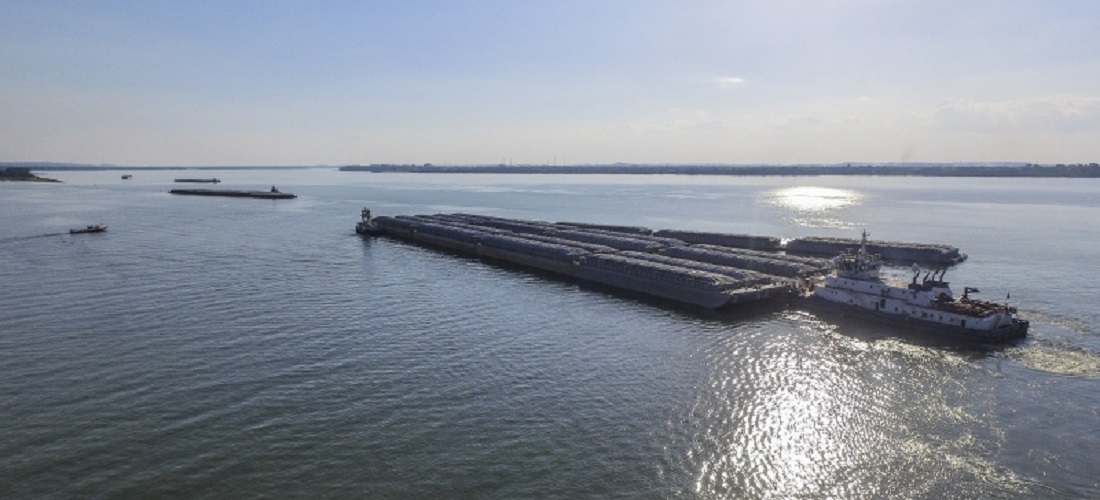
Barges are the key differentiator of Amazonian river transport. Some convoys — sets of multiple barges pushed by a towboat — can carry up to 75,000 tonnes in a single trip. Transportes Bertolini, for example, has already dispatched a convoy from Porto Velho along the Madeira River carrying the equivalent of 1,000 trucks at once.
“It is the most efficient mode for moving large volumes over long distances, with the lowest emissions per tonne transported,” said Décio Amaral. From an environmental standpoint, inland waterway transport emits up to 73% less CO₂ than road transport and 36% less than rail, according to a study by the Future Climate Group.
The efficiency of the mode has helped reduce logistics costs in recent years. According to the Brazilian Confederation of Agriculture and Livestock (CNA), transport carried exclusively by truck along the BR-163 highway to the port of Vila do Conde, in Barcarena (PA), costs US$ 120 per tonne. When cargo is unloaded in Miritituba, about 1,200 km before Vila do Conde, and then shipped by barges, freight costs fall to US$ 108 per tonne, according to the entity.
Despite its advantages, river navigation in the region faces long-standing challenges. The main one is seasonality, with droughts that restrict navigation for several months of the year. Another is access to ports. “Within the city of Miritituba, we have an 8 km stretch that generates truck lines of up to 60 km,” said Daniel Bertolini, vice president of the Federation of Logistics, Transport and Freight Forwarding Companies of the Amazon (Fetramaz) and director of Transportes Bertolini.
Concessions of the Barra Norte, Madeira, Tapajós and Tocantins waterways — which are on the government’s list of planned projects — could address part of this issue through dredging and channel maintenance. The removal of the Pedral do Lourenço, a rocky stretch between Marabá and Tucuruí in Pará, could make the Tocantins Waterway viable, with potential to move up to 60 million tonnes of cargo per year toward the port of Barcarena (PA) — equivalent to 500,000 truck trips — but it faces socio-environmental challenges.
Transferring management to the private sector would also bring efficiency gains. “Today, what we really have are navigable rivers. Ideally, there should be management with constant maintenance of the route, which in this case involves dredging, signaling and safety,” said Marcus Quintella, director of FGV Transport.
Concessions in the region, however, are delayed and, at best, are expected only in 2027. While auctions have not yet taken place, the Ministry of Ports and Airports announced initiatives to maintain regional infrastructure. One of them is the signing of R$ 370 million contracts, with five-year terms, for dredging and signaling on the Amazon and Solimões rivers.
The ministry also highlights investments in small-scale terminals, which function as logistical and social hubs. “We are talking about improving connectivity for populations that depend on the country’s waterways. This is essential to deliver fuel and basic goods to riverside communities at lower cost,” said the national secretary for Waterways and Navigation, Otto Luiz Burlier.
Source: Valor Econômico
-
Grains
Feb, 22, 2022
0
Anec raises Brazil’s soybean and corn export forecast in February
-
Ports and Terminals
Aug, 26, 2020
0
Federal government sanctions measure to update port operations laws
-
Trade Regulations
Sep, 12, 2023
0
Lula aims to strike EU-Mercosur deal in coming months
-
Oil and Gas
May, 29, 2026
0
Brazil’s oil exports plunge in May as export tax and domestic use weigh on shipments