

Paraná Ports Measures Carbon Footprint and Prepares Decarbonization Plan
May, 27, 2025 Posted by Sylvia SchandertWeek 202522
Paraná Ports Measures Carbon Footprint and Prepares Decarbonization Plan
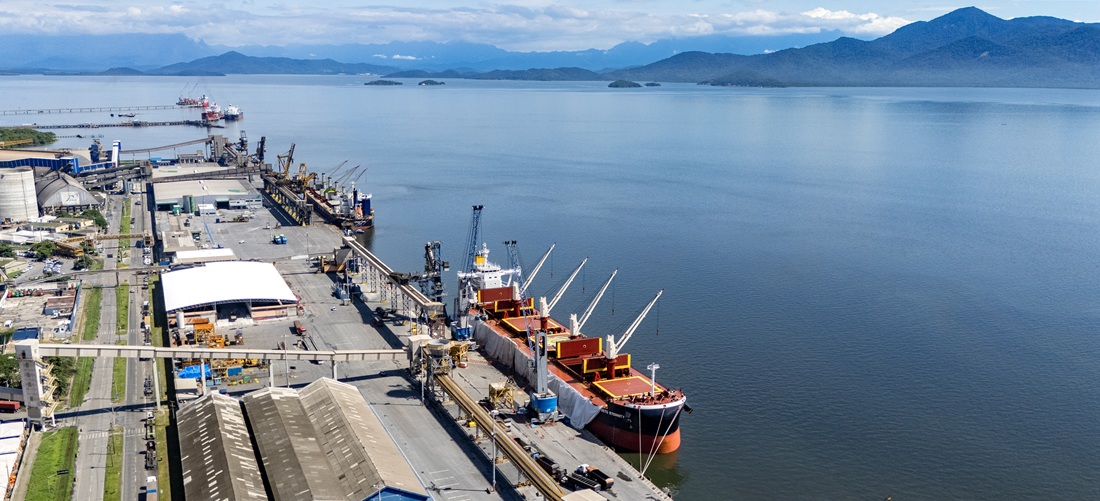
The public company Portos do Paraná is preparing for a new phase in its sustainability practices. With the completion of its Greenhouse Gas (GHG) Inventory, developed by Fundación Valenciaport, the next step for the Port Authority will be to prepare a decarbonization plan for the ports in Paraná.
“Calculating the carbon footprint is essential for designing effective ESG (Environmental, Social, and Governance) initiatives, always aiming to fight climate change,” stated Luiz Fernando Garcia, CEO of Portos do Paraná.
The study, presented during Intermodal 2025 in São Paulo, revealed that 89.2% of the GHG emissions recorded in the entire port region in 2023 originated from ships rather than the port’s operational activities. “This is a partnership between Valenciaport and Portos do Paraná, and we remain firmly committed to the sustainability goal, which is humanity’s shared mission in 2025,” said Paraná’s Secretary of Infrastructure and Logistics, Sandro Alex.
Below is a historical chart of container throughput at the Port of Paranaguá, dating back to January 2022. The chart was created using DataLiner data:
Container Throughput at the Port of Paranaguá | Jan 2022 to Mar 2025 | TEUs
Source: DataLiner (click here to request a demo)
The inventory was based on the international GHG Protocol methodology and the “Methodological Guide for Calculating the Carbon Footprint in Ports,” published by Puertos del Estado. During the period analyzed, the Paraná ports complex emitted approximately 678,000 tons of CO₂ equivalent, distributed across three scopes of analysis.
Scope 1 refers to direct emissions from the Port Authority itself, representing just 2.7% of the total. Scope 2, which includes indirect emissions from electricity consumption, accounted for 0.1%. Scope 3, which encompasses indirect emissions from other port-related activities — such as terminals, land transport modes, port support services, and vessels — accounted for 97.1% of total GHG emissions.
“In Scope 3, most emissions come from ships. A small portion is linked to the Port Authority’s operations due to the use of electric equipment, and another small share comes from other port community stakeholders such as lessees, operators, dredging activities, and road-rail transport. Now, with this data, we can set targets toward a net-zero carbon future,” explained João Paulo Santana, Environmental Director at Portos do Paraná.
With the inventory delivered, the following steps will be carried out in partnership with Fundación Valenciaport to develop a Decarbonization Plan, which will include defining targets, deadlines, and socio-environmental projects. “This calculation is a milestone. Without it, we couldn’t plan the next stages. From this study, we will move forward with the Portos do Paraná team on the actions that need to be implemented,” emphasized Innovation and Port Strategy Consultant Jonas Mendes Constante.
“Today, Portos do Paraná truly enters the 21st century, with this shift toward sustainability that affects not only the port but also society, the population, and the environment of Brazil. This is a significant day, and from now on, everything will be better for Portos do Paraná,” concluded Miguel Garin Alemany, Director of International Development at Fundación Valenciaport.
Source: Informativo dos Portos
-
Grains
Apr, 05, 2023
0
Ukraine grain exports at 38.5 mln T as of April 5
-
Sugar and Ethanol
May, 09, 2023
0
VLI kicks off 2023 sugar export season with two shipments at Santos port
-
Ports and Terminals
May, 27, 2022
0
Port of Vitória and BYD study joint strategic projects
-
Other Logistics
Jan, 05, 2024
0
Rumo Included in B3’s Sustainability Index (ISE) for Third Consecutive Year