


Plan would allocate China beef quota through September
Feb, 24, 2026 Posted by Sylvia SchandertWeek 202608
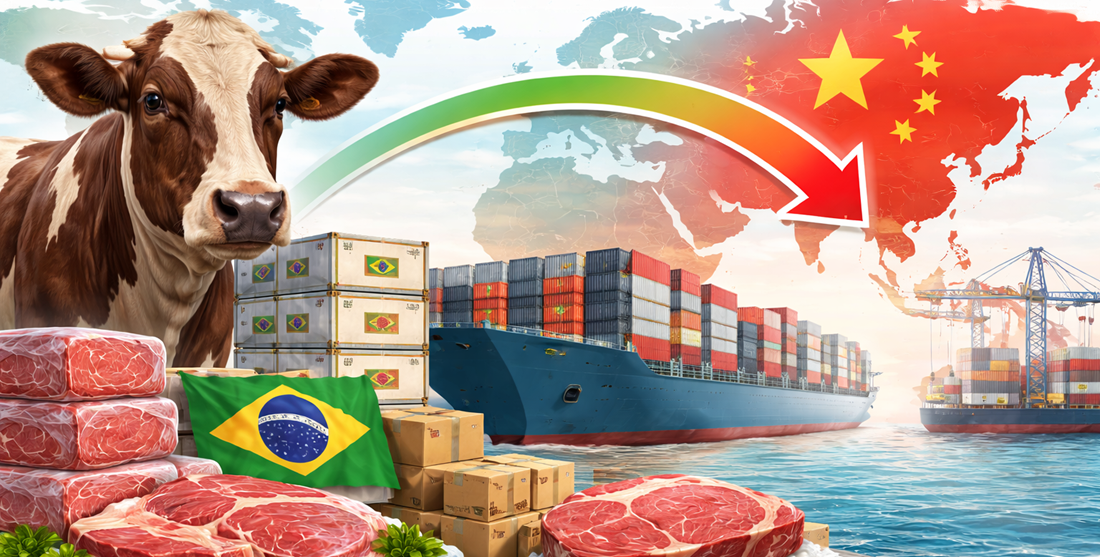
A model proposed by Brazilian meatpackers to manage the beef export quota to China calls for distributing the total annual volume only across the first three quarters of the year—through the end of September.
The measure responds to China’s decision to count shipments sent in 2025, before the safeguard measure limiting Brazil’s beef exports to 1.1 million tonnes in 2026 was announced, but that arrived in 2026. The goal is to give companies predictability that cargoes shipped will be cleared and deducted from the quota within the same calendar year.
Under the proposal, the quota would be allocated proportionally based on each company’s 2025 export performance among the 67 plants authorized to sell to China. Distribution would occur quarterly, with monthly monitoring of quota usage to allow for “timely adjustments” and avoid a concentration of unused volumes at the end of the period.
The model sets a minimum annual allocation of 8,000 tonnes per meatpacker to ensure smaller companies can continue exporting, and establishes a 33,000-tonne technical reserve for potential new entrants.
The measures are outlined in a legal opinion prepared by the law firm of former Foreign Trade Secretary Welber Barral at the request of the Brazilian Association of Meat Exporting Industries (ABIEC), according to a copy reviewed by Valor.
A resolution is expected to be considered at an extraordinary meeting of the Executive Management Committee (GECEX) of the Foreign Trade Chamber (CAMEX) late next week. The government is still seeking what officials describe as “legal comfort” to ensure the rule is not challenged in court.
At least one exporting meatpacker has objected to the terms of the resolution and expressed its concerns to the government. The Attorney General’s Office (AGU) is said to have been asked by the Foreign Trade Secretariat (SECEX) of the Ministry of Development, Industry, Trade and Services (MDIC) to issue a legal opinion. The agencies did not confirm the request. The MDIC said no date or agenda has yet been set for the CAMEX meeting.
Industry representatives argue that the distribution criteria are “legally valid and economically appropriate,” as they align with China’s operational calendar. Beijing counted about 300,000 tonnes of beef shipped in 2025 but arriving in 2026 toward the new quota, leaving just over 700,000 tonnes to be allocated. In January alone, exports totaled 123,100 tonnes, a record for the month.
According to Datamar, China currently accounts for 56% of Brazil’s beef exports. This level of market concentration is prompting the national industry to seek alternatives to mitigate the challenges posed by new Chinese export quotas.
The following chart provides a month-over-month comparison of Brazilian beef shipments (in containers) to China from 2022 through 2025, based on data from Datamar’s DataLiner platform
Beef Exports to China | Jan 2022 – Dec 2025 | TEUs
Source: DataLiner (click here to request a demo)
Allocating one-third of the quota each quarter through September would ensure exporters “orderly access to their allocation throughout the year,” the legal opinion says. The model mirrors international practice and allows monthly reallocation of unused volumes. If an exporter fails to use its quarterly share, the balance could be redistributed to others. The shipping window is designed to match maritime transit times of about 40 days to China.
Basing the allocation on 2025 market share is described as “objective and transparent,” reflecting each company’s demonstrated operational capacity and providing planning predictability. Since the safeguard will remain in place through 2028, the proposal provides that from 2027 onward, the quota would be calculated based on a rolling two-year average of actual export volumes, promoting gradual adjustment and long-term stability.
To qualify, exporters must be tax-compliant, hold valid sanitary certifications, and have no recent penalties.
“The quota system is rational and reasonable, grounded in transparent criteria based on objective data—namely, each company’s 2025 exports—with no room for administrative discretion,” the legal opinion states. “The proportional allocation preserves historical market shares based on 2025, reflecting productive capacity. The guaranteed minimum allocation of 8,000 tonnes per year ensures that even small exporters retain access to the Chinese market, within the limits imposed by that country.”
Source: Valor International
-
Economy
Jul, 10, 2026
0
Brazil sees progress in U.S. tariff talks but keeps ethanol off agenda
-
Shipping
Jun, 10, 2019
0
CMA CGM no longer to accept shipments between ECSA and Cagliari
-
Ports and Terminals
Mar, 16, 2022
0
Intermodal 2022: CODEBA brings together world-class port sector leaders at its stand
-
Ports and Terminals
Jul, 15, 2024
0
Cattalini Terminais celebrates 43 years with increased draft at private pier