


Porto Itapoá Targets Paranaguá Cargo with $333 Million Babitonga Bay Dredging Project
Sep, 29, 2026 Posted by Sylvia SchandertWeek 202640
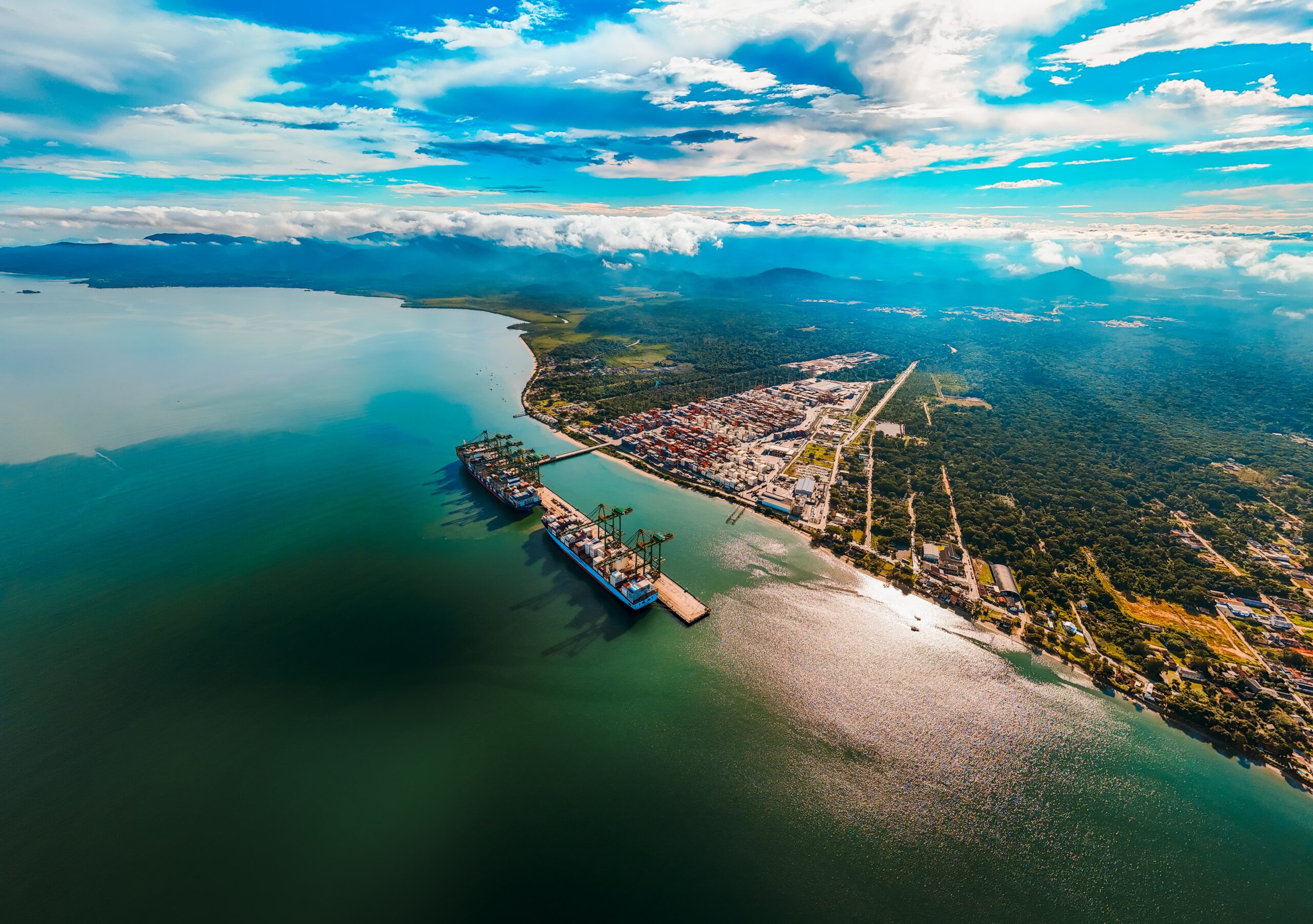
The Port of Itapoá plans to use the deepening of the Babitonga Bay channel to expand its share of the container market and compete for cargo currently handled by Santos, in São Paulo state, and Paranaguá, in Paraná state. According to the private terminal, the strategy depends on deepening the access channel from 14 to 16 meters, allowing it to accommodate vessels up to 366 meters long.
The channel-deepening project will cost R$333 million. According to the Port of São Francisco do Sul, which is responsible for carrying out the work, the Port of Itapoá is financing R$300 million, while the public port authority will contribute the remaining R$33 million. The private terminal is to be reimbursed by 2037 through a portion of the additional tariff revenue generated by increased vessel calls and cargo throughput after the project is completed.
The commercial gains, however, will depend on factors beyond the channel’s depth. The Federation of Industries of Santa Catarina (Fiesc) believes the increased draft could ease cargo restrictions and reduce costs per container, but stresses that industry will benefit only if larger vessels actually call at the ports, shipping lines compete, direct routes are available, and land access can accommodate the additional traffic.
Babitonga Bay dredging enters final phase
As of the end of August, the Port of São Francisco do Sul reported that dredging was 88% complete. The dredger Galileo Galilei has already removed 10.6 million cubic meters of sediment out of a planned total of 12 million. Dredging is scheduled for completion in the second half of 2026, with the remaining 12% to be removed over the next three weeks.
Once completed and verified, the project could allow the Babitonga port complex to accommodate vessels up to 366 meters long, with capacities of up to 16,000 TEUs per ship. “It will expand operational capacity, reduce costs for users and make the ports more competitive,” said Guilherme Medeiros, operations director at the Port of São Francisco do Sul.
The Port of Itapoá, which uses a more conservative estimate for its operations, said the increased draft should allow it to handle vessels of up to 14,000 TEUs. “The actual capacity gain per call will depend on each vessel’s configuration, the shipping service, and the commercial and operational conditions of each operation,” said Ricardo Arten, CEO of the private port.
Deeper channel creates room for growth but does not guarantee new cargo
The Port of Itapoá is betting that deepening the channel will help it expand its share of Brazil’s container market. The terminal’s strategy involves attracting new shipping services, strengthening ties with carriers, and positioning itself as an alternative for importers and exporters in southern and southeastern Brazil.
The port, however, did not provide an estimate of how many additional calls or containers it could handle annually after dredging is completed. The terminal said the outcome would depend on carriers’ decisions, changes in demand, and the commercial and operational conditions of each service.
To prepare its landside infrastructure for a potential increase in operations, the private terminal says it is investing approximately R$500 million in a new expansion phase. According to the company, the investment will add 120,000 square meters to the yard, increasing its area from about 455,000 to 575,000 square meters. The investment also includes an eighth ship-to-shore crane, new cranes and handling equipment, expanded facilities for refrigerated containers, automation, and a new gate dedicated to inbound trucks. This should increase daily vehicle entries from 2,000 to 3,000.
“These investments are essential to ensure that growth in maritime capacity is matched by landside handling capacity, maintaining the Port of Itapoá’s levels of efficiency and safety,” Arten said.
According to terminal data, the port ended 2025 with just over 1.5 million TEUs handled. The company says installed capacity is approximately 1.8 million TEUs annually, with projections of about 2 million per year following the investments now underway. The terminal handled about 412,000 containers in the first half of 2026. In June, when it marked 15 years of operations, it handled just over 74,000 containers — its highest monthly volume on record, according to the company.
Port of Itapoá targets industrial and agroindustrial cargo from southern Brazil
The Port of Itapoá’s CEO said its growth efforts target industrial and agroindustrial cargo from southern and southeastern Brazil, particularly Santa Catarina and Paraná. Among the segments cited by the terminal are food, proteins, refrigerated products, machinery and equipment, chemicals, auto parts, electrical and electronic products, and consumer goods transported in containers.
Cargo throughput data obtained by Datamar provide an overview of operations at Portonave. According to the company, chicken meat exports accounted for the largest share of containerized cargo movements in the first seven months of the year. The chart below shows the share of the other leading cargoes:
Main Cargoes Handled at Portonave | Jan-Jul 2026 | TEUs
Source: DataLiner (click here to request a demo)
Maurício Battistella, chairman of Fiesc’s Council on Transportation and Logistics, believes deepening the channel is likely to benefit Santa Catarina’s industrial sector, particularly metalworking, machinery and equipment, agribusiness, pulp and paper, wood and furniture, and animal protein. Battistella noted that Babitonga Bay accounts for about 60% of Santa Catarina’s port cargo throughput.
He cautioned, however, that there is still no origin-and-destination study or reliable dataset that would make it possible to estimate how much cargo currently handled by Santos and Paranaguá could be redirected to Babitonga Bay.
Door-to-door logistics costs will determine competition with Santos and Paranaguá
The Fiesc representative said the ability to accommodate larger vessels could reduce the need for light loading — a practice in which a ship carries less cargo so it can navigate a draft-restricted channel.
According to him, higher vessel utilization tends to reduce maritime transport costs per unit on long-distance routes. But he maintained that those benefits would not automatically be passed on to infrastructure users. “The project creates a necessary condition for reducing costs, but it does not, on its own, guarantee that the savings will be passed on in full to industry,” Battistella said.
In his view, the impact will depend on a combination of factors: larger vessels actually calling at Babitonga Bay, competition among carriers and terminals, higher vessel utilization, direct routes, fewer transshipments and shorter waiting times, as well as adequate road access and port hinterland infrastructure.
The chairman of the Council on Transportation and Logistics stressed that, for industry, the relevant measure is not simply draft or the channel tariff. “The indicator being tracked should take into account door-to-door logistics costs — ocean freight, terminal handling charges, storage, road transport, transit time and inventory costs — rather than just the channel tariff.”
Fiesc believes Santos and Paranaguá retain advantages that deepening the Babitonga channel alone will not eliminate. Battistella cited scale, cargo volumes, international connectivity, service frequency, land access and port hinterland facilities as factors favoring the competing ports. For that reason, he considers it “more accurate to talk about gaining market share in specific segments and routes, such as direct services linking Asia and Europe with southern Brazil, as well as refrigerated cargo and manufactured goods, than about surpassing Santos in total volume.”
The Port of Itapoá is seeking to position itself in precisely that competition for new international connections. In August, the company opened an office in China to strengthen relationships with carriers, customers and investors, and pursue new shipping services. “The goal is not only to strengthen existing services but also to pursue new maritime connections that make southern Brazil more competitive,” Arten added. He believes a physical presence in the country should improve the port’s ability to present logistics, industrial and investment opportunities in Itapoá and the surrounding region.
Bottlenecks outside the port are the next challenge
But other barriers must be overcome for both the Port of Itapoá and the Port of São Francisco do Sul to achieve the expected results. Fiesc warns that the benefits of the increased draft could be limited by landside infrastructure problems.
Among the main bottlenecks cited by Battistella are BR-280, the corridor connecting the port complex to Araquari, Joinville, BR-101 and inland areas; BR-101 itself, which is under pressure from regional, industrial and long-distance traffic; and the final access roads to São Francisco do Sul. For Itapoá, the association cited SC-416, a roughly 45-kilometer route between the municipality and BR-101. According to Battistella, contracts have been awarded to widen a 25-kilometer stretch into a divided highway with concrete pavement, but the connection remains a concern.
One solution to reduce the complex’s dependence on BR-101, he said, would be to use rail transport. However, only 17% of Santa Catarina’s rail network is currently in operation, on the Mafra–São Francisco do Sul stretch. “Because the available network does not meet the need for broad, competitive connections between Santa Catarina’s industrial base and its ports, we advocate planning for an intermodal system, with logistics centers and rail connections to the ports,” said the chairman of Fiesc’s Council on Transportation and Logistics.
The Port of Itapoá’s CEO agreed that widening highways SC-417 and SC-416 into divided highways, with the respective processes already underway, and improving access roads should make the terminal’s land connections more efficient.
Source: Tribuna do Paraná
-
Coffee
Mar, 10, 2023
0
Brazil coffee exports down 35% as farmers hold on to remaining stocks
-
Shipping
Nov, 27, 2025
0
Zero-emission trade routes expand as China, India and Brazil step in
-
Ports and Terminals
Jan, 30, 2023
0
Port of Itajai to offer new container service in February
-
Automotive
Mar, 08, 2020
0
Vehicle exports fell 7% year-on-year in February