



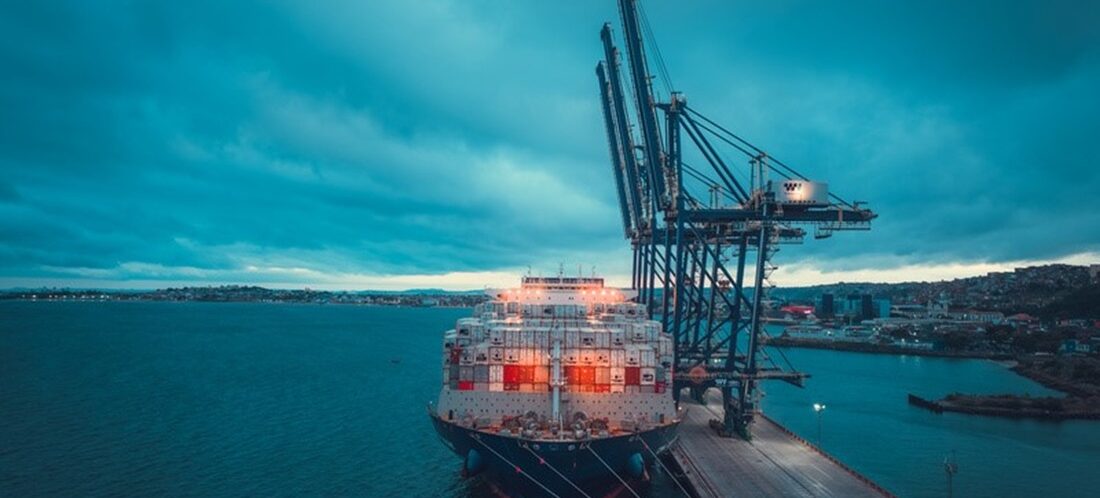
Salvador Container Terminal Expansion to Increase Annual Capacity to Over 1 Million TEUs
Nov, 13, 2026 Posted by Gabriel MalheirosWeek 202646
The Salvador container terminal expansion and modernization project in the northeastern Brazilian state of Bahia has reached the dredging stage. The project is backed by R$848 million in financing approved by Brazil’s National Bank for Economic and Social Development (BNDES), using resources from the Merchant Marine Fund (FMM), which operates under the Ministry of Ports and Airports. Once completed, the expansion is expected to increase the terminal’s annual handling capacity from the current 553,000 TEUs (twenty-foot equivalent units) to more than 1 million TEUs.
The investment will fund an expansion of the container yard, the purchase of new domestically manufactured and imported port equipment, and infrastructure and technology upgrades. The project is also expected to improve quayside productivity, increasing container handling rates from 70 to more than 100 containers per hour.
The Port of Salvador currently plays an important role as an export hub for key sectors of the Brazilian economy, including the pulp and cotton industries. Expanding the port’s handling capacity could support these sectors as they seek to strengthen their presence in international markets. The chart below shows the share of the main export products handled at the port:
Top Export Products | Port of Salvador | Jan-Sep 2026 | TEUs
Source: DataLiner – explore our trade data
According to Brazil’s National Secretary of Ports, Alex Ávila, the terminal expansion is important for meeting growing cargo transportation demand and improving operating conditions at Brazilian ports. “We are investing in expanding and modernizing port infrastructure so that terminals can accommodate growing demand. Salvador plays an important role in the Northeast’s logistics network, and this project will help improve operational efficiency and the sector’s competitiveness,” Ávila said.
The construction phase is expected to generate approximately 1,400 direct and indirect jobs.
Salvador Container Terminal Expansion: Construction and Logistics
The current dredging work, which involves removing sediment from the bottom of the port’s access channel, is being monitored by a team of biologists, engineers, archaeologists, oceanographers and other specialists. The work is licensed by Bahia’s Institute for the Environment and Water Resources (Inema) under Ordinance 34.801/2026 and authorized by the Brazilian Navy. Dredged material will be transported to an approved offshore disposal area in waters 500 meters deep.
Beyond the Salvador container terminal expansion itself, the port’s access infrastructure will also need to accommodate the expected increase in handling capacity.
According to Antonio Gobbo, president of the Bahia State Docks Company (Codeba), investments in roads and new technologies will be needed to support cargo flows. “With capacity reaching 1 million TEUs per year, operations at the Port of Salvador will become much more constrained by the road network and the ability to move cargo into the container terminal. Physical infrastructure and operating systems will therefore need to be studied and planned to ensure consistent and efficient operations,” he said.
Source: MPOR
-
Grains
Jul, 21, 2023
0
Soybeans become top Brazilian export to Argentina
-
Ports and Terminals
Dec, 11, 2018
0
Mar del Plata offers a tender for a Multipurpose Terminal
-
Ports and Terminals
Jul, 20, 2020
0
Port of Santos auctions to be brought forward
-
Shipping
Jul, 23, 2019
0
Paraguay waterway cargo movements fall 30% in 2019