

Shipping companies in Amazonas prepare for dry season risks
Jul, 29, 2025 Posted by Lucas LorimerWeek 202532
After two years of historic droughts in Brazil’s North region, which halted ship traffic on the Amazon River for months, industries and logistics operators active in the area are anticipating a less severe dry season in 2025. Still, companies are preparing for potential disruptions in shipping flows.
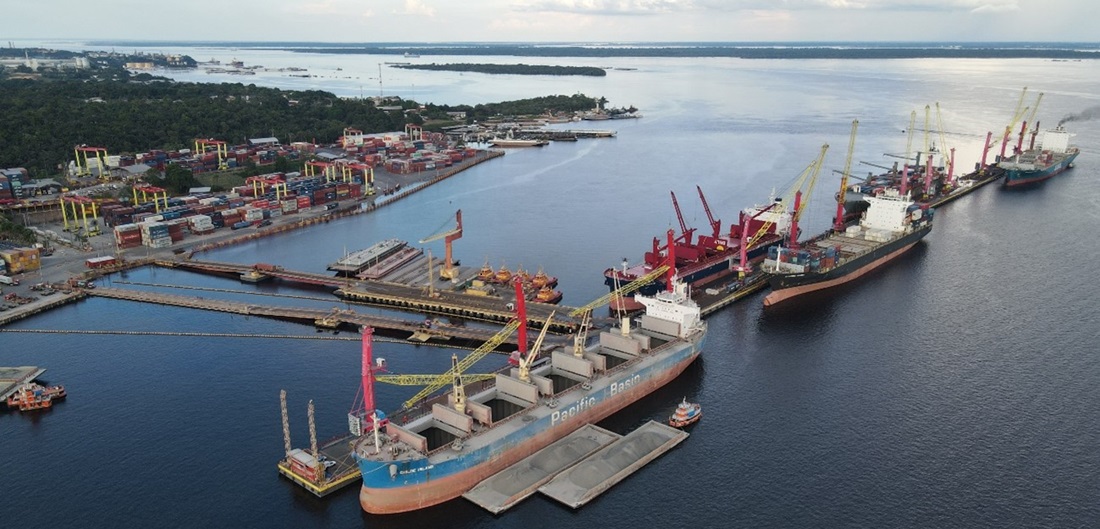
Grupo Chibatão, which operates one of the largest terminals in Manaus, has not yet confirmed whether it will set up the floating pier that allowed cargo shipments to reach the port in 2024. However, the company is preparing for that scenario, according to executive director Jhony Fidelis.
The company is currently securing the environmental licenses and authorizations needed for the structure and is preparing temporary lodging for the employees who would work at the “temporary” terminal, he said.
The operation, inaugurated in 2024, was set up in Itacoatiara (AM), on the stretch of the Amazon River that typically blocks passage. At the floating terminal, larger ships transferred their cargo to barges, which require less depth to navigate. “There’s still no data to say whether the river will dry up, so we’re waiting for August. But we can’t just sit back — we have to ensure we have a solution if the drought worsens.”
Super Terminais, which also set up a temporary terminal in Itacoatiara last year, has likewise not decided whether to do the same in 2025. However, general manager Julio de Almeida says the group could have a provisional terminal up and running in just ten days.
“In the years of drought before 2023 [when the dry season reached above-normal levels], ships would come in with less cargo, around 70% to 80% of their capacity, and that was enough to reach Manaus. So if this year’s drought isn’t as severe, we can go that route. But Super Terminais is prepared for the worst-case scenario. We’ve already left the moorings, anchors, and all the infrastructure in Itacoatiara.” According to him, after the historic droughts of 2023 and 2024, the need for floating terminals will now have to be assessed annually.
In addition, part of the industrial sector has stepped up its advance ordering to avoid the supply disruptions caused by the drought, according to Augusto Rocha, director of the Amazonas State Industry Center (Cieam). “Advance shipping has always been the ‘modus operandi.’ But in 2023, the volume wasn’t enough. In 2024, it was again more severe than the year before, and it caught us off guard. So now some companies are preparing for the worst.”
The strategy is being adopted especially by manufacturers of higher-value-added goods, says Márcio Salmi, Commercial Director of the shipping company Norcoast. “We saw more activity in the second half of July — companies moving shipments earlier to avoid the extra fee charged during the dry season, though some are betting on a milder drought. It depends on the company’s profile. Those dealing in commodities have difficulty with storage.”
The logistics costs incurred due to the drought over the past two years have had a major impact on the industry, said Rocha. Just considering the surcharges paid to shipping companies, additional costs in 2023 totaled R$1.5 billion. In 2024, a year in which the sector was better prepared, that figure was R$1.4 billion, according to Cieam’s estimates.
This year, the expectation is for lower costs, given current river conditions. “There’s more volume, and we’ve gained scale. The river is higher, and there’s more competition among carriers. The shipping companies have already said there’s a risk of surcharges, but at this time last year, we were already seeing the first announcements of extra fees,” Rocha said.
Asked about surcharges, Salmi explained that they have always been charged to offset the reduced shipping capacity during the annual dry season in the region. “What happened in 2023 and 2024 is that the surcharge was higher.”
In addition to the temporary terminals, another measure adopted by the government last year was the launch of a dredging contract by the National Department of Transport Infrastructure (Dnit), aimed at ensuring the river’s depth.
Rocha criticized the work. “There are no studies on the area. The dredging wasn’t useful in 2024 for the passage of large vessels. Without studies, there’s no point in continuing.”
Dnit, however, says the service has been helpful. In a statement, the agency said that “the dredging carried out during the 2024/2025 campaign met expectations” and that “for the 2025/2026 campaign, bathymetric surveys are already underway to support the new dredging plan.” The agency added that it expects a “less severe drought” and “therefore does not foresee any interruption in vessel traffic, especially because pre-dredging measures are already in progress.”
Source: Valor Econômico
-
Steel and Aluminium
Feb, 01, 2024
0
2024 brings ominous outlook for Brazilian steel mills as Chinese imports show no signs of abating
-
Meat
Nov, 03, 2022
0
Brazilian meatpackers lose 43K tonnes in shipments month-on-month
-
Shipping
Nov, 27, 2023
0
Market players criticize gov’t over supposed inaction following pilotage law approval
-
Ports and Terminals
Aug, 01, 2023
0
Minister Márcio França says that work on the Santos-Guarujá tunnel will begin in 2024