


Trump conflict raises urgency of Canada-Mercosur trade deal
Aug, 24, 2026 Posted by Gabriel MalheirosWeek 202635
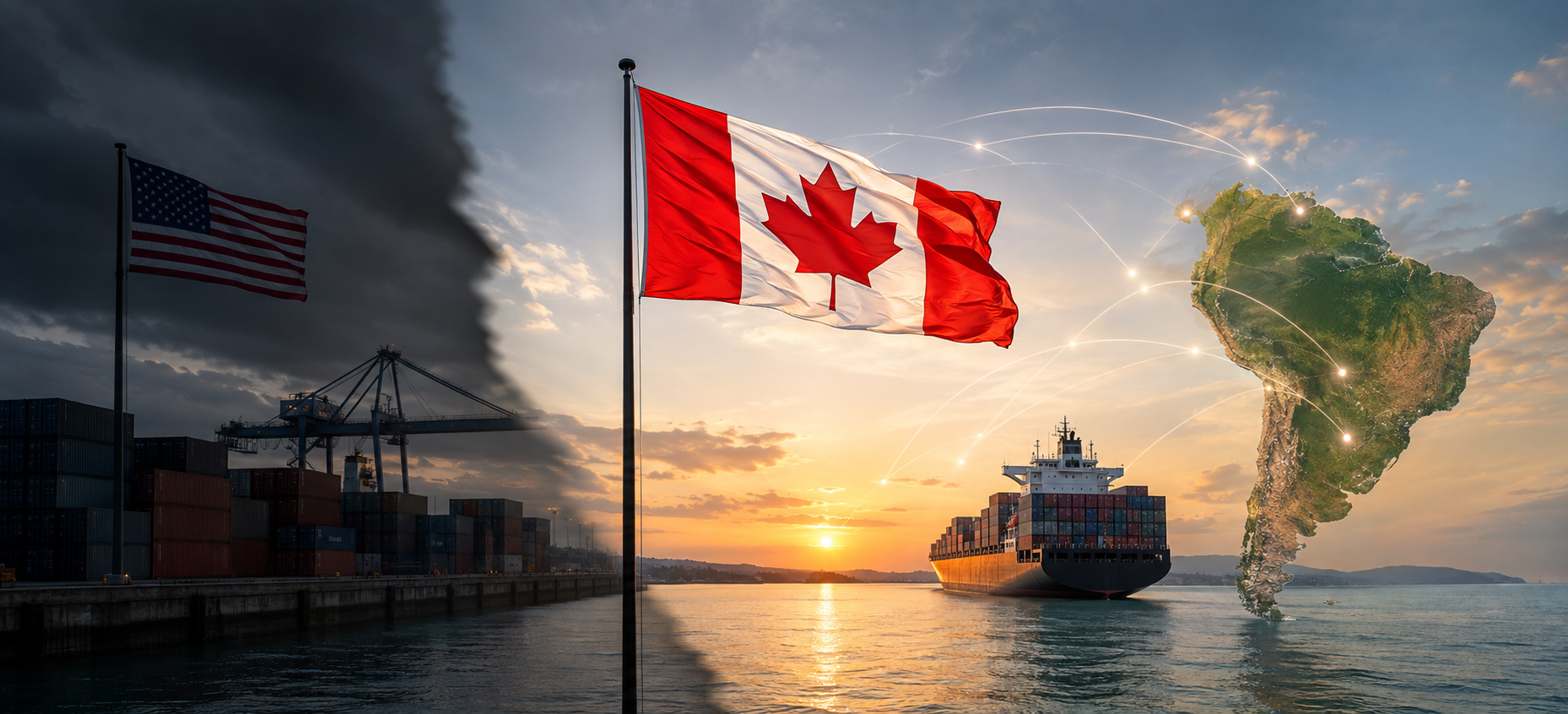
Canada’s trade war with the United States could indirectly help accelerate a free trade agreement between Canada and Mercosur, depending on the next moves in Ottawa and Brasília.
More than a commercial opportunity, the Canada-Mercosur trade deal has become more strategic and more urgent for Ottawa as its confrontation with its U.S. neighbor deepens.
A source from the South American bloc said the conclusion of the Mercosur-Canada agreement may be accelerated, but it will depend on concessions from both sides on agricultural market access. The source said the next step depends mostly on the Canadians.
Not everything has been negotiated. Canada has agricultural sensitivities, but it also has sectors interested in exporting farm products to Mercosur.
Prime Minister Mark Carney’s government will need to overcome resistance from Canada’s agricultural protectionists, who use arguments similar to those made by Europeans against Mercosur products, especially beef imports.
Carney will also have to assess how much room he has to make concessions in a more complicated political environment as Canada enters a new phase of tensions with the Trump administration.
According to the prime minister, one of the “unacceptable” conditions imposed by Washington for an agreement with Canada would have restricted Ottawa’s ability to sign trade deals with other countries.
Canadian media reported that Carney was presented with a U.S. proposal that had suddenly become an attack on Canadian sovereignty — an attempt at psychological annexation that could have turned Canada into a kind of North American Belarus.
That was also viewed in the context of Trump’s repeated provocations about Canada becoming the “51st state” since his return to the White House.
Canadians are also aware of what Trump’s National Security Strategy says about U.S. neighbors in the Western Hemisphere: “We want other nations to view us as their partner of first choice, and we will discourage their collaboration with others by various means.”
In an editorial, The Globe and Mail backed Carney’s decision to break off talks with the Trump administration.
“Most gallingly, the U.S. tried to restrict Canada’s ability to enter into other trade agreements,” the newspaper said. “That would have reduced Canada to a second-class vassal state: it would give up free access to other markets while having limited access to the markets of what would be its de facto master.”
Canada is deeply integrated with the United States, on which it depends for defense, and heavily reliant on trade with its superpower neighbor. But the message behind the breakdown in talks is that Canada refuses to submit.
“You are at war when you are attacked. We were attacked,” Carney told Canadians as he described the state of relations with the United States after deciding to end negotiations on an agreement that, he said, Washington was trying to use to undermine Canadian sovereignty through last-minute demands.
Canada seeks trade diversification
In a speech in Davos, Switzerland, in January, Carney did not hesitate to describe a new era in which the United States would no longer be the guarantor of stability and middle powers such as Canada would have to come together to survive. The speech was well received globally but irritated Trump.
“When we negotiate only bilaterally with a hegemonic power, we negotiate from weakness. We accept what is offered to us,” he said, referring to Trump’s United States. “That is not sovereignty. It is the simulation of sovereignty while accepting subordination.”
The Canadian government has set a goal of doubling exports to markets outside the United States over the next decade. To achieve that, Carney has been working to build free trade agreements with different countries.
“Building at home and diversifying trade abroad is not our plan B. It has been, from the beginning, our plan A,” he said over the weekend.
For Canadian analysts, this shift now carries new urgency for the country’s producers.
Beyond limiting concessions for the auto sector, U.S. negotiators pushed to reverse Canada’s efforts to promote French-language content, one of the country’s two official languages, on streaming services. They also targeted subsidies for sectors such as publishing and film production, as well as requirements for French and English labeling on packaging.
The Canadian government says it is now preparing a “dollar-for-dollar” retaliation against new U.S. tariffs of 50% on $28 billion in Canadian exports.
For the Toronto Star, Carney is consolidating his position as a leader of international resistance to Trump’s policies. That comes at a cost, including nearly 60,000 jobs that could be lost. But for Canadians, the response matters in the long run.
Carney has not ruled out using all available tools in a trade war.
“Canada fuels American growth by supplying 99% of its natural gas imports, 85% of its electricity imports and 60% of its crude oil imports,” he said. “I do not think they want us to stop sending any part of that energy.”
For Canadian officials, one thing has become clear: Trump cannot be trusted.
For exporters and policymakers, the Canada-Mercosur trade deal has therefore gained weight as part of a broader strategy to reduce dependence on the United States and build new trade channels with South America.
Source: Valor Econômico
-
Ports and Terminals
Mar, 10, 2021
0
Port of Imbituba prepares to receive soybean crop
-
Ports and Terminals
Aug, 08, 2019
0
Atlântico Sul Shipyard closes in Pernambuco
-
Other Cargo
Jun, 23, 2022
0
Fertilizer imports from Russia steady and growing
-
Economy
Aug, 15, 2023
0
Brazilian industry wary of ‘Milei effect’ on sales to Argentina