


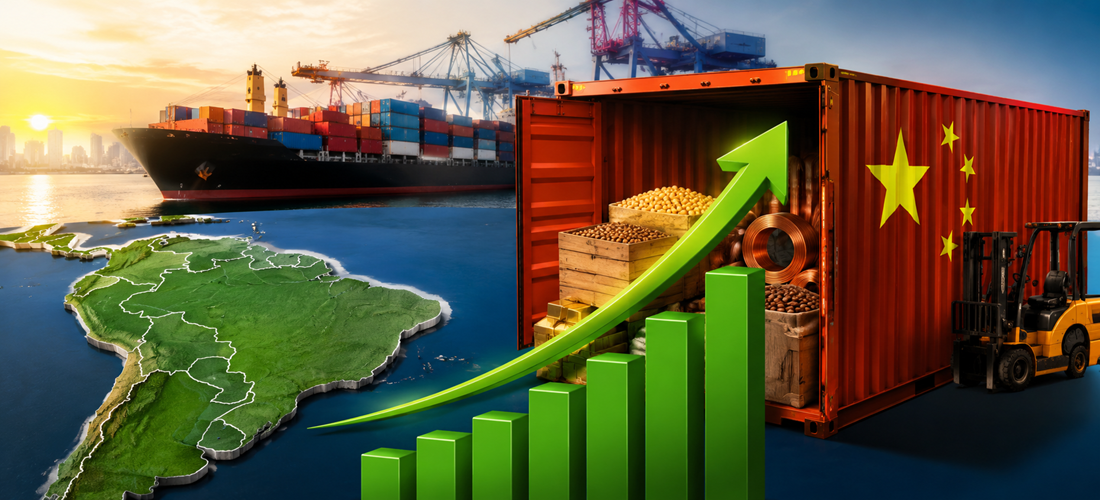
Latin American exports to China rise 25% in first quarter
Jun, 18, 2026 Posted by Gabriel MalheirosWeek 202625
China was the fastest-growing market for Latin American exports in the first quarter of 2026, even as the United States remained the region’s largest buyer, according to a report by the Inter-American Development Bank (IDB).
Latin American exports to China rose 25% from the same period in 2025. Sales to the rest of Asia increased 24%, while exports to the European Union grew 19% and shipments to the United States rose 14%.
According to DataLiner-featured data, Brazil’s two most exported products to the United States were beef and plywood. The chart below shows the top 10, based on Datamar container data:
Top Products Exported to the United States | Jan-Apr | 2026 | TEUs
Source: DataLiner (click here to request a demo)
Overall, the region’s exports expanded nearly 16% in the quarter, more than twice the 6.4% growth recorded in 2025.
The United States’ position as the region’s top buyer, however, was driven largely by trade with Mexico and Central America. China’s purchases, by contrast, are concentrated in South America, especially Brazil.
Although the report does not detail the causes behind the trend, the pattern is linked to the USMCA trade agreement, which gives Mexican exports tariff-free access to the U.S. market. The agreement has encouraged thousands of U.S. companies to relocate operations to Mexico in search of incentives and lower labor costs.
The rise in exports to China in the first quarter extends a trend that began in late 2025. Chinese imports from the region were broadly flat last year, falling in the first half before rebounding in the second.
In South America, China accounted for 40% of all export growth in 2025, according to the IDB. Amid tariffs imposed by President Donald Trump, Brazil’s foreign sales rose 1.8% year on year, supported by China and neighboring South American markets.
Why it matters
China’s growing role reinforces South America’s position as a supplier of raw materials to the Chinese economy. At the same time, Washington has been pressing countries in the region to reduce ties with Beijing in areas such as ports, minerals and technology.
The first-quarter increase, however, was driven by higher prices for some commodities, including gold and copper, rather than by a more diversified export base. A reversal in those prices, which the IDB expects, would leave the region more exposed as competition between the United States and China intensifies across the continent.
Source: Folha de S. Paulo
-
Meat
Aug, 17, 2021
0
Saudi Arabia suspends adoption of three-month shelf life for chicken meat
-
Ports and Terminals
Aug, 01, 2024
0
Maranhão’s investment drive focuses on Port of Itaqui expansion
-
Automotive
May, 22, 2025
0
Volkswagen Brazil Resumes Exports to Africa with Country’s Best-Selling SUV
-
Ports and Terminals
Nov, 01, 2024
0
Super Terminais recognized for efforts to amend drought woes in Amazonas