


Maritime transport may adopt global carbon pricing scheme
Oct, 15, 2025 Posted by Lucas LorimerWeek 202543
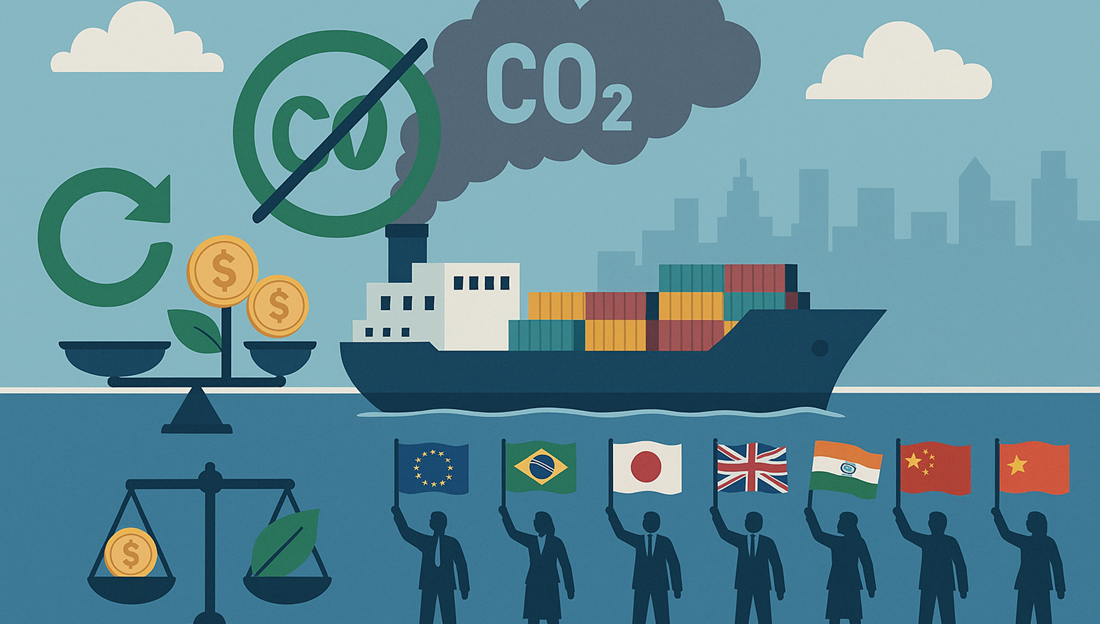
Governments are expected to adopt this week the world’s first global carbon pricing scheme — the International Maritime Organization’s Net-Zero Framework (IMO NZF), approved by vote in April, with a clear majority of 63 countries in favor, including Brazil, India, China, the 27 EU nations, the United Kingdom, and Japan. The adoption of this framework is being discussed in London from October 14 to 17 during the IMO’s Extraordinary Marine Environment Protection Committee (MEPC E.2) session.
The IMO Net-Zero Framework represents the agreed pathway to implement the maritime sector’s energy transition plan, approved in 2023. This transition is critical to tackling climate change, as shipping is one of the world’s largest polluters — if it were a country, it would rank as the sixth-largest emitter of greenhouse gases and the fifth-largest consumer of fossil fuels.
The expected IMO decision could mark one of the biggest wins for climate diplomacy in years by establishing the first global, legally binding carbon-pricing standard for an international sector. More than a technical milestone, it would be a direct blow to future oil demand — and a powerful political signal, ahead of COP30 in Belém, that multilateralism can still deliver tangible climate results.
For this reason, the U.S. under President Donald Trump is reportedly trying to block the decision — even pressuring other countries. This is not the first time the U.S. has attempted, unsuccessfully, to derail an IMO deal. According to civil society observers, opposition remains far short of the votes needed to overturn the majority.
The IMO NZF consists of two integrated components: carbon-intensity targets and an emissions-pricing and rewards mechanism for vessels using zero- or near-zero-emission energy and technologies (ZNZs). In this category, advanced biofuels and e-fuels (carbon-neutral synthetic fuels) could emerge as key production routes to meet the sector’s high energy demands.
Among experts, the main concern is that the NZF could include unsustainable fuels such as natural gas. “LNG must be excluded from the Zero Emission Framework, or the IMO risks promoting a false solution and compromising its climate credibility,” argued Elissama Menezes, director of Equal Routes.
“Methane emissions — an extremely potent greenhouse gas, 82 times stronger than CO₂ — from LNG-powered vessels have increased 180% between 2016 and 2023, directly contradicting the industry’s rhetoric. LNG is fundamentally incompatible with the maritime sector’s decarbonization goals,” Menezes added.
On the other hand, the framework is viewed as insufficiently ambitious by small island states — the nations most threatened by climate change — many of which abstained from the April vote. “While larger and wealthier nations debate threats to livelihoods, Pacific island nations are forced to consider threats to their very existence and statehood. That’s the magnitude of what’s at stake,” said Simon Kofe, Tuvalu’s Minister of Justice, Communication, and Foreign Affairs.
Meanwhile, the global shipping industry, represented by the World Shipping Council (WSC), which includes more than 180 global carriers, supports the NZF, saying it will provide the regulatory certainty “needed for the sector to do its job.”
This week’s meeting will be followed by a round of technical negotiations (ISWG-GHG-20) from October 20 to 24. Critical political details of the NZF still need to be finalized by 2026 before it enters into force in 2027. These include defining incentives for zero-emission technologies and allocating the expected US$15 billion per year in carbon levy revenues starting in 2030.
Fonte: Clima Info
-
Ports and Terminals
Jan, 03, 2023
0
Paraná state expects BRL 1.2 mln for two port areas in Paranagua
-
Economy
Mar, 31, 2021
0
Brazilian container imports up in February
-
Other Cargo
Aug, 11, 2020
0
Brazilian footwear exports fall 33% between Jan-July 2020 compared to year-ago levels
-
Shipping
May, 27, 2022
0
Containership orderbook equivalent to the extent fleets of Cosco, Hapag-Lloyd and Evergreen