


Emerging markets offset weak U.S. demand for global consumer giants
Feb, 11, 2026 Posted by Sylvia SchandertWeek 202607
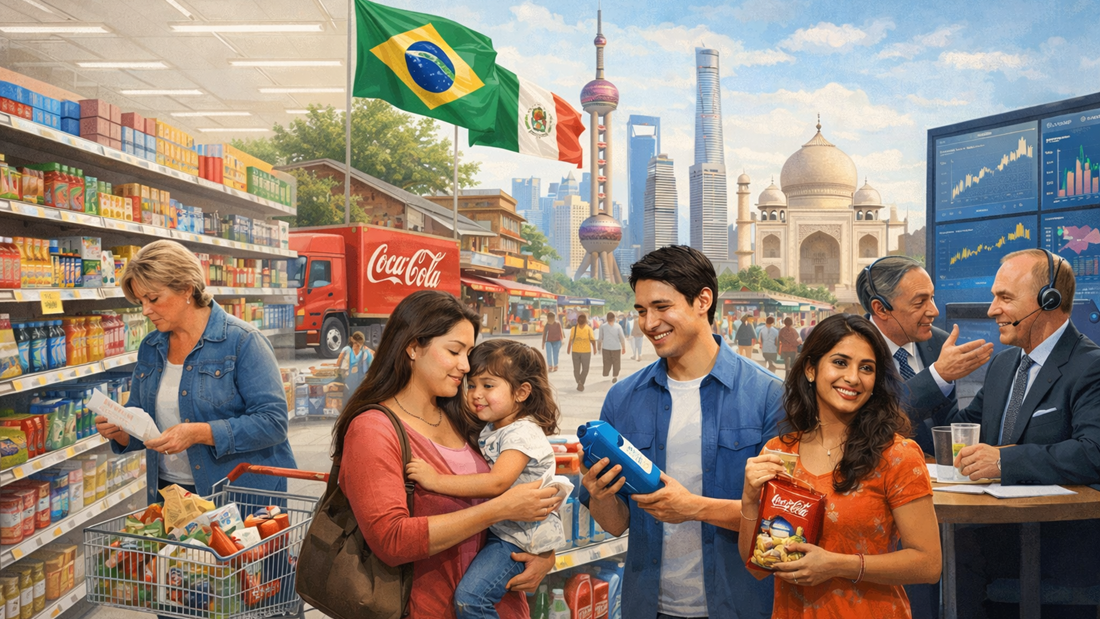
The world’s largest consumer goods multinationals have been posting weak results in the United States. Still, Latin America—especially Brazil and Mexico—alongside Asia, notably China and India, has helped steady earnings as the American middle class loses purchasing power and intensifies its search for discounts.
The difference is that in Asia, gains are being driven by higher volumes, while in Brazil and Mexico, growth largely reflects price hikes and product mix adjustments by leading brands, according to earnings reports for the October-to-December quarter released in recent weeks and conference calls monitored by Valor.
Senior executives at Procter & Gamble, PepsiCo, and Colgate-Palmolive, in discussions with analysts in recent days, as well as Unilever in a December presentation with J.P. Morgan, have described a U.S. consumption environment marked by weakness or deceleration.
One regional highlight has been the number of analyst questions about performance in emerging Latin American markets. Unilever was the only company to cite political instability risk in Brazil during its December presentation. The company is set to release its fourth-quarter results on Thursday (12).
“We need to make the U.S. grow faster,” Shailesh Jejurikar, CEO of Procter & Gamble, told analysts in late January. The group is the world’s third-largest consumer goods company by quarterly sales, behind Nestlé and PepsiCo.
Chief financial officer Andre Schulten said the second half of 2025 was “challenging, with weaker consumer markets, intense competition, and a dynamic geopolitical environment.” The first positive element in the results, he added, was the strength of operations outside the U.S.
“If we look at Latin America, we had 8% growth [in the fourth quarter]; Europe overall grew 3%. China reached 3%, while Asia, the Middle East, and Africa recorded a 2% increase,” he said, highlighting solid performance in Brazil and Mexico.
For P&G, which owns 65 brands including Downy, Oral-B, Gillette, and Pampers, there is a mismatch between emerging markets and the U.S. Schulten cited product revamps in fabric softeners in Mexico and hair care in Brazil, noting that many of these initiatives “are just starting now in the U.S.,” the group’s largest and most impactful market. The situation in the American market is expected to improve as those measures take effect.
At the same time, P&G said it has reassessed markets outside the U.S., analyzing regional potential more closely and making strategic choices. As part of that process, it reorganized operations in Latin America and altered its business model in Argentina, allowing it to focus more on Mexico and Brazil, Jejurikar said.
That shift has led to a sharper focus on consumers and, as a result, 9% growth in Brazil—above the market’s average pace, according to the CEO.
Coca-Cola reported that in Latin America, sales and volume rose 10% and 4%, respectively, in the fourth quarter, with price/mix up 6%. In North America, sales increased 5%, volume grew 1%, and price/mix rose 4% compared with 2024.
In Asia, including key Coca-Cola markets China and India, price/mix declined 3%, in contrast to the gains seen in Latin American countries.
A common backdrop for many companies was the U.S. government shutdown between October and November due to delays in budget approval, which postponed salary payments and food assistance.
While this hurt low-income households and domestic demand, companies believe that even excluding this factor, U.S. consumption remains under pressure.
Like P&G, Colgate-Palmolive felt the impact of the shutdown but describes the U.S. consumer market as sluggish even after it ended. The company also cited political instability in Latin America.
“The geopolitical environment is volatile, particularly in Latin America, and the U.S. market remains slow. While we believe trends will improve, we are not forecasting a major recovery,” CEO Noel Wallace said. The company owns brands such as Pinho Sol, Ajax, Protex, and Ola.
“Volume is the most critical issue in the U.S.,” Wallace said, noting declines in several core categories. “Nine of our categories posted volume declines in October and 10 in November. In December, it was six, but we won’t get too excited about December—we’ll wait for the first quarter.”
He attributed the scenario primarily to “significant consumer uncertainty about the future.” The company said it will increase investment in markets where it can capitalize on stronger growth rates.
In North America, Colgate’s net sales fell 1.5% in the fourth quarter, with volume down 2.3% and prices up 0.5%.
In Latin America, sales and volume rose by 12.8% and 2.3%, respectively, with prices up 4.2%. The region delivered the second-fastest sales growth, behind Africa/Eurasia (15%).
Both Mexico and Brazil posted high single-digit growth, with strong expansion across oral care, personal care, and home care, though the company does not disclose country-specific figures.
Despite comparatively better conditions in Brazil, retail data show demand slowing since the second half of 2025, with weak volumes at supermarkets and cash-and-carry amid rising household indebtedness due to high interest rates.
Brazil consumer outlook improves in 2026, but risks persist
According to NielsenIQ, sales value at supermarkets and cash-and-carry rose 8.1% in 2025, while volume increased 1.9% compared with 2024. “Each country has its own challenges. The difference is that Brazil is a very innovation-friendly and adaptable consumer market, with less competition than in the U.S., and commercial teams see quick returns on strategic changes,” said a São Paulo-based supermarket executive.
Unilever drew attention to risks in Brazil and other regional markets.
CEO Fernando Fernandez said in December, in a discussion with J.P. Morgan, that Brazil’s political instability caused some economic slowdown.
He had already said in October that the company had “gone too far” on pricing in Brazil’s laundry segment—where it owns Omo, Brilhante, and Comfort—and was reversing course. He also mentioned a drop in remittances from Mexican families in the U.S., affecting consumption, as well as a contraction in Argentina.
“I would say that probably explains half of the issues in Latin America,” he said. “It has been very difficult to price in Brazil, given exchange-rate volatility. We had to reduce some of our prices. In a country where taxation is very complex, adjusting prices takes time. But I believe that in home care, particularly in Brazil, we are now gaining momentum.”
In a similar pricing rethink, PepsiCo said it will cut prices by up to 15% in the U.S., a move discussed during last week’s conference call. Management said it is going on the offensive in the North American food market, offsetting lower prices with productivity gains. The company owns brands Pepsi, Quaker, Toddy, and Doritos.
CEO Ramon Laguarta said the American middle- and lower-income consumer has limited options and that the company needs to “be part of their daily life.”
By contrast, “the rest of the world looks different,” he said. “We are optimistic about Mexico, seeing positive trends in China and a good consumer environment in the Middle East. Western Europe is a bit weaker. And Brazil is roughly neutral.” The company sold $1.7 billion in Brazil in 2025, up 1%, according to its earnings report.
From October to December, North America posted the largest volume declines for PepsiCo in food and beverages—2% and 5%, respectively—while Latin America fell 1%. Price increases in Latin American countries reached 6%, above the company average of 4.5%, while Asia saw no price gains.
To address U.S. challenges, companies are emphasizing innovation and premiumization strategies—an approach familiar from past downturns.
“We are preparing with a much stronger innovation pipeline for 2026,” said Colgate’s Wallace. PepsiCo said it will focus on smaller portions—partly reflecting the surge in weight-loss drug use—while also offering lower price points.
“We are very interested in innovations with fiber and protein. And we are betting heavily on portion control, which is a lever to keep consumers in the category,” Laguarta said.
Asked to comment, Colgate-Palmolive said it had nothing to add beyond its published results. PepsiCo, Unilever, and P&G declined to comment.
Source: Valor International
-
Ports and Terminals
Aug, 01, 2020
0
Antaq authorizes company to start expansion works at Ceará port
-
Meat
Dec, 11, 2018
0
Brazil set to export a record amount of beef in 2019
-
Ports and Terminals
Jun, 10, 2022
0
Energias do Brasil and TCP sign renewable energy contract
-
OTI Rankings
Jul, 04, 2024
0
OTI Ranking | Dataliner | Jan-May 2024 vs Jan-May 2023