


U.S. Supreme Court ruling brings relief to Brazilian agribusiness, but caution remains
Feb, 23, 2026 Posted by Sylvia SchandertWeek 202609
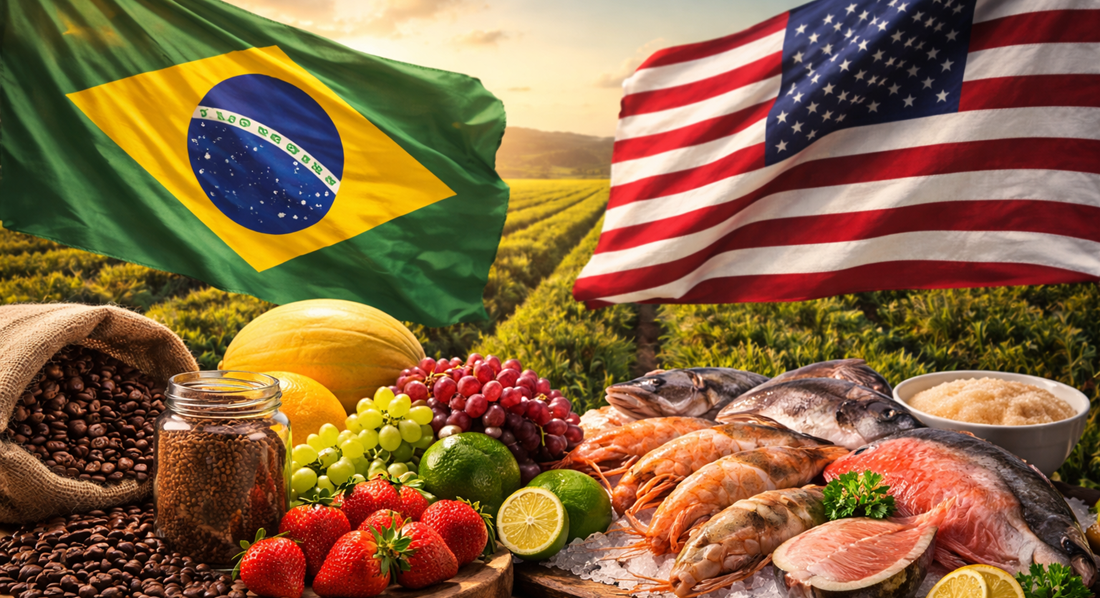
Brazilian agribusiness players that were still facing 50% import tariffs in trade with the United States celebrated on Friday (20) a ruling by the U.S. Supreme Court declaring President Donald Trump’s sweeping tariff increase illegal. Even so, industry players and analysts voiced cautious optimism given the unpredictability of the American leader.
Their caution proved warranted. Shortly after a ruling clarified that U.S. law does not allow the president to impose tariffs without congressional approval, Trump announced a 10% global tariff on all countries trading with the United States for 150 days. On Saturday (21), he raised the rate to 15%.
Leandro Gilio, a researcher at Insper Agro Global, said overturning the tariff hike provides temporary, short-term relief for agribusiness but does not signal a return to normal trade relations with the United States. He noted that the decision is particularly relevant for sectors that had been excluded from tariff exemptions, such as instant coffee, seafood, fruit, honey, and sugar.
“It’s not a return to pre-tariff normality. There is still unpredictability and risk. The Trump administration has other mechanisms to impose tariffs and trade restrictions. They are not as straightforward, but he has tools at his disposal and is likely to use them to circumvent the Supreme Court,” he said Friday. Contacted again on Saturday, he reiterated his assessment.
Gilio had pointed out that the Trump administration could rely on Section 301 of U.S. trade law to impose duties on other countries. That process is slower, as it requires an investigation by U.S. authorities into trade practices. Brazil itself is currently under investigation under that provision.
Also on Friday, Larissa Wachholz, a specialist at the Brazilian Center for International Relations (Cebri), urged restraint. “The key word is caution, as the scenario is unstable and the U.S. government appears determined to maintain the tariffs.”
She also believes Trump may resort to other measures to preserve, at least until the end of his term, the taxes announced in April 2025, citing his own statements that he could seek alternative instruments to keep tariffs in place.
“One might imagine that products such as instant coffee and fishery would now have easier access to the U.S. market. (…) But it’s not something we can celebrate calmly. There is still a great deal of uncertainty,” she said.
The Brazilian Fish Industries Association (Abipesca), which on Friday said the U.S. Supreme Court’s decision could “change the course” of the fishery sector in 2026, spoke out again on Saturday.
Eduardo Lobo, president of the association, told Valor that even with a 15% tariff, Brazilian seafood remains competitive in the U.S. market. “The fishery sector went through a very difficult period in 2025. We were hit with a 50% tariff, which made us completely uncompetitive,” he said.
According to him, a 15% tariff allows the segment to regain competitiveness and expand fish exports to the United States. “It’s not ideal, but it’s much better,” he stressed.
Aguinaldo Lima, executive director of the Brazilian Instant Coffee Industry Association (Abics), also welcomed both the court’s decision and the new 15% global tariff on Saturday. “The situation had been worsening month after month in sales to what is Brazil’s largest instant coffee customer. Now we are entering a new phase—whether the tariff is 10% or 15%—that places all suppliers on equal footing,” he said.
In 2025, the United States remained the main destination for Brazilian instant coffee exports, purchasing the equivalent of 558,740 60-kilo bags, although that represented a 28.2% drop from 2024, according to ABICS. With the tariff hike overturned, exporters may try to win back clients lost in 2025, said Lima.
He added that Brazil has historically been the world’s most competitive producer of instant coffee but is now being challenged by Vietnam, which is expected to surpass the country in production and exports this year, benefiting from trade agreements that Brazil lacks.
Another sector of Brazilian agribusiness still affected by the tariff hike, fruit exporters, also viewed the Supreme Court’s decision positively. On Friday, the Brazilian Fruit Association (Abrafrutas) said in a statement that the more favorable environment could help improve market access conditions for Brazilian fruit in the United States, especially for products such as grapes, melons, and watermelons, that had been hurt by tariff restrictions and lost competitiveness.
According to data from Datamar’s DataLiner platform, Brazilian grape exports to the U.S. saw a significant 66.4% year-over-year (YoY) decline in 2025. The following chart details the historical volume of containerized grape exports to the U.S. over the last four years.
Grape Exports to the U.S. | Jan 2022 – Dec 2025 | TEUs
Source: DataLiner (click here to request a demo)
Also on Friday, Renato Cunha, president of Sindaçúcar-Pernambuco and of the Sugar, Ethanol and Bioenergy Producers Association (NovaBio), said that after the tariff hike was overturned, it is “time to rebuild” Brazil-U.S. relations “following highly burdensome losses.” The expectation is that bilateral ties will stabilize after a meeting scheduled for March between presidents Lula and Trump.
According to Cunha, the reduction in tariffs is unlikely to affect sugar exports to the United States at this time, as mills in Brazil’s Northeast have already shipped nearly all sugar produced in the 2025/26 harvest.
“What we are focused on now is negotiating the 2026/27 crop. The previous scenario was putting us in an even more difficult position,” he said. Production for the 2026/27 season will begin reaching the market in September, but mills typically start negotiations in advance, and uncertainty over trade terms could delay sales.
For that reason, Cunha said, there is hope that the upcoming meeting between Lula and Trump will provide a solution for Brazilian sugar exports to the United States.
Source: Valor International
-
Grains
Dec, 12, 2022
0
China invests in local corn production against Brazil’s wishes
-
Economy
Jul, 28, 2026
0
Uruguay leather exports fall 19% in first half despite June rebound
-
Shipping
Apr, 11, 2021
0
CMA CGM launches first low-carbon shipping service
-
Grains
Jan, 14, 2020
0
Argentina wheat exports fail to reach forecast volumes